



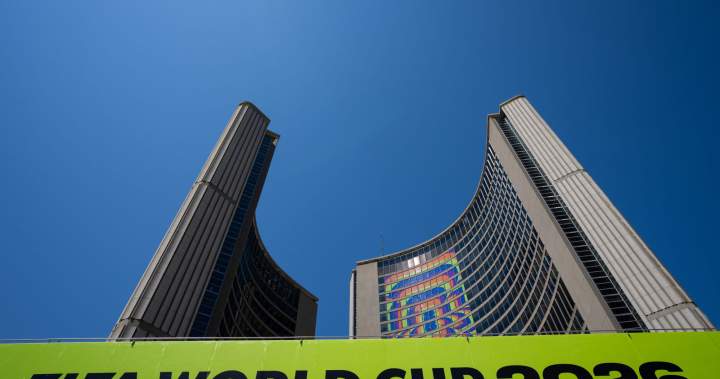
Demand for Toronto’s hotels looks set to be “uneven” this month as the city prepares to host six FIFA World Cup matches, with questions still lingering over how many will travel.
Toronto’s tourism sector had at one point expected to see a major boost from the global soccer tournament, driven by travelling fans and large-scale bookings made by FIFA itself.
The tournament organizer, however, cancelled large blocks of rooms earlier this year and concerns about prices appear to have dampened demand for Toronto’s less high-profile group stage games.
“I would expect that the business throughout June will be uneven, stronger on some days than others,” Andrew Weir, the CEO of Destination Toronto, told Global News.
“What’s encouraging is that May was fairly strong, and the rest of the summer is showing a good pace as well. So even if June ends up a little bit lower than initial expectations — or even lower than a typical June would be — the rest of the summer likely will balance out.”
Between June 12 and July 2, Toronto will host five group stage matches and one knockout game for the 2026 FIFA World Cup.


Get breaking National news
Get breaking Canada news delivered to your inbox as it happens so you won’t miss a trending story.
Germany and Croatia, ranked 10th and 11th overall, are the most high-profile teams to play in the city, with 15th-placed Senegal also playing a game in Toronto.
Other teams like Ghana (73rd) or Iraq (56th) may draw less excitement.
In fact, a study completed by the travel company Rustic Pathways had Toronto as one of the cheapest cities to book an Airbnb to stay in, suggesting there may be reduced demand.
That study put Toronto at 13th out of 16 host cities for cost, with only Mexico’s three cities having less expensive offerings.
Weir said hotels were still seeing last-minute bookings as rates in the city dropped, an important final flurry since FIFA cancelled many of the rooms it had secured.
“There are also the larger room blocks that are contracted by the organizer, by the host. In this case, by FIFA, those turned out to be far less than anyone expected,” he explained.
“There was an expectation that there would be more contracted rooms that forms the base of business and then the individuals booking their rooms would go on top of that. When the core business, the blocked business, turned out to be less than expected, that puts more pressure on the transient business.”
Destination Toronto said it doesn’t yet have detailed data on room bookings across the sector, but is drawing positive signs from some of FIFA’s own numbers.
Weir explained that half the tickets for games to be played in Toronto have been sold to foreign fans, many of whom will need hotel rooms, while American fans of teams like Panama or Germany are also snapping up tickets in the city.
The event, he contends, should be a major boost for the city’s reputation, even if hotel bookings fall short.
“Toronto is one of the major cities of North America and we need to host the major events that are happening in North America,” Weir said.
“We need to act like the big city that we are. And I think we’re showing that with the World Cup.”
Read the full article here


