

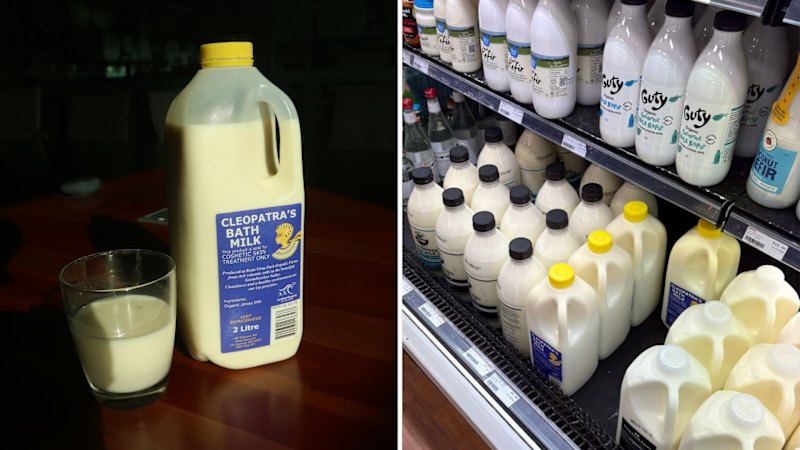
A barefoot man walks down the aisle of a Market Organics store in Brisbane’s inner north. He approaches a worker restocking the dairy section: “Do you have any Cleopatra’s?”
He’s referring to Cleopatra’s Bath Milk, a controversial unpasteurised “bath milk” that maintains niche desirability despite serious health warnings.
A dairy industry leader has slammed the inclusion of unpasteurised milk in Market Organics’ regular dairy display, labelling it misleading and unsafe.
Cleopatra’s Bath Milk is an unpasteurised cow’s milk produced in Goomboorian, in the Gympie region, north of Brisbane.
The milk also usually occupies a spot on a fridge shelf in Market Organics’ Albion store, right next to the empty spot where Heavenly Bath Milk, another unpasteurised milk produced in the Gympie region’s Cedar Pocket, would be stocked.
Neither can be sold legally as suitable for human consumption in Australia. But both are stocked in stores alongside milk products suitable for drinking.
At each of the Market Organics Brisbane stores, unpasteurised bath milk products are allocated a spot in the regular dairy section. At the Chapel Hill store, unpasteurised bath milk is placed in the middle of the display with drinking milk on either side.
The Cleopatra’s company suggests to stores they don’t put their products in the same fridge as other milk, a spokesperson tells this masthead. They express surprise at how it is being displayed by Market Organics.
The customer asking for Cleopatra’s in Market Organics is told by staff the shop is out of stock, but another cold-pressed milk product is suggested to him instead.
This masthead reached out to Market Organics for comment but despite several phone calls and email requests, the store had not responded by publication.
The head of Australia’s key dairy group, Doug Eddy, told this masthead it was unethical to subtly encourage people to drink it through comparison or association with pasteurised products.
Eddy, the national president of the Dairy Industry Association of Australia, says unpasteurised milk products should not be sold near pasteurised products.
“Why would you put milk not for human consumption in among a milk, a lot of milks, that are for human consumption? By confusing the public to think, well, it’s in with all the milk so it must be consumable, if they don’t read the label properly,” he says.
“They could easily give it to someone who gets sick or dies. If there’s a possibility of misconstruing what this is and what it can do, then I think people need to be clear about it.”
“Why would you put milk not for human consumption in among milks that are for human consumption? They could easily give it to someone who gets sick or dies.”
Doug Eddy, Dairy Industry Association of Australia
Eddy slams producers of those products as risking people’s lives for profit.
“You’re playing with the lives and the health of susceptible people.
“Some parents may even think they’re doing the right thing by their kids in giving it to them.
“Good-meaning parents can unfortunately do silly things. They don’t understand that their kids’ immune systems haven’t fully developed, and they may have a specific susceptibility or the kid might drink more than the adults might drink.
“I’d hate to think that I made a milk, charged three times the price, and it was dangerous and killed some kid.”
Pasteurisation – which removes bacterial microorganisms from milk – became standard practice in Australia after raw milk was linked to a typhoid outbreak that killed 30 people in Moorabbin, Victoria, in 1943.
Unpasteurised milk can now only be sold in Australia as bath milk, and must be labelled as being for cosmetic purposes only.
Every raw milk product permitted for sale in Australia must be labelled with a statement to the effect that the product has not been pasteurised.
Cleopatra’s label does not use the word raw or identify its pasteurisation status in any capacity, simply saying it is for cosmetic skin treatment only.
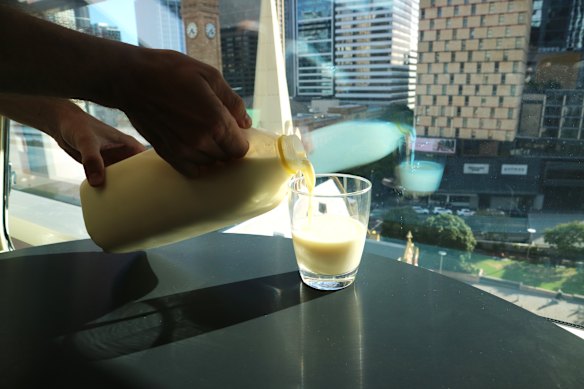
“I would’ve thought by now that they would’ve known that Cleopatra’s Bath Milk isn’t for human consumption,” a company spokesperson says.
At Market Organics Newmarket store, an additional label has been placed next to the store’s Cleopatra’s label stating it is not for human consumption but is for cosmetic use only.
The Rocklea store stocks Heavenly Bath Milk, with an additional sign added to the milk fridge door stating that “it is legislated that raw milk is not for human consumption”.
“Raw milk is not pasteurised and is for cosmetic purposes only!” the sign reads.
None of the chain’s other stores, in Bulimba, Chapel Hill, Woolloongabba or Albion, have added additional signage despite including bath milk in its regular display.
A Market Organics customer first reported the display issue to this masthead, after picking up a bottle without knowing what it was.
While some farmers might drink their own milk, many will scald it beforehand, and most will only keep it until the next morning before it’s thrown out.
Cleopatra’s Bath Milk products in Market Organics stores on January 27 had a use-by date of over a week later, on February 5.
Eddy warns that temperatures could also vary drastically during transportation of unpasteurised milk products.
“The longer you have this product, the more chance there is of microorganisms growing. Listeria monocytogenes actually grows below zero, so it grows when it’s in the fridge,” he says.
Queensland Health urges customers to use products for their intended purpose and not consume raw milk products.
A toddler died and four children became seriously ill in Melbourne after drinking unpasteurised bath milk in 2014, prompting an overhaul of the state’s standards.
Eddy suggests Queensland should consider following Victoria’s lead in requiring that unpasteurised milk be made undrinkable.
Unpasteurised milk products in Victoria must now include a bittering agent, similar to that added to products that discourage nail-biting.
After the rules changed in Victoria, bath milk rarely appears on shelves, Eddy adds.
Start the day with a summary of the day’s most important and interesting stories, analysis and insights. Sign up for our Morning Edition newsletter.
Read the full article here
