

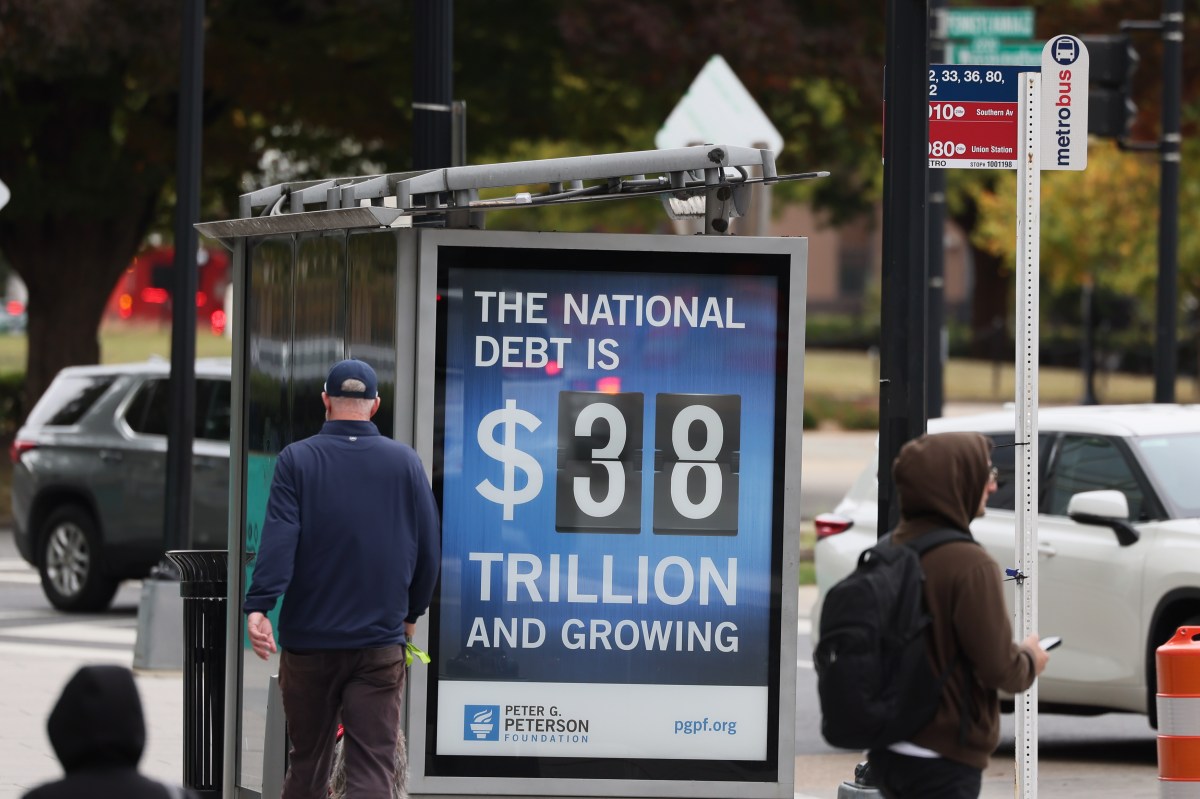
Anxieties over America’s ballooning debt have reached fever pitch, but economists question whether Washington can muster the political will needed to avert a reckoning, and worry that the proposed remedies could carry their own set of fiscal ailments.
America’s national debt—now $39 trillion—has long alarmed fiscally hawkish lawmakers. Congressional Republicans on the Joint Economic Committee (JEC) recently labeled the country’s borrowing practices “unsustainable,” calling the failure to address them an “immoral” burden placed on future generations.
Those concerns have been echoed by influential voices in finance. Hedge fund billionaire Ray Dalio has warned of an imminent “debt‑induced heart attack,” while JPMorgan Chase CEO Jamie Dimon has described rising U.S. debt as one of two “tectonic plates,” alongside geopolitical volatility, that could destabilize the global financial system.
At the core of the concern is a simple dynamic: debt is growing faster than the economy, driving up interest costs and increasing the risk of a self‑reinforcing fiscal spiral. Treasury data show the U.S. paid $1.2 trillion in interest on the federal debt in the most recent fiscal year, a figure the Congressional Budget Office projects could rise to $2.1 trillion by 2036.
And while perennial, the issue was brought into sharp relief last week, when Treasury data showed that America’s liabilities now far exceed its total assets, prompting economist Steve Hanke and former Comptroller General David M. Walker to conclude that “Uncle Sam, by any accounting standard, is insolvent.” Writing in Fortune, the pair said that once off‑balance‑sheet obligations such as Social Security and Medicare are included, total federal commitments could exceed $136 trillion, concluding that Congress “has clearly lost control of the nation’s finances.”
Despite that stark diagnosis, Hanke and Walker argue that a fiscal reckoning is not inevitable—pointing instead to two proposals lawmakers say could help restore discipline. Economists, however, warn those fixes may fall short.
Two Proposed Fixes—and Their Limits
One proposal from Michigan Republican Representative Bill Huizenga would create a bipartisan fiscal commission tasked with recommending ways to stabilize the debt over the medium and long term.
The aims of the commission would be to “identify policies to improve the fiscal situation in the medium term and to achieve a sustainable debt-to-GDP ratio in the long term,” Huizenga’s office said. Priorities would include proposing recommendations designed to balance the budget, how to meaningfully improve long-term fiscal outlook, and educating the American people.
A second proposal would go further. House Budget Committee Chairman Jodey Arrington, a Texas Republican, is seeking a constitutional amendment to require a balanced budget and cap federal spending growth.
Both of these proposals have appeal because they signal a recognition of the seriousness of the issue, while avoiding implementing immediate cuts or tax hikes, instead placing the focus on fiscal responsibility, forcing lawmakers to make trade-offs and hard choices that restore the country’s fiscal health.
Why These Plans May Fall Short or Backfire
Even their supporters acknowledge the constraints. “These two bills represent the most credible path forward—if Congress has the will to act,” Hanke and Walker wrote in Fortune. But history suggests that will is precisely what is lacking.
Fiscal commissions, in particular, have a weak track record: their recommendations are often politically costly and non-binding, making them easy for Congress to ignore.
Laurence J. Kotlikoff, a professor of economics at Boston University, told Newsweek that the history of fiscal commissions has shown that they work by “studying the problem, but not really fixing it.”
“When you have politicians trying to fix problems that they caused rather than having independents come up with answers that will really fundamentally change things and produce real solutions, permanent solutions, you end up with this practice that we’ve been engaged in which is operating on half of the tumor and then telling the patient to come back years later and then the tumor is three times as large,” he said.
He added that this sort of proposed solution is therefore “always too little too late.”
More fundamental reforms, he suggests, would be required.
And stricter U.S. budget rules also risk being procyclical because statutory caps and balanced budget constraints can force spending cuts or tax hikes during downturns, amplifying economic swings rather than smoothing them. This means that not only could these plans fall short, based on these factors, but they could also have the potential to backfire.
Such concerns, and the massive spending required to tackle economic crises like the COVID-19 pandemic were central to criticism of Germany’s constitutional “debt brake,” and led the country to ease these fiscal restrictions.
A study by the National Bureau of Economic Research (NBER) into measures taken following the 2008 financial crisis showed that rapid fiscal tightening—or “austerity shocks”—lowered GDP, investment and employment across many advanced economies. Worse still, the post-2008 European experience revealed that in many cases, countries implementing aggressive austerity measures saw their debt ratios, rather than fall.
“Institutional fixes have been tried before and failed,” said Jonathan Portes, professor of economics at King’s College London. “That is not to say they can’t be useful. But the underlying problem is political.”
He added that these issues appear particularly acute under the Trump administration, which has committed to cutting taxes “while only partially offsetting this with tariffs which mainly hit middle-income households.”
Others warn that high debt may constrain governments’ ability to respond to future shocks.
“Concern over mounting debt levels globally is undoubtedly an issue, particularly as it perhaps may limit what support may be available to soften blow of higher oil prices and inflation right now on business and consumers,” Vicky Pryce, chief economic adviser at the Centre for Economics and Business Research in London, told Newsweek.
However, Pryce said that the public “won’t forgive” lawmakers if their efforts to pare down the debt disrupt public spending, and will punish them at the ballot box for doing so.
But U.S. fiscal policy is “ultimately unsustainable—something has to give,” said Portes. “At some point taxes need to go up and/or spending needs to be cut.”
The U.S. debt trajectory is widely seen as unsustainable. Resolving it will require politically painful trade-offs—choices these proposals largely postpone rather than confront.
Read the full article here
