



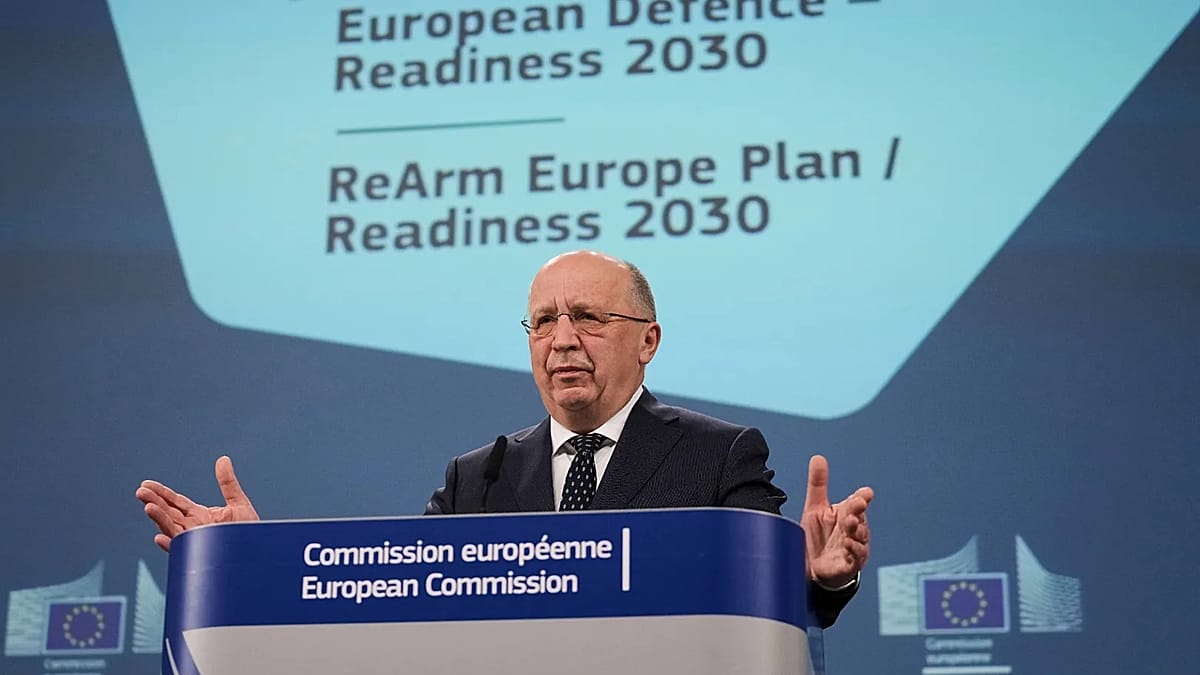
The US’s ongoing withdrawal of key military assets from Europe will cost €500 billion to replace, European Commissioner for Defence Andrius Kubilius said on Tuesday, warning that the bloc must work together and start producing the “big items” it needs to defend itself – or suffer the consequences.
“We have big defence industrial challenges at the moment for the European Union,” he said at a public event in Brussels. “German experts just recently calculated that it will cost around €500 billion for Europeans to build those strategic enablers and to replace American strategic enablers now located on the European continent.”
“We need (a) big change of our policies and practices in defence now.”
These assets traditionally include air defence, reconnaissance, strategic airlift and more. The defence commissioner, however, grounded his argument in a paper from the German Kiel Institute that estimates €500 billion will need to be spent over the next decade across 10 key areas.
“Significant progress toward sovereignty can be achieved within 3-5 years, and a high degree of autonomy can be reached in most areas within 5-10 years – provided these are pursued as a political priority through a concerted European effort,” the paper argues.
Kubilius has repeatedly stated that in order to defend itself from foreign aggression, the EU needs to produce more of these capabilities, and faster. There will be a “big amount of money” required, he said on Tuesday.
Various European security agencies have warned that Russia could be ready to attack a NATO ally or EU member state by 2030. The threat has been exacerbated by US President Donald Trump using his second term to retreat further from defending Europe.
The Republican president most recently announced the withdrawal of 5,000 American troops from Germany, which is part of a larger troop withdrawal campaign expected to occur over 6-12 months. Around 80,000 US troops are stationed around Europe under the auspices of NATO.
Tensions between the US and the other NATO allies – 23 of which are also EU member states – have flared in recent weeks over Europe’s reticence to support Washington in its military campaign against Iran.
In late April, German Chancellor Friederich Merz said White House negotiators were being “humiliated” by Iran’s leadership, remarks that were followed by the announcement of US troop cuts in Germany.
US Ambassador to the EU Andrew Puzder recently told Euronews that Trump is “still disappointed” with Europe over its position on the war. Trump himself has gone further and described his NATO allies as “cowards” on social media, vowing to “remember” how they rejected the US army’s request for assistance in the Middle East.
Fight or flight
Despite the political will from Brussels to ramp up the bloc’s defence output, key questions remain how Europe can support the massive projects required.
Kubilius’ comments come a day after Merz and French President Emmanuel Macron announced that Europe’s flagship European defence project, the Franco-German Future Combat Air System (FCAS) programme, has been abandoned.
The programme was launched in 2017 to replace France’s Rafale jets and the Eurofighter planes used by Germany and Spain. It was to be complemented by drones, sensors and digital communications systems designed to operate together in a networked battlespace.
The project was seen as a key test of European efforts to work more closely on defence as they seek to present a united front in the face of a hostile Russia at a time of souring ties with the US.
Asked by Euronews whether pan-European defence cooperation is achievable and whether FCAS’s failure augured ill for future projects, European Commission spokesperson Thomas Regnier said the EU executive would not comment on specific projects.
But the EU’s innovative funding options, particularly the Security Action for Europe (SAFE) funding program, would help, Regnier said.
“This is a top priority identified by Commissioner Kubilius and also the (European Commission) President Ursula von der Leyen herself,” he explained.
The European Commission has earmarked roughly €150 billion for loans as part of the programme, aiming to ensure that national governments are spending enough on their defences. The goal is to ensure that if the US continues to pull back and Russia comes knocking by 2030, Europe will be ready.
“Joint procurement is pretty much alive, and again, the success of SAFE speaks for itself,” Regnier said. Eighteen applications have been approved by the Commission, with five loan agreements finalised.
Read the full article here


