

Canada, America’s northern neighbour, also struck a pointed note – with Prime Minister Carney winning a standing ovation for his frank assessment of a “rupture” in the US-led, rules-based global order.
Addressing political and financial elites at the forum, Carney said middle powers like Canada, which had prospered through the era of an “American hegemon”, needed to realise that a new reality had set in, and that “compliance” would not shelter them from major power aggression.
From Beijing’s vantage point, the visits by leaders from the West are part of a calibrated strategy rather than a reflex to external pressure, analysts said.
From Beijing’s perspective, the outreach is about managing risk, not rekindling trust, Sun Chenghao, a fellow at Tsinghua University’s Center for International Security and Strategy (CISS), told CNA.
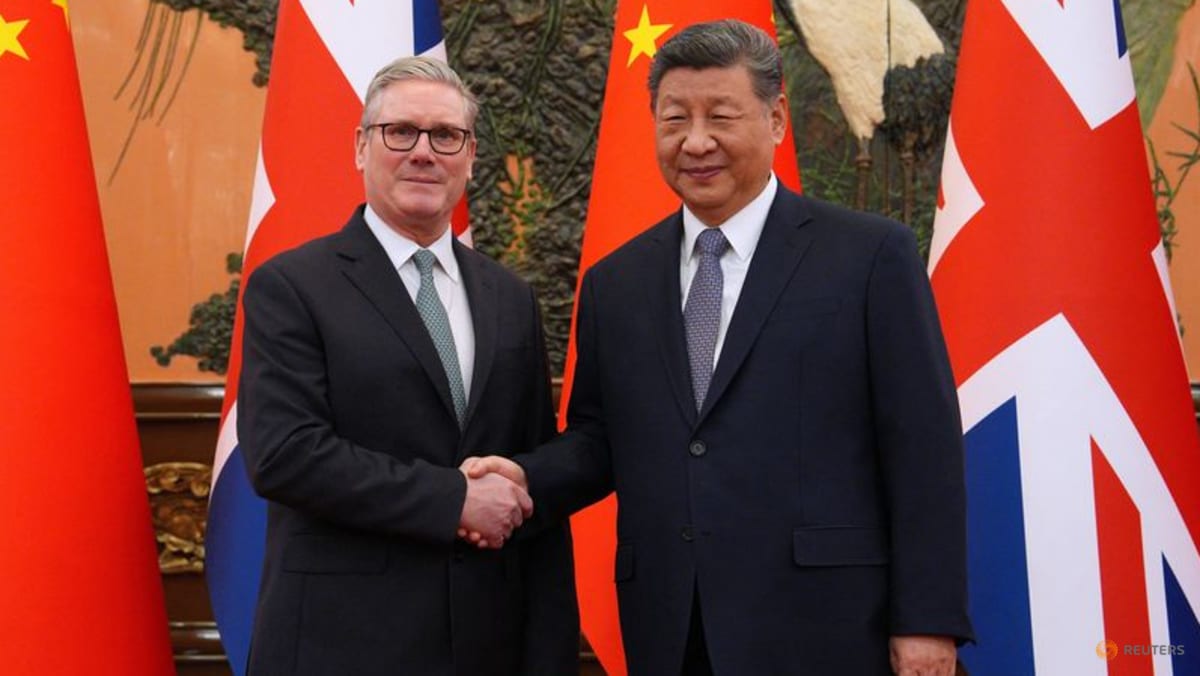
“This visit should first be seen as an opportunity to halt the slide and stabilise China-UK relations, rather than a simple reset,” he said, referring to Starmer’s China visit.
Sun, who is head of the US-EU (European Union) programme at CISS, said China is placing Starmer’s trip within “a broader European picture of more frequent and more pragmatic engagement”, testing whether key capitals have room to rebalance without choosing sides.
RECALIBRATION, NOT A RESET
Yet even as diplomatic traffic picks up, analysts have cautioned that the scope for a deeper reset in China-Europe relations remains tightly constrained, with trade frictions, Ukraine and security concerns continuing to set a low ceiling on what renewed engagement can achieve.
The current wave reflects a form of “managed re-engagement”, in which leader-level diplomacy is being used as a stabilisation tool rather than a signal of restored trust, said RSIS’ Li.
“Trade frictions over overcapacity and subsidies will resurface despite warmer optics, and Ukraine remains a persistent trust barrier.”
More fundamentally, Li said, security and technology concerns – including export controls and investment screening – now define the outer boundaries of engagement.
In the recent visits by the UK, Finland, Canada and Ireland, deliverables have largely clustered around low-friction cooperation rather than big strategic bargains.
Starmer’s trip has focused on reopening economic channels and practical law-enforcement coordination, including against people smuggling, alongside discussions on easier visa access.
Orpo’s visit yielded a clean-energy cooperation agreement, while Martin’s trip centred on trade promotion and people-to-people links such as education and business engagement.
Carney’s trip secured agreements on a raft of areas from trade to tourism, although he has described them as limited in scope rather than a sweeping deal after coming under pressure from Trump over doing business with China.
Read the full article here
