

Last week at Apple’s “Surprise and Shine” event, Dr. Sumbul Desai, Apple’s VP of Health and Fitness, announced the redesigned Health app and its fresh features. Between the new Insights tab with Apple Intelligence-powered suggestions, a Longevity tab that shows your Health Age, a readiness score, movement assessments, a blood panel and curated doctor videos, my head was swimming with questions. The following day, I sat down for a video chat with Desai for deeper insight into Apple’s reimagined health platform.
Now, on Wednesday, the new Health app debuted in the first developer beta of iOS 27.2. Some announced features will be available in later betas, including personalized summaries under the Insights tab, personalized recommendations and the ability to order a blood panel from Quest Diagnostics.
“Features will roll out progressively,” Apple said in an email. “Feedback during the beta period will help us continue refining it ahead of the public release in late 2026.”
Here’s everything you can expect to uncover in the Health app and the features you shouldn’t sleep on.
From data spreadsheet to intelligent experience
Launched in 2014, the Health app was initially intended to be like a spreadsheet, with data flowing in, Desai explained. However, the team realized they wanted more from the app, so it evolved over the past 12 years into what Desai now calls “an experience.”
Those at the helm of the Health app’s 2026 makeover considered how to leverage Apple’s machine learning and AI to help people live healthier, while also personalizing the app’s recommendations and turning it into an intelligent hub, not unlike the iPhone itself. For instance, as you open the app and move through your day, different screens appear to reflect your health status.
Movement assessments have also been added to provide an even more complete picture of a user’s health and track progress or decline. Desai described them as a “mini physical” you can complete at home.
All assessments under the app’s Longevity tab are science-based and contribute to a rainbow-petal visual that illuminates your state of health. Some assessments rely on vision-based AI models that integrate the phone’s camera, marking the first time Apple has used the camera for health.
The current iteration of the Health app is just the beginning and was designed to set in motion the next era of the team’s work in health and fitness, as Desai said those working on the app still feel they have more to do.
Health Age: Biological vs. birthday
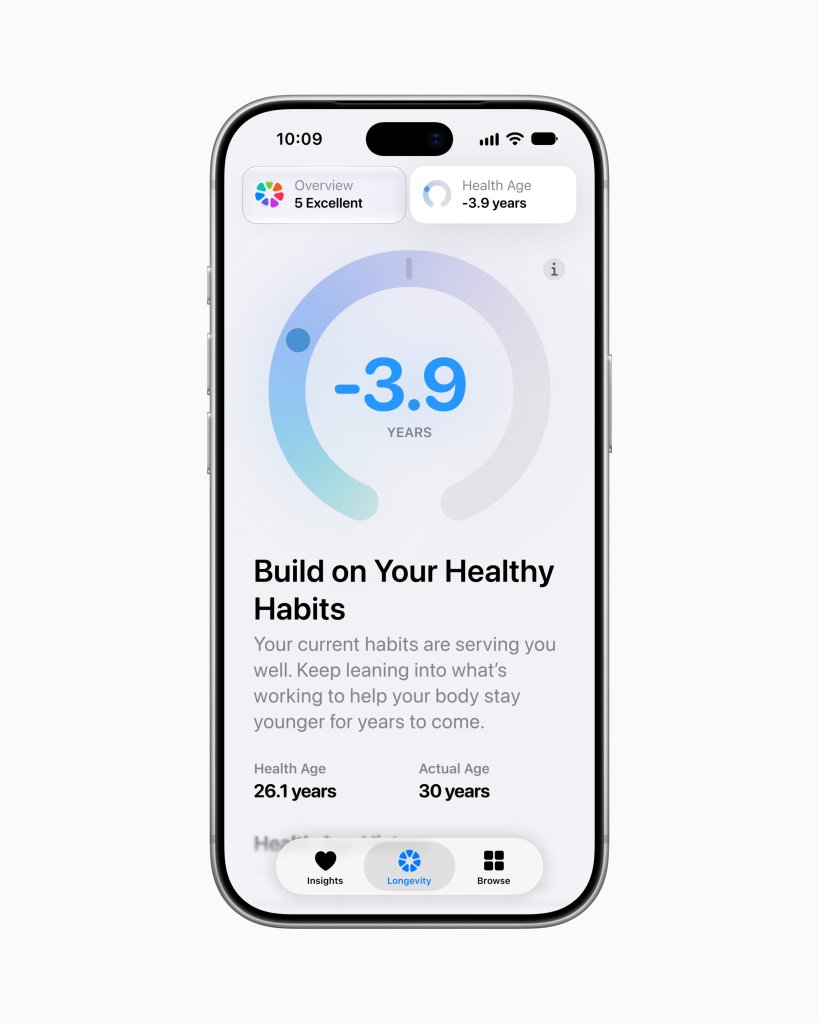
One standout feature from Apple’s event was the Health app’s Longevity tab, which will include a feature called Health Age that uses health metrics such as your VO2 max (the maximum amount of oxygen your body consumes during exercise), resting heart rate, sleep and heart rate variability, along with lab data such as LDL cholesterol and A1c for your average blood sugar level, to provide your biological age, which represents how your body is aging on a cellular level when compared to your actual age.
Apple’s own Heart and Movement Study, which it applies across all its health products, informs both Health Age and Readiness, which uses your activity data, daytime and overnight vitals and sleep data to tell you about your capacity for the day ahead.
The five-year Heart and Movement Study was conducted in collaboration with the American Heart Association and Brigham and Women’s Hospital to explore the connection between heart health and physical activity. Apple used that data to create the normative ranges for the insights it provides in the app.
While Desai acknowledged the Health Age assessment is more of a “fun way to look at your health habits” and that no one can tell you your actual biological age, it’s another way to provide insight and suggest healthy habits users can integrate into their lives.
Apple’s secret sauce
Apple isn’t the first company to offer features such as a readiness score or biological age, but Desai said that it stands out from competitors because of its unique perspectives, experiences and the science behind its work.
“When we first started our work in health, when we announced our irregular heart rhythm notifications and ECG, those were clinically validated scientific features,” she said. Desai likened those early days to building a muscle that lets the team create impactful products the medical community will appreciate, and users can easily understand.
That muscle Apple first built has been exercised with all the Health app’s new features, as Desai said that everything is rooted in science. On her team, for instance, physical therapists graded each movement in the app’s mobility assessments to ensure that when a movement is picked up and a result is given, it’s graded the way an actual physical therapist would grade it.
Uniting science and expertise, Desai said that’s what Apple brings to the table, and its Health app experience.
The new Health app’s ‘sleeper hit’
Much of the discourse following Apple’s event has been about the new readiness score and Health Age. I was curious what Desai felt was the “sleeper hit” feature that didn’t get as much attention.
“It’s actually the assessments,” Desai said. “You’re going to be able to, on a regular basis, do a push-up test and a core test and see if you’re improving. Then we give you insights and things that you can do to improve, and then you can test again. It’s almost like having a physical therapist or a trainer.”
The VO2 max test, in particular, marks the first time Apple’s doing an on-demand, in-the-moment VO2 max test.
You can then take all your assessment results, and the Health app will put them into a report you can share with your doctor.

Homing in on your body’s big players
Based on its new assessments, the Longevity tab’s visualization has seven tabs: heart health, sleep, mental wellbeing, movement health, metabolic health, hearing and nutrition. But how did Apple narrow it down to those seven?
“We picked areas where we felt like we had the appropriate data to comment on,” Desai explained. “For example, we do a cardiovascular risk score through some of the questions. It’s based on traditional risk scores and cardiovascular risk scores that are done.”
The team prioritized information they believe people will use and assessments they’ll complete, while ensuring the chosen health areas feel holistic and will help people concerned about long-term quality of life.
“There’s still more that we think we can do, but this is where we’re starting,” Desai stated. In other words, Longevity’s rainbow visual could gain more colors in the future.
Keeping privacy at Apple’s core
When it comes to its Health app, Desai said privacy is where they start and end.
“Candidly, we may not always be the first to market, but when we release something, we can stand behind it from a privacy standpoint,” Desai stated. “All the features you saw [announced] are no different. … It’s part of the conversation every day, and up till the day that the products are launched.”
Apple will hold off on releasing a product if it hasn’t met its privacy bar. The team behind the Health app also uses a checks-and-balances system, having other teams review their work to ensure they are nailing their privacy approach.
“In this world where more things happen in the cloud, we want to make sure that’s all encrypted and private, which is why we have Private Cloud Compute,” said Desai. Private Cloud Compute is Apple’s cloud intelligence system designed for private AI processing.
The team’s approach is end-to-end because privacy matters for all your data, not just health data.
Apple Intelligence has suggestions
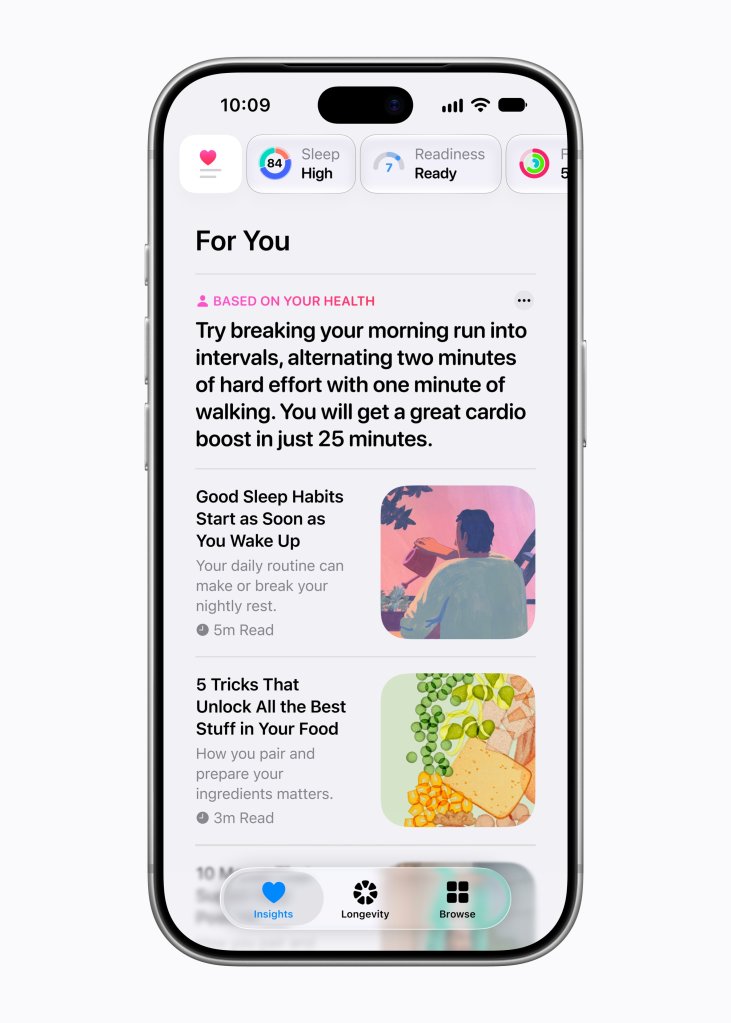
The Health app’s new Insights tab uses Apple Intelligence to analyze your health metrics and provide a timely summary that updates throughout the day.
“We also make suggestions,” said Desai. “For example, if you have an injury or you’re trying to work on your mobility, we’ll give you suggestions on the types of exercises you might be doing.”
It’s another example of how the app is evolving from a database to something that more closely resembles a personalized health advisor.
The daily insights are meant to be bite-size pieces of information that are one small thing you can do for your health each day. Some days these insights may be interesting; other days, you might be given information you already know.
Health on a cellular level, explained
For $119, the new Health app will let you purchase a blood panel with over 50 biomarkers through Quest Diagnostics. You can also get your blood pressure, height, weight and waist and hip circumferences measured. All this helps provide a more complete picture of metabolic health.
The revamped app will include videos from doctors that help people better understand what they see in the app.
“When you get your assessment results, you’ll actually see your own data in the videos where they’re explained by clinicians,” said Desai. “We have a physician, a physical therapist, a sleep expert, a mental health expert. The reason we did that is, for certain things, gamification works, but for certain things, you just want to know the information in an easy-to-understand way from an authoritative resource.”
While an expert explains the subject at hand, your health data, whether from your labs or your Apple Watch, will be overlaid on the video so you can see it as you learn more.
Ultimately, Desai doesn’t see the future of the Health app as one size fits all. Depending on the feature, the team always chooses what makes health as accessible and understandable as possible. In a world with an abundance of health data, perhaps that’s what matters most: ensuring people understand the numbers they see on their devices, and knowing what to do with them once the screen goes black.

See full bio
Read the full article here
