

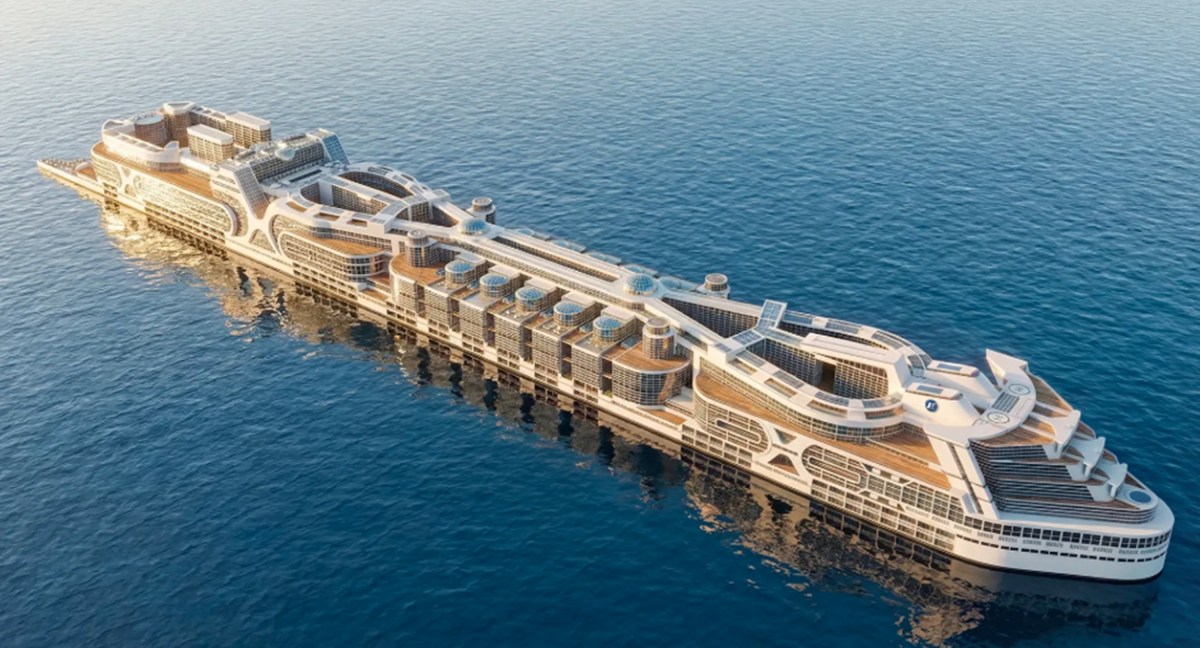
Renewed talks about the Freedom Ship, a proposed “permanently mobile city at sea” designed to house up to 80,000 people and travel continuously around the globe, have reignited interest in the decades-old ambition of floating cities.
The concept of the Freedom Ship, first introduced in the 1990s, envisioned a vessel 5,900 feet (around 1.1 miles) long, with homes, hospitals, and schools, as well as hotels and commercial space, creating a self-contained ocean metropolis. Roger Gooch, the CEO of Freedom Cruise Line International, the company behind the Freedom Ship, told The Telegraph on Monday: “We feel very confident that we can put this together, but capitalization is key.”
But the Freedom Ship and other similar projects have yet to move beyond the drawing board, with some being stalled at different stages.
Floating cities have long been proposed as a radical solution to 21st-century pressures. Advocates argue they could provide new land for overcrowded coastal regions, accommodate populations displaced by climate change, and create experimental hubs for alternative governance or tax systems. Many designs also promise sustainable living, with integrated food, energy, and water systems tailored to ocean environments.
Yet across decades of proposals—from “seasteads” to luxury megayachts—various barriers have prevented these visions from becoming a reality. The obstacles have ranged from a lack of investment and financing to cover multibillion-dollar costs to regulatory and political challenges involving local opposition and governance concerns.
The Freedom Ship
The Freedom Ship was envisioned as a “permanently mobile city at sea” that “continuously circumnavigates the globe while supporting everyday life,” the company says.
Passengers would travel around the ship via a tram system, while moving to and from land via ferries, with eight helipads also built into the ship. It was reported that the ship could take up to four years to be built, but Gooch said its first residents could move onto the ship while it’s being completed.
Despite periodic revivals, plans for the multibillion-dollar structure have repeatedly stalled, largely due to escalating costs—reportedly as high as around $16 billion—and difficulties securing financial backing.
The Maldives Floating City
The Maldives Floating City, developed by Dutch Docklands in a joint venture with the Maldives government, is one of the few projects to enter early implementation, with phased development planned off the capital, Malé.
Designed by Waterstudio, “it is the first floating city with thousands of houses that has full governmental support, based on a legal framework and title deeds for the owners,” its website says.
Dutch architect Koen Olthuis, the CEO and founder of Waterstudio, told Newsweek that “the first prototypes are floating in the Maldives.” Noting that it is a modular system, he explained that the project’s “scale-up process is ready,” but the project “slowed down through all the trouble in the Middle East.”
He said that it’s “definitely not what we wanted, but hopefully it will speed up again after summer.”
While smaller phases are underway, scaling such projects like this into full urban environments remains uncertain due to cost, infrastructure demands, and long-term feasibility questions.
Oceanix Busan
Plans for Oceanix Busan, which aims to be “the world’s first prototype floating city,” and has been developed with support from UN‑Habitat, were first unveiled in April 2022. The project was created by Oceanix, a New York-based sustainable design firm, in partnership with UN-Habitat and the city of Busan, South Korea’s second-most populous city.
The project aims to house around 12,000 people before later expanding to accommodate around 100,000 people on floating modular platforms that “generate 100 percent of the required operational energy on site,” UN-Habitat said at the time.
Phase 1 of its construction reportedly broke ground in 2023, and the project was “being implemented off Busan’s shores,” UN-Habitat said in May 2024. Reports note that while engineering solutions are advancing, high costs and regulatory frameworks continue to slow broader adoption.
The French Polynesian Seasteading Project
The Seasteading Institute proposed a floating island city off the coast of Tahiti in French Polynesia to “provide new lands for people whose current habitats are threatened by sea level rises, overcrowding, or other dangerous conditions.”
While the project initially gained momentum in 2017, it later collapsed within a year. The French Polynesian government’s memorandum allowing feasibility studies expired at the end of 2017, and the project was postponed indefinitely amid political opposition and local backlash.
MS Satoshi, the Crypto Cruise Ship
One of the few attempts to repurpose an existing vessel, the MS Satoshi, from Ocean Builders, was intended to host a floating community for cryptocurrency enthusiasts to engage in crypto mining.
However, the project failed due to regulatory and insurance barriers, effectively halting the initiative. In an announcement to potential investors, Ocean Builder’s CEO Grant Romundt reportedly said they would not be able to proceed “because of archaic big insurance companies that cannot adapt to innovative new ideas.” The vessel has since been sold for scrap.
The Pangeos ‘Terayacht’ Project
Unveiled in 2022, the Pangeos “Terayacht” concept, from the Lazzarini Design Studio, is a turtle-shaped vessel that aims to be the world’s largest floating structure. Housing up to 60,000 people, it spans around 1,800 feet in length and about 2,000 feet at its widest point.
However, it has yet to move beyond the development stage. It is estimated to cost around $8 billion to build and would require constructing an entirely new type of shipyard capable of accommodating a vessel of this size. If these funding and logistical hurdles are crossed, construction could reportedly begin in 2033.
Newsweek has contacted Freedom Cruise Line International, Oceanix, UN-Habitat, the Seasteading Institute, Ocean Builders, and the Lazzarini Design Studio via email for comment.
Do you have an architecture or design-related story to share? Let us know via [email protected], and your story could be featured by Newsweek.
Read the full article here
