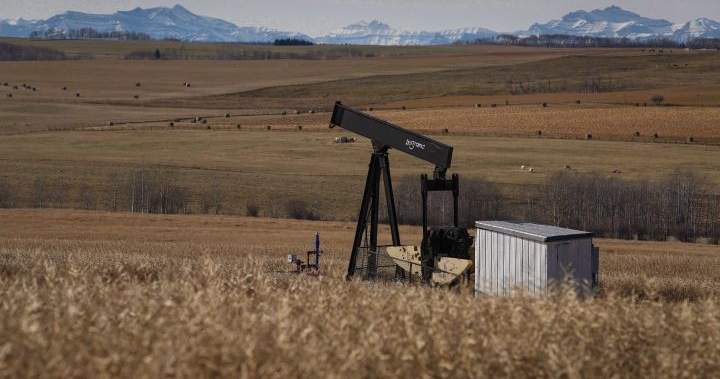
Alberta landowners are going to court over what they allege is the provincial energy regulator’s failure to properly fund the cleanup of oil and gas sites that have no company legally responsible for them.
Lawyers at environmental law charity Ecojustice are representing landowners Dwight Popowich and Teresa Patry, as well as the Polluter Pay Federation and the Alberta Surface Rights Federation.
Their judicial review application in the Court of King’s Bench challenges what they call the Alberta Energy Regulator’s “chronic underfunding” of the Orphan Well Levy.
The regulator deems oil and gas wells “orphans” when an energy company becomes insolvent, defunct or unable to meet its obligations to safely and responsibly close its sites.
Cleanup is managed through the non-profit Orphan Well Association and is funded through an industry fee, the amount of which the AER recommends to the Alberta government every year.
The Orphan Well Levy for the 2026-27 fiscal year is $154.56 million, up from $144.45 million the previous year, though the well association has pegged total cleanup costs of its inventory at $1.66 billion.
Such wells can come with “significant risks,” the applicants argue in their lawsuit.
“Orphan wells can leak contaminants into the soil, the air and the water, putting Albertans’ health at risk and causing irreversible damage to the environment,” they said in the court document, adding orphan wells can also affect property values and land use and also come with big unpaid bills to municipalities and landowners.
“Oil and gas corporations with closure liabilities that exceed the value of their remaining assets often do not pay their bills, causing economic damage — and taxpayer funds are used to cover these shortfalls.”
The application alleges the AER is in violation of part of the Oil and Gas Conservation Act that says it alone is responsible for determining the amount of the levy, which must be “sufficient to cover, among other things, a number of costs associated with orphan oil and gas wells in the current fiscal year, as well as deficiencies arising from the previous fiscal year.”
The claim also alleges that the regulator has improperly delegated its legal responsibility to set the levy rates to Alberta’s political executive and allows for too much industry influence.
Get weekly money news
Get expert insights, Q&A on markets, housing, inflation, and personal finance information delivered to you every Saturday.
It further accuses the regulator of improperly taking into account factors like commodity prices and the health of the industry when setting the levy.
Among other things, the applicants are asking the court to declare the 2026-27 levy “unreasonable” and order it to be recalculated.
The latest monthly numbers from the Orphan Well Association include an inventory of 7,370 wells in need of decommissioning, which involves permanently dismantling equipment so that the site is safe.
Another 9,151 are in need of reclamation, which means restoring the land so it’s similar to its original state.
In the 2025-26 fiscal year, the average cost of decommissioning a well was $28,800 and for reclaiming a site, it was $27,700.
An inactive well on Popowich’s property in Two Hills, Alta., was designated an orphan in 2025 after eight years of effort on his part, the claim stated.
He was then informed by the Orphan Well Association that it would take 10 to 12 years to reclaim it.
He told a news conference Tuesday that he’s tried to work through the proper channels, but his concerns have been dismissed while the problem keeps getting worse.
“This isn’t complicated. Even my grandkids know that if you make a mess, you clean it up,” Popowich said.
“Landowners have held up their end of the bargain. As Albertans, we understand the importance of resource development to our province, and we welcome that development in exchange for the promise that, when companies were finished producing, they would clean up after themselves.
“That promise to me and thousands of other Albertans has been broken over and over again.”
Patry, who lives near Vermilion, Alta., told the news conference the issue goes beyond finances.
“For years my family has lived with uncertainty about what these sites mean for our home, our land, our health and our future. We’ve experienced unexplained health concerns in our family, worry about our animals and repeatedly tried to get answers from the Alberta Energy Regulator,” she said.
“Living with that uncertainty takes a real toll.”
The complainants’ claims have not been tested in court.
The AER declined to comment on the legal challenge Tuesday. But a statement from the regulator noted that the most recent annual levy has increased by seven per cent from a year earlier.
“The increase provides additional funding to help the Orphan Well Association address the growing number of orphaned oil and gas sites across the province.”
Ecojustice lawyer Susanne Calabrese said she’s heard some compare steady increases to the levy to gradually paying down a mortgage.
“That does not make any sense when the amount of wells are just astronomically increasing at the Orphan Well Association,” she told reporters.
“It’s like you’re paying interest-only payments on a mortgage and your house is doubling in size and you’re buying 10 more houses.”
Read the full article here