

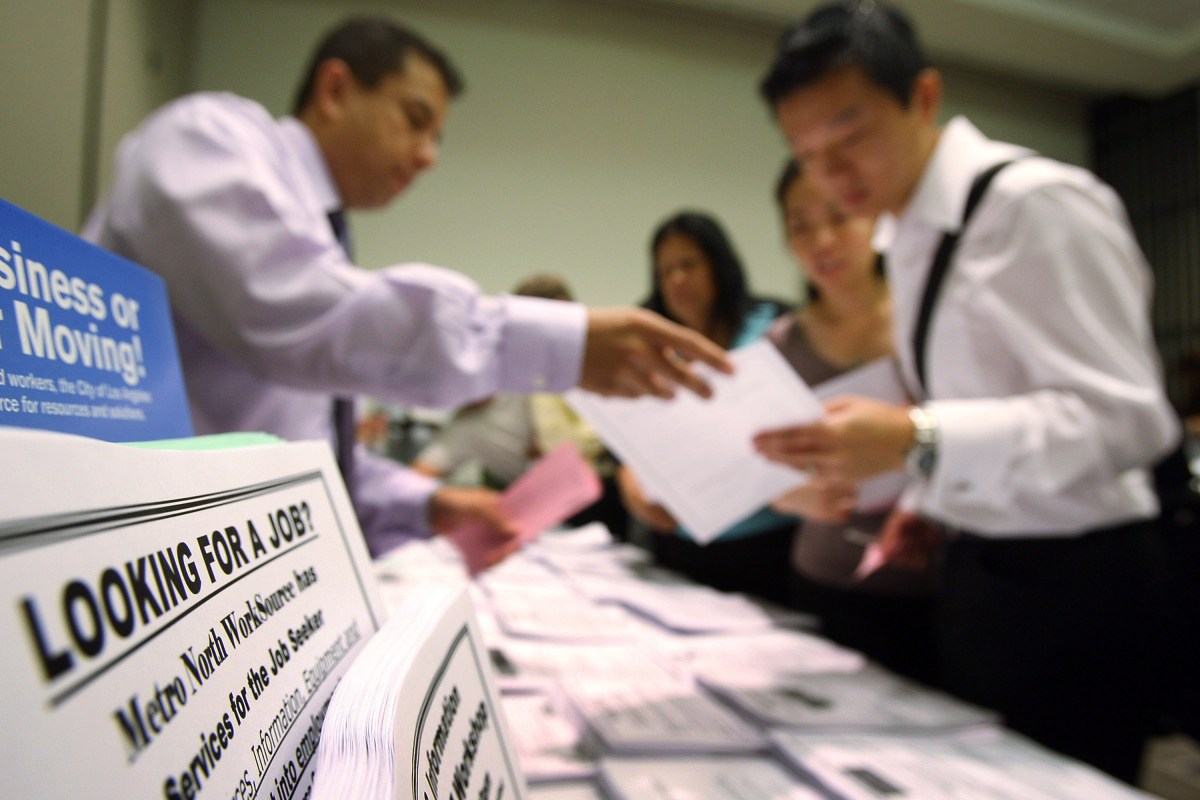
A growing number of Americans are running out of unemployment benefits as hiring slows, leaving job seekers without income support after months of searching.
The trend highlights a gap in the labor market, where layoffs remain low but finding new work is taking longer.
Workers in industries like tech, media and retail are among those most affected, as long-term unemployment rises.
Despite a relatively low unemployment rate, economists say the labor market is stuck in a “low hire, low fire” cycle—companies aren’t cutting jobs in large numbers, but they also aren’t adding them. That means workers who lose jobs are increasingly struggling to find new ones before their benefits expire.
Why the Labor Market May Be Misleading
The unemployment rate has remained near historic lows, but analysts say it does not fully capture the growing strain beneath the surface.
- More Americans are working part-time when they want full-time jobs
- Multi-job households are rising
- Long-term unemployment is increasing
Reuters described the stability as a potential “mirage,” while Federal Reserve Chair Jerome Powell said the economy is in an “unusual and uncomfortable” balance.
Long-Term Unemployment Is Rising
The number of people who are unemployed for 27 weeks or more is climbing again, reaching levels seen just before the 2008 recession—though still well below peaks during the pandemic. The number peaked in March 2021 before declining through February 2023, and has been ticking up since.
Over 1.83 million people have been unemployed for more than 27 weeks, according to the Bureau of Labor Statistics (BLS). That’s up from 1.67 million at the same point last year and 1.24 million in April 2024.
It’s not just the raw number rising—the share of long-term unemployed workers is also increasing.
- In December, 26 percent of unemployed Americans had been jobless for at least 27 weeks
- The most recent data shows that figure at 25.3 percent
“Long-term unemployment is on the rise, and more individuals are working part-time when they’d rather obtain full-time positions,” the St. Louis Fed wrote in March.
Why 27 Weeks Matters
While 27 weeks may seem arbitrary, it is the BLS definition of long-term unemployment and can point to deeper structural issues in the economy.
It may indicate a mismatch between available jobs and workers’ skills. It is also the point at which people are far more likely to drop out of the labor force altogether, according to the St. Louis Federal Reserve.
Economists say the problem is not only job availability but job matching. Even as some sectors continue to add jobs, workers in industries like media, tech and retail are facing longer searches as roles shift or disappear.
For many, unemployment insurance—designed as a temporary bridge—has become a critical lifeline during prolonged transitions.
For some workers, that lifeline is now expiring before they can secure a new job.
How Long Do Unemployment Benefits Last?
In most states, standard unemployment insurance typically lasts up to 26 weeks, though the exact duration can vary depending on state law and economic conditions.
During severe economic downturns, the federal government has historically extended benefits. However, those extensions are not currently in place at the scale seen during the COVID-19 pandemic.
Without extensions, workers who remain unemployed past their eligibility cut-off receive no additional weekly payments, even if they continue searching for work. This can force difficult trade-offs, including dipping into savings, taking on debt or accepting lower-paying jobs.
What the Unemployment Rate Does—and Doesn’t—Show
While benefit exhaustion is rising, the official unemployment rate tells a more nuanced story.
Unemployment remained steady at 4.3 percent in April, even as job growth exceeded expectations. Employers added 115,000 jobs, suggesting the labor market remains stable—but not accelerating. Economists say this reflects structural factors that reduce the number of jobs needed to keep unemployment unchanged.
The broader environment has remained resilient despite pressures, including higher energy prices and geopolitical uncertainty.
“Slower population growth, aging demographics and a sharp slowdown in immigration are keeping labor supply structurally tight,” Lydia Boussour, senior economist at EY-Parthenon, told Reuters. “This limited supply buffer is allowing unemployment to remain range-bound even as hiring slows.”
What States Have the Best Unemployment Benefits?
Unemployment benefits in the U.S. are administered at the state level, meaning eligibility, payment amounts and duration vary widely.
The most generous benefits are concentrated in states with higher wages and cost-of-living adjustments.
- Washington: $1,152 max weekly benefit
- Massachusetts: $1,105
- Other high-paying states: Rhode Island, Minnesota, New Jersey
In some cases, total payouts can exceed $33,000 depending on duration and caps.
These states are primarily located in the Northeast and West Coast, where higher median wages contribute to stronger benefit systems and longer coverage periods.
By contrast, the least generous benefits are generally found in the South and parts of the Midwest.
- Mississippi: $235 weekly max
- Alabama, Florida, Louisiana: $275 caps
In these states, benefits often fall short of covering basic costs and expire more quickly, with total payouts in some cases coming in well under $5,000.
What’s Next
For households already strained by inflation, losing unemployment benefits can be a tipping point.
As hiring slows and long-term unemployment rises, more Americans may face extended job searches without support—driving the increase in workers exhausting their benefits.
Read the full article here
