

Brian Angus and Dorothy Stauffer were on their sailboat on Sunday afternoon heading to Saturna Island from Vancouver when they came across a startling sight.
“We were about an hour and a half out of the active pass area when we adjusted course, and as we were under sail, partial sail, and the engine was running, I looked over in the starboard side, the right-hand side, to see a person in the water, and then two more,” Angus told Global News.
That’s when he yelled to Stauffer.
“Well, Brian said he saw three people, and I looked around in disbelief initially, and realized I could see five in total in the water, and Brian was saying we had to get the sail down because we can’t do anything with it up, so we proceeded to bring in the sail, and then circled back,” she said.
Angus immediately issued a Mayday warning and the Victoria Coast Guard and the Canadian Coast Guard answered immediately.
The Coast Guard then issued an automatic call for help to any boat in the area.
“So we actually ended up with two BC Ferries, a number of RCMP vehicles, the Hullo ferry … but there was no one close to us. There was no one anywhere near,” Angus said.
The two have training in the aviation industry, so Angus drove the boat and made the decision that the three people they could see, they had the best shot at saving.
“We knew we could not save two, the other two, without getting these people in,” he said.
Stauffer said she directed Angus to the people and circled the three with their dinghy on a floating line 50 feet behind them.
“I went for the female as she was screaming the loudest and was closest, and I basically commanded her to swim towards the line and the dinghy, which she did, and she did get to the dinghy and hung on at the stern of the dinghy, and then basically had Brian circle back again to go after the other two gentlemen,” she said.

Get breaking National news
Get breaking Canada news delivered to your inbox as it happens so you won’t miss a trending story.
“They were in the water, floating face up, spread eagle in the water to keep themselves afloat; one had no clothes from the waist up. I imagine he lost the clothing in the water, and none of them had life-jackets on.
“That was the most disturbing thing for me to see, but we continued to circle around to grab the two remaining that we could see, and they hung on to the dinghy. I treated that dinghy as a life ring for them. There was no way with those seas that we could have brought them on board our boat, but that was the best means, is to have them hang on to the dinghy, and while we waited for the hovercraft, I tried to scan the waters for the other two, but there was just no way we could see anybody, and I believe we had even drifted.”
Angus said it took almost 20 minutes to get the three people to hang on to the dinghy as they were hypothermic.
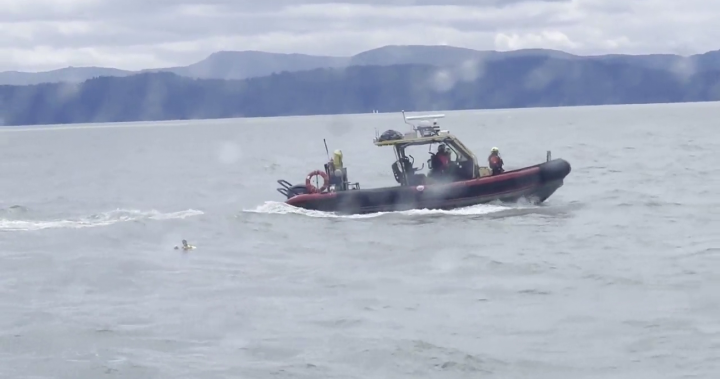
By that time, the hovercraft was there, which told them to drive their boat straight into the wind, which they did.
“I watched them jump, the rescuers from the Coast Guard jump right into the water with lines attached to the hovercraft, and basically pluck the two fellows out of the water, and I didn’t really see the procedure, how they got the girl out of our dinghy, but they essentially just pulled them on board the hovercraft,” Stauffer said.
Angus, who is trained as a pilot and has been sailing his whole life, knew they couldn’t save everyone.
Stauffer is trained as a flight attendant and follows the three As of training: assess, adapt and act.
“I had to assess where we were, and how the people were around us. Then I had to adapt our positioning by telling Brian how to drive and acting by shouting commands at the people in the water to try and have them listen,” she said.
Angus said they knew they had to act fast and do what they could to help.
“We made the decision, and once we made the decision, I wasn’t about to change it, and Dorothy was doing exactly what she’s trained for, and that’s why these people are still alive today,” he said.
Stauffer said they were able to make decisions without getting emotionally involved and do what they needed to do, but they know they will need time to process what happened.
Richmond RCMP said four men and two women remain unaccounted for and are presumed drowned and that the search has turned into a recovery effort.
“To know that we had to leave two people is the hardest thing for me,” Angus said.
“You, you can talk about training, like, how are you gonna bring someone, a man overboard, drill things like this, but when it happens to you, it’s totally unexpected,” he said.
“You don’t know who the people are. You’re wondering if you’re doing the best, and all you can do is rely on the training, what you’ve read, how your boat operates.”
A fourth person was rescued by someone else.
A 26-year-old man and a 33-year-old woman have since been discharged from hospital. A 33-year-old man and a 28-year-old woman both remain in critical condition, RCMP said on Monday.
Stauffer said the conditions on Sunday were awful and only experienced boaters should have been out there.
Angus agreed.
“From the wind standpoint, we work in nautical miles an hour; it was 15 to 16 knots, and from the sea swell, it was about one and a half to almost two metres from the west, and so it was very choppy,” he said.
Stauffer said they want people to wear life-jackets.
“We just have one simple message: if you’re going on the water, wear your life-jacket,” she said.
Read the full article here
