

Most people associate historic America with properties east of the Mississippi River. This is for good reason: these early colonies and states established the foundation for our modern federal government.
But, west of the Mississippi is a fruitful historic landscape worthy of exploration in somewhat unexpected cities, like Los Angeles.
What is now Los Angeles was founded thrice—once in 1781 by a group of 44 settlers known as Los Pobladores, once when Mexico won independence from Spain in 1835 and again in 1850 when the city became an American municipality five months after California became a state.
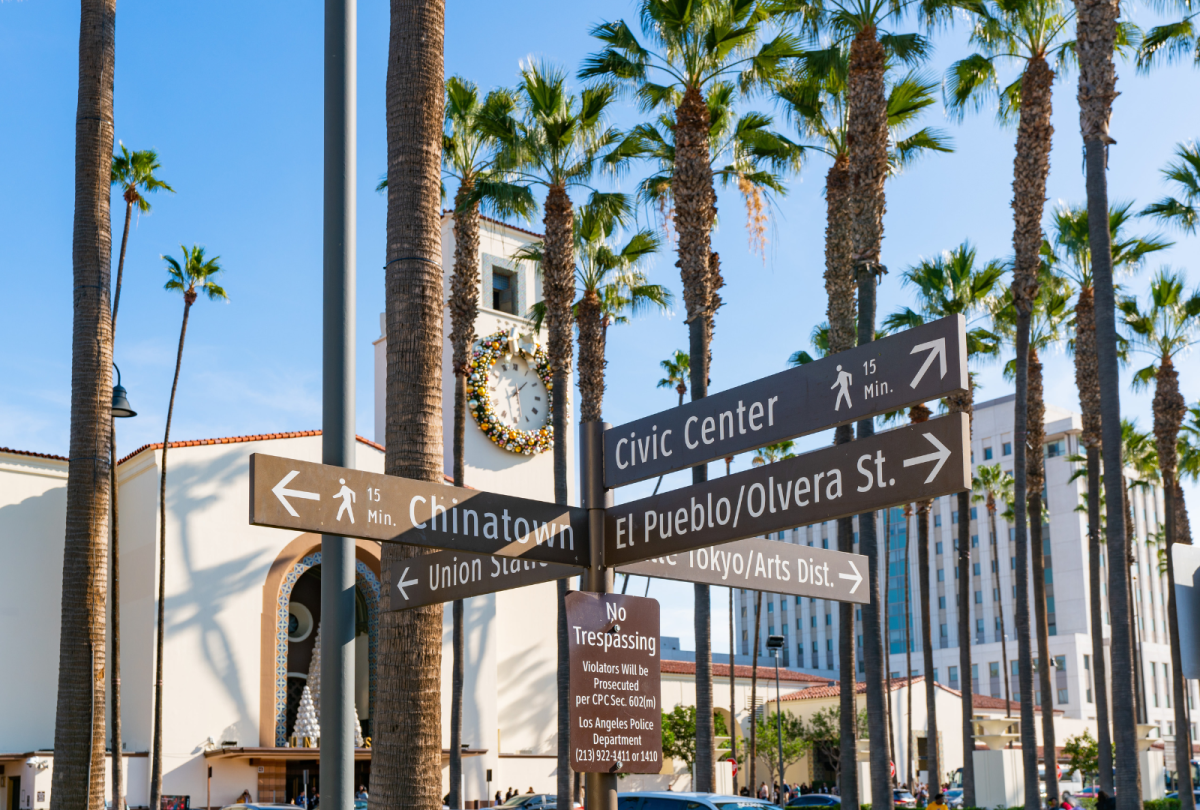
The first dwellings of the Los Pobladores are gone, but in the city’s El Pueblo de Los Angeles Historical Monument district visitors can explore the city’s 1781 footprint. Ávila Adobe (1818) is the area’s oldest standing residence, La Iglesia de Nuestra Señora la Reina de los Ángeles (1822) is the oldest church, and the Pico House (1870) was once a grand hotel.
Venturing 9 miles outside the city to the Mission San Gabriel Arcángel (1771) allows exploration of the oldest building in Los Angeles County.
In the decades before Hollywood, LA was a destination for tourists who wanted to visit a Mediterranean climate without hopping on an ocean liner. They took the train, getting off in what is now Downtown LA. Later, they were able to continue to Santa Monica.
Then, hotels in LA weren’t what they are today. The modern LA hotel is an evolution of the grand hotels built to support the rapidly expanding movie industry in the early 1900s. Guests can still stay at some of those grand dames, including The Biltmore Los Angeles (1923), The Hollywood Roosevelt (1927), Chateau Marmont (1929) and Hotel Bel-Air (1946).
The Biltmore was the height of luxury when it opened and hosted early Academy Awards ceremonies. The Hollywood Roosevelt was home to Marilyn Monroe for a number of years and its barber shop is where Errol Flynn is rumored to have created bootleg gin in a tub during Prohibition. Chateau Marmont has been host to Hollywood lore-creating moments for a century and Hotel Bel-Air was similarly seen as a secluded sanctuary.
The Los Angeles Athletic Club bridges the gap between historic Los Angeles and exclusivity. “Los Angeles Athletic Club and Downtown Los Angeles offer visitors a side of L.A. that feels more layered, authentic, and deeply connected to the city’s history. While many travelers know Los Angeles for the coast or Hollywood, Downtown is where you can experience its architectural landmarks, evolving food scene, arts culture, and creative energy all within a walkable urban setting. LAAC sits at the center of that story, offering guests the rare opportunity to stay inside one of the city’s most historic institutions while enjoying modern hospitality, wellness, dining, and social experiences,” Valentina Salas, marketing manager for LAAC, told Newsweek.
Founded in 1880, LAAC was the city’s first private club. It was established when Los Angeles was a small town of just 11,000 residents. As the city matured, the club did too, moving into its 12-story, Beaux-Arts style building at 7th and Olive in 1912.
“For nearly a century and a half, the Club has welcomed athletes, entrepreneurs, artists, and civic leaders, while remaining part of the city’s cultural fabric,” Salas explained.
Men and women of early Hollywood royalty were members: Mary Pickford, Douglas Fairbanks, Rudolph Valentino and Charlie Chaplin. Duke Kahanamoku, who popularized surfing, trained there, as did Olympic champion and “Tarzan” actor Johnny Weissmuller.
In the mid-1900s, LAAC member roster was a hush-hush who’s who of power players including the family that owned the Los Angeles Times.
Today, guests can stay at the LAAC Hotel in luxurious comfort, enjoy the new fitness center and relax with a treatment at the spa. Salas advises using the hotel as a home base for exploring LA. “Many of the city’s most iconic cultural destinations from Grand Central Market and The Broad to the Historic Core, Crypto.com Arena, and the Jewelry District, are just minutes away. Guests can spend the day exploring the neighborhood, then return to the Club for a workout, cocktail, dinner, or a quieter retreat above the city,” she said.
Part of that exploration can be restaurants associated with historic LA, in downtown and beyond. Santa Monica’s Loring’s Lunchroom was founded in 1902 as a beachside escape and has been in operating as Big Dean’s, since 1970. Little Tokyo’s Fugetsu-Do Bakery Shop has been serving sweet treats since 1903. Musso & Frank Grill (1919) is Hollywood’s oldest dining establishment and renowned for its vintage vibe.
Philippe the Original and Kohl’s PE Buffet, both established in Downtown LA in 1908, each claim that they created the French dip sandwich.
El Cholo (1923) was LA’s first Mexican restaurant and today remains a family-run institution. In addition to the original Western Ave location, there are outposts in Santa Monica, Orange County and Utah.
Read the full article here
