

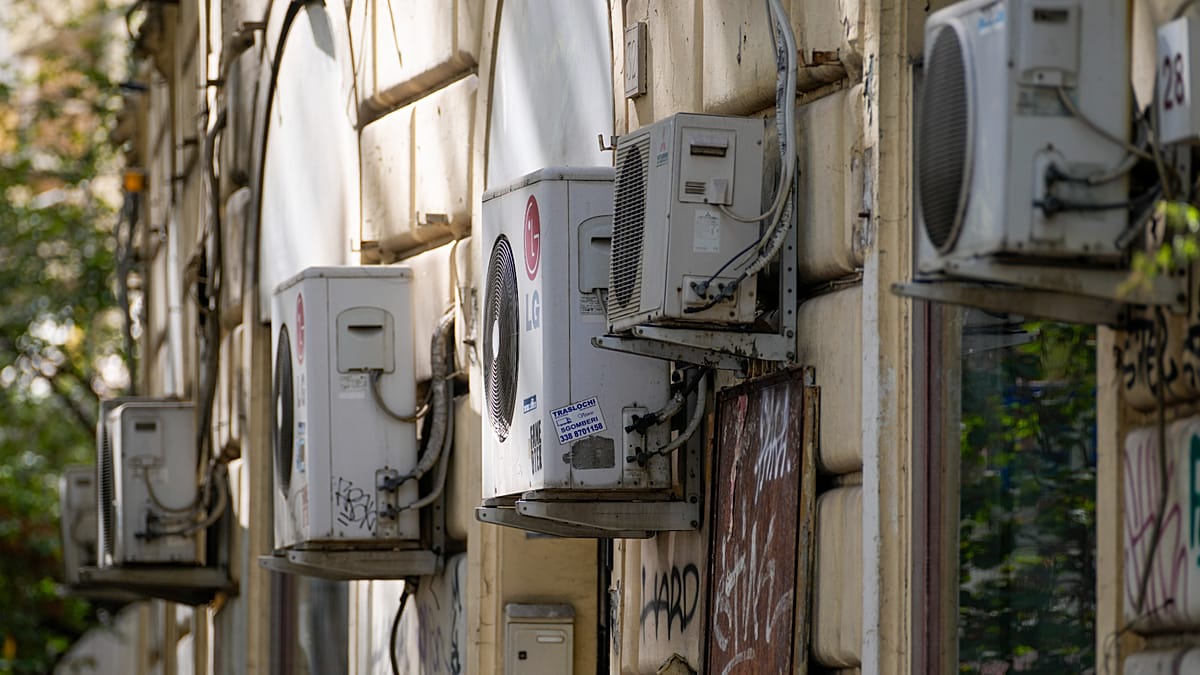
European Commission officials privately acknowledge that air conditioning is essential during increasingly frequent heatwaves, as passive cooling measures such as shading and insulation will not always be sufficient.
But as cooling demand rises, they also argue that relying solely on air conditioning would drive up electricity consumption, require additional power generation and leave households facing higher energy bills, particularly given today’s high electricity prices.
“Air conditioning is definitely one of the tools and a very necessary tool. In some cases, insulation or other passive strategies are not sufficient,” one EU official said on condition of anonymity, after a brutal heatwave exposed Europe’s lack of preparedness to cope with rising temperatures.
“At the same time, if you rely only on air conditioning, you may have to pay a lot for installation because you need a big generator to produce equally, but also you can end up with high energy bills,” the EU official said.
Moreover, the widespread installation of air conditioners can worsen the urban “heat island” effect through waste heat, the EU official added, reinforcing the need for green spaces, shading, building orientation and better city design.
The EU official outlined the rationale behind the bloc’s upcoming climate adaptation strategy, due in the fourth quarter of 2026, which will seek to shift governments away from disaster recovery towards prevention and resilience.
Overall, the Commission advocates a “holistic” approach that combines passive and efficient cooling technologies. Rather than encouraging mass installation of air-conditioning units, Brussels wants Europe to prioritise cooler buildings and cities through design, insulation and passive measures, using efficient air conditioning where it is genuinely needed.
Air-conditioning units vs fixed systems
EU officials acknowledge that portable air conditioners remain popular because they require no installation, but warned that they are considerably less energy-efficient than fixed systems.
The Commission noted that modern fixed units are “highly efficient”, often operating as reversible heat pumps that can help decarbonise heating as well as provide cooling.
EU energy-labelling and eco-design rules have steadily improved their efficiency since 2002, with further regulatory updates planned, the EU official said.
However, the Commission noted that the installation of air-conditioning is typically regulated at regional or local level.
“You need urban premises to install a solar shading façade or to install air conditioning. And member states, regions, and municipalities really need flexibility and to decide the approach that works best for them,” the EU official said.
Veteran lawmaker Pascal Canfin (France/Renew Europe) said that reducing the climate adaptation debate to “for or against air conditioning” was “simplistic”.
“I believe schools and hospitals should be air-conditioned so that children, elderly people, or people who are ill aren’t left alone to face heat that has become dangerous. But air conditioning isn’t the answer to everything,” Canfin told Euronews.
The French MEP noted that air-conditioning alone can’t solve infrastructure vulnerability or declining agricultural yields, noting that it is “ineffective to systematically reject every technological adaptation solution as it is to rely on a single miracle fix”.
Terry Reintke, co-president of the Greens/EFA in the European Parliament, said the “absolute priority” is to save lives, protect the most vulnerable and those without access to cooling.
“We need to reimagine our urban spaces: planting trees, restoring wetlands, and creating cooling zones with water features and green corridors. Nature-based solutions are not just aesthetic, they are life-saving infrastructure,” Reintke told Euronews.
However, the German lawmaker noted that the latest heatwave was a “wake-up call to accelerate the transition away from fossil fuels”, which she said are the root cause of this escalating danger.
“We must double down on renewable energy to power our cities without cooking the planet,” Reintke added.
Read the full article here
