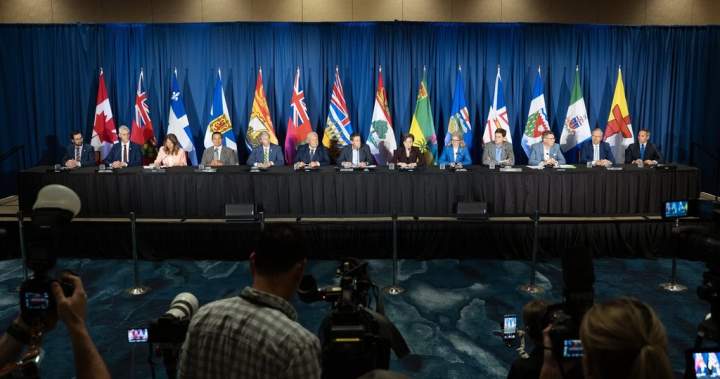
Alberta Premier Danielle Smith’s counterparts across the country are keeping their cards close to their chest on where they stand on the major constitutional reforms Smith is sending to a provincewide vote next month.
Smith’s four proposals, three of which would likely require the support of seven legislatures representing over half of Canada’s population (known as the 7/50 rule) and Parliament to implement, are among 10 questions she’s putting to Albertans on Oct. 19.
Her ideas, in brief, are: to abolish the Senate; let Alberta, not Ottawa, pick provincial King’s Bench and Court of Appeal judges; allow Alberta to opt out of federal programs without losing the associated funding; and to give provincial laws standing over Ottawa’s when jurisdictional disputes occur.
Smith’s government concedes on its referendum website that abolishing the Senate, which would require unanimous cross-country support and the support of the Senate itself, is going to be a non-starter for other political leaders.
But the premier’s office says there’s support for the other proposals and that “targeted” amendments to Canada’s legal and administrative spine are more likely to become reality, which is why it wants a mandate from Albertans to proceed.
“Provinces across the country are tired of federal overreach and want more authority within Confederation, not less,” said Ryan Fournier, a communications adviser to Smith.
“We believe this conversation is a vital step towards a fairer Confederation.”
The Canadian Press reached out to premiers across the country to ask whether they supported Smith’s proposals, but many did not respond to repeated requests.
Some, such as Saskatchewan Premier Scott Moe’s office, said they wouldn’t be commenting, and those who did respond didn’t answer directly.
“This is a matter for Albertans to consider through their referendum process,” said a spokesperson for Northwest Territories Premier R.J. Simpson.
Nunavut Premier John Main said the territory is be closely monitoring the results of the referendum.
“Like Alberta, Nunavut is rich in resources that benefit the rest of Canada and the world, and we need external supports to bring those resources to market,” Main said.
Get breaking National news
Get breaking Canada news delivered to your inbox as it happens so you won’t miss a trending story.
“We intend to make our mark in partnership with other governments and private industry, and support measures that build a stronger Canada.”
Yukon Premier Currie Dixon said he looked forward to “hearing what Albertans have to say” when it comes to the Constitution, but didn’t offer an opinion.
He did, however, voice his support for Alberta remaining in Canada, referring to the headlining question on succession.
“While I know Albertans have a number of grievances with the federal government, it’s my hope that Alberta will continue to stay in Confederation,” Dixon said.
“Canada, including the Yukon, would be negatively affected if Alberta were to leave.”
While they may not be saying so now, one constitutional law expert said Smith’s office is correct in saying there could be enough support from other provincial governments to take two of the proposals beyond the ballot — having provinces pick provincial judges and opting out of federal programs without financial punishment.
“It’s extra provincial power. Why wouldn’t they want it?” said Gerard Kennedy, a constitutional law professor at the University of Alberta.
“To me, the big problem is going to be getting the federal Parliament to agree, because the federal government would have to be agreeing to reduce its own power for nothing in return.”
Smith, Moe, Ontario Premier Doug Ford and former Quebec premier François Legault penned a letter to Ottawa in March asking that all provincial Appeal Court and Superior Court judges be appointed from a pre-approved list submitted by the provinces.
Federal Justice Minister Sean Fraser quickly shut the issue down, saying Ottawa wasn’t considering changes to the judicial appointment process. He pointed to the advisory committees set up across the country that review and advise on judicial applications to say that provinces already have input, since each government appoints some of the committee’s members.
Kennedy said the proposal about giving provincial laws paramountcy over federal laws probably won’t go anywhere, adding that there was no federation in the world with that setup.
He said regardless of the support that may exist, Alberta could be opening a can of worms if it makes serious efforts at working with other provinces.
“The problem if you open up constitutional negotiations is that some other provinces are going to have their pet projects and they’ll say, ‘well, we won’t agree to amend the Constitution on terms favorable to Alberta unless they’re also amended on terms that are favorable to New Brunswick or Quebec,’” he said.
“And then you end up having a package and too many provinces won’t like some part of the package and then it doesn’t get through.”
He said there’s a third way Alberta could try to amend the Constitution.
Some changes can be made with only the support of Parliament and the province that is being affected by the amendment. An example was in 2001, when the Constitution was amended to change the name of Newfoundland to Newfoundland and Labrador.
Alberta could try to go that route, Kennedy said, but the effort would likely end up in court, as granting the province special privileges others don’t have would go against the presumption that all provinces are treated equally.
Despite the premier and her office hinting that they’re committed to lobbying other provinces should the four proposals get majority approval on Oct. 19, some doubt Smith is willing to put in the effort.
Smith framed her referendum questions as presenting Albertans with a plan to better the province’s standing within Confederation so that voters don’t resort to separatism. She’s also blamed federal immigration policy for Alberta’s overburdened health and education systems.
Calgary-based political scientist Duane Bratt said the constitutional questions feel like an afterthought for the referendum.
Bratt said he’d feel differently if the questions were a bigger part of the premier’s messaging or the government’s $4-million ad campaign, which he said are far more focused on Smith’s five immigration proposals that are also on the ballot.
“She’s not really talking about the Constitutional questions,” Bratt said in an interview, pointing to recent speeches the premier has made.
“It’s immigrants who are the scapegoats and the villains here.”
Bratt, a professor at Mount Royal University, said the lack of attention Smith has given the constitutional proposals, combined with the amount of work needed to actually move the issues forward, means he doesn’t think she will act after Oct. 19.
“Where is their energy? Is their energy (on) building pipelines, restructuring the health-care system, or constitutional change? Because I don’t think they could do all of that.”
Opposition NDP Leader Naheed Nenshi said this week that he thinks Smith is only trying to find new enemies to blame for Alberta getting a raw deal.
“She doesn’t want to get those things,” Nenshi told reporters Tuesday about the Constitution reforms.
“She wants to complain about not getting those things.
“She wants the other provinces to say no.”
Read the full article here