

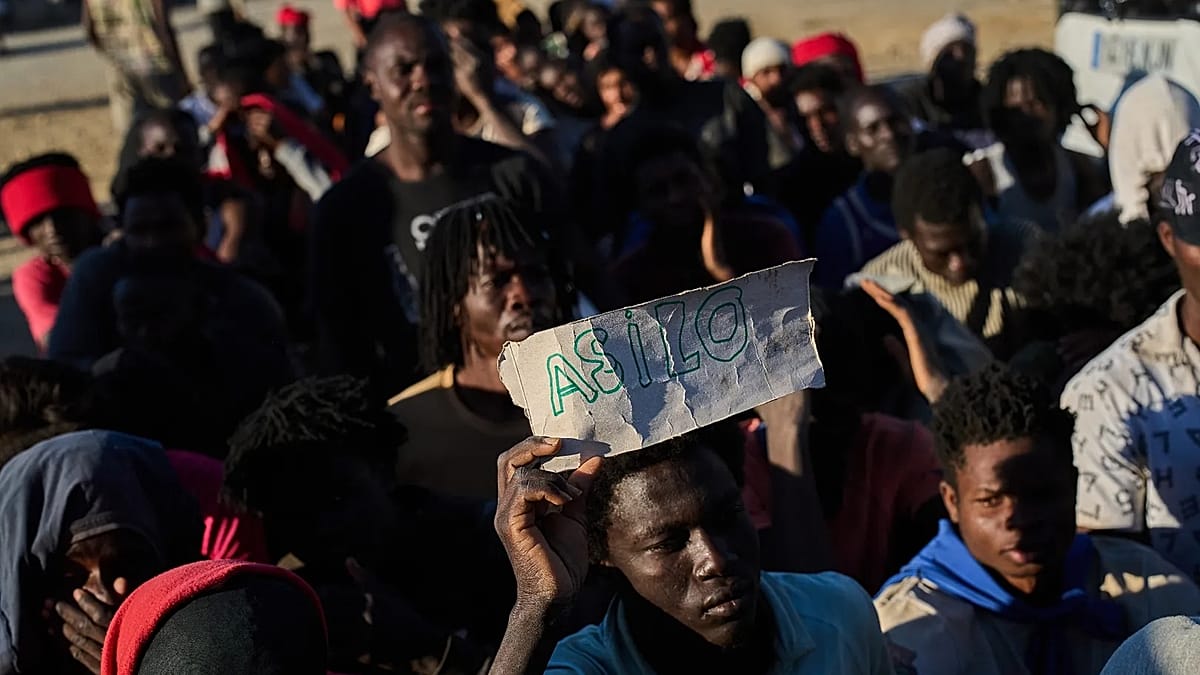
“Spain’s sovereignty over Ceuta and Melilla is beyond any doubt”, Spanish diplomatic sources have told ‘Euronews’.
“Ceuta and Melilla are part of Spain’s territorial integrity, which is internationally recognised. Spain’s territorial integrity has never been and will never be discussed with anyone,” the same sources pointed out.
Their remarks and comments reinforce the firm message from Defence Minister Margarita Robles, who has in recent days repeatedly stressed in the Autonomous City of Ceuta that “Ceuta and Melilla are not to be touched”.
Robles has sought to convey a sense of calm to the people of Ceuta and to guarantee that the Armed Forces will remain deployed to support the population.
In a brief appearance, Robles insisted that what happened on the 30th cannot be allowed to happen again: “Ceuta and Melilla are utterly Spanish”, she said, before highlighting the work of the troops deployed for the past 11 days.
“People in Ceuta should know that their Armed Forces will be by their side. We are not going to abandon them,” she assured.
Analysts believe the message was not only intended to reassure and dispel fears in the face of rumours of a new attempt at a mass entry of migrants this weekend; but more importantly, it was a message to Morocco.
Ouahbi publicly presents Ceuta and Melilla as a territorial claim of Morocco
The assurances from Spain comes amid territorial claims of the enclave by Morocco’s Justice Minister, Abdellatif Ouahbi.
Speaking in an interview with Saudi channel ‘Asharq News’ on Tuesday, the Moroccan justice minister said that the debate over control of the two autonomous cities is a “pending issue”.
Ouahbi stated that the question of Ceuta and Melilla “remains on the table” in meetings between representatives of Spain and Morocco.
While Morocco reopens this thorny topic, it has still not updated the number of dead or missing on its territory following the migration crisis.
Ouahbi criticised Madrid for “accepting” and “regularising” migrants who arrive irregularly on its territory while, he said, Rabat is trying to prevent them from leaving Morocco.
Earlier he had told the Spanish press that “Morocco is considering suspending the extradition agreement with Spain”.
Situation of minors among pending issues between Madrid and Rabat
The interview in Saudi Arabia comes almost two weeks after the Ceuta migration crisis, with the situation of Moroccan minors still in the city among the pending issues between Madrid and Rabat.
The minister has called for their return to Morocco and insisted that they must be reunited with their families. “We do not abandon our children. We want and demand that our children return to Morocco,” he insisted.
In this context, Ouahbi responded to one of the key questions raised during the crisis: whether Morocco was using mass migration as an instrument of pressure on Spain.
“We continue to assert our territorial claims” and we want to resolve the problem through dialogue,” Ouahbi said, but “we have never used this issue as a tool of pressure.”
Ouahbi rejected the idea that Moroccan children could stay in Spain to help meet the country’s demographic needs and argued that Morocco does not have to play that role. “We are not a state whose purpose is to solve any other country’s demographic problem”, he concluded.
Read the full article here
