

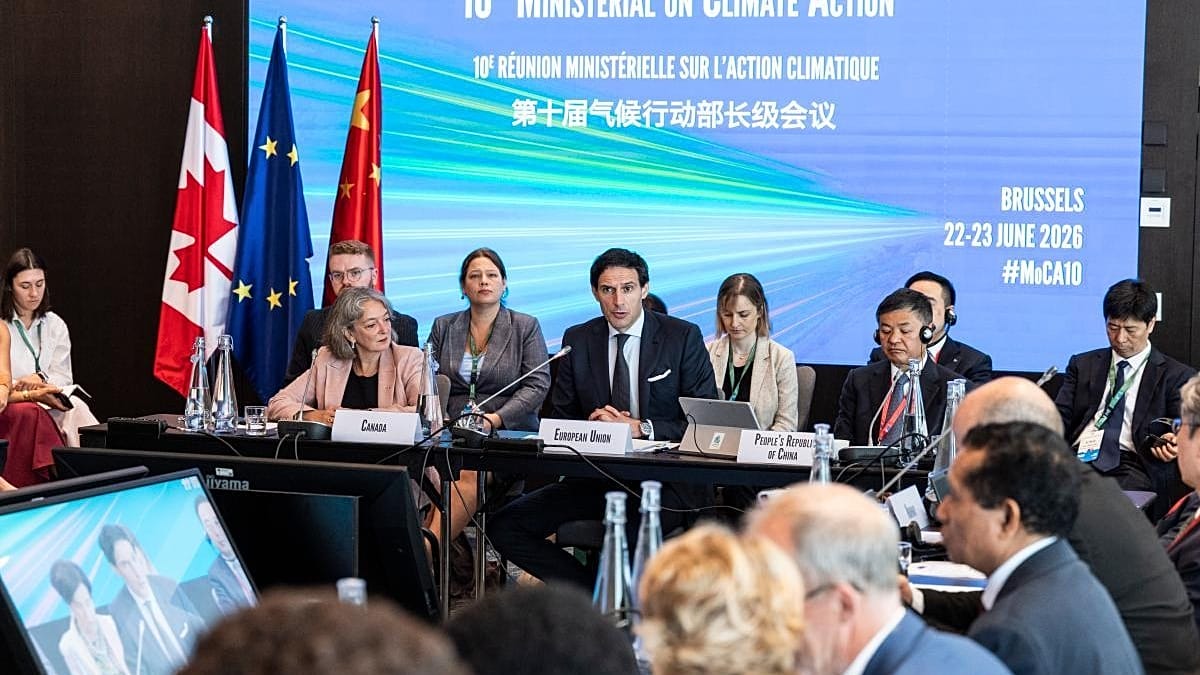
Efforts to tackle climate change are facing “changing political circumstances,” but international cooperation must not be “weakened” by leaders like US president Donald Trump, China’s Minister for Ecology and Environment, Huang Runqiu, said on Monday.
Speaking on the sidelines of the EU’s annual “ministerial on climate action” in Brussels, Huang’s remarks appeared to be an indirect reference to the Trump administration’s retreat from international climate commitments.
Despite being the world’s second-largest greenhouse gas emitter after China, Washington bailed on last year’s COP30 in Brazil and quit the Paris Agreement.
“We have a shared responsibility to safeguard commitments and ensure that international cooperation is not weakened by the absence of individual leaders or changing political circumstances,” Runqiu said.
The Chinese Minister addressed an audience alongside European Climate Commissioner Wopke Hoekstra and Canadian Minister for Environment and Climate Change Julie Dabrusin, as the trio discussed priorities ahead of the COP31 in Turkey later this year. There, world leaders hope to consolidate political momentum at a time when western and southern Europe are being hit by a severe heatwave.
Runqiu said that China remains determined to do “even more”, citing Beijing’s 15th Five-Year Plan, which outlines a roadmap for accelerating the comprehensive green transition of China’s economic and social development over the next five years.
In addition, China is advancing an eco-environmental code featuring a dedicated chapter on low-carbon development and climate change response, the Chinese minister added.
“China will continue to pursue a path of green and low-carbon development despite international backlash and uncertainty,” Runqiu said, hailing the country’s “world’s largest carbon emissions trading market” as well as the “world’s largest and fastest-growing renewable energy system”.
The Chinese minister acknowledged that the more turbulent and unstable the world becomes, the greater the test of countries’ resolve to pursue the energy transition and climate action, as ongoing conflict in the Middle East continues to disrupt global energy markets and expose the vulnerability of fossil fuel-dependent economies.
“It is precisely in such times that we must strengthen cooperation rather than retreat from it,” Runqiu maintained.
‘Slowing energy transition not an option,’ Hoekstra says
Despite several pushbacks at the EU level due to high energy prices and the closure of several heavy industries, Commissioner Hoekstra said that slowing the green transition was not an option.
The Dutchman insisted that electrification powered by clean energy offers a pathway to greater energy security, stronger industrial competitiveness, lower long-term costs and increased resilience.
“Climate action, energy, security and economic prosperity are mutually reinforcing and increasingly inseparable objectives. In a world where climate impacts are accelerated, the value of science has never been greater,” Hoekstra said.
The Commissioner reaffirmed the EU’s strong support for climate science, including the work of the Intergovernmental Panel on Climate Change and international scientific cooperation. Reliable climate data and evidence-based decision-making, he said, are more important than ever as climate risks intensify.
Turning to national climate commitments, Hoekstra stressed the importance of ambitious and credible Nationally Determined Contributions (NDCs). These plans provide certainty for investors, businesses and citizens while helping keep the goals of the Paris Agreement within reach. He urged all countries that have not yet submitted updated NDCs to do so “as soon as possible”.
Reflecting on the outcomes of the Global Stocktake, a mechanism under the Paris Agreement designed to assess the world’s collective progress toward combating climate change, Hoekstra listed several priorities: accelerating the transition away from fossil fuels, expanding renewable energy, improving energy efficiency and strengthening climate resilience.
Delivering on these objectives, he said, is essential to maintaining confidence in the Paris Agreement process and preserving the possibility of limiting warming to 1.5°C.
Looking ahead to COP31, Hoekstra described the conference as an “opportunity to move beyond promises and focus on implementation”.
He pointed to the importance of advancing the global climate action agenda, supporting a just transition away from fossil fuels and developing practical roadmaps that can mobilise investment, deepen international cooperation and speed up progress across sectors and regions.
Canada’s ‘climate competitiveness’
Canada, which has been deepening its alliances with the EU, presented itself as pursuing a “practical climate competitiveness” strategy — reducing emissions while growing the economy.
Dabrusin described the country’s policy actions such as decarbonising transport and heavy industry, tightening methane regulations, modernising electricity grids and advancing biodiversity protection targets — including conserving 30% of land and oceans by 2030.
She also argues that these measures support the argument that economic growth and emissions reduction can occur simultaneously, citing Canada’s economic expansion alongside declining emissions as evidence.
“We’re looking forward to COP 31 in Antalya, Turkey, with a clear purpose: from promises to progress, from plans to implementation, from ambition to action,” Canadian Minister Dabrusin said.
“It’s incumbent on all of us to harness the mobilising potential of the UNFCCC process and COP31 to highlight how effective climate action strengthens competitiveness and fosters economic prosperity for citizens and communities at the local level.’
The COP31 will kick off in November in Antalya, Turkey.
Read the full article here
