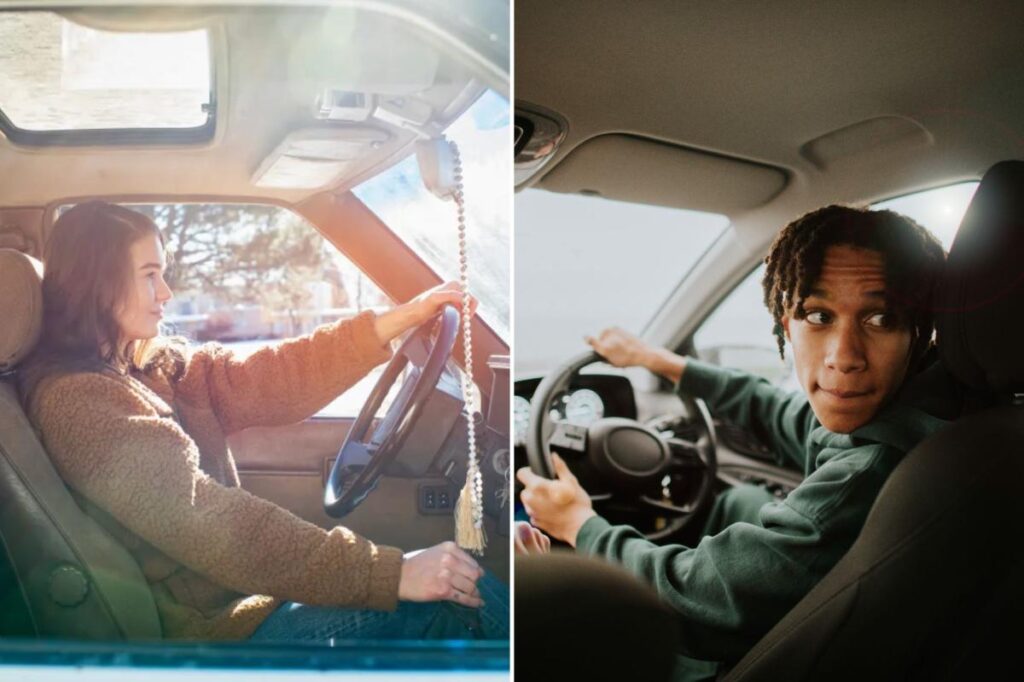
Are drivers who never learn this skill getting the short end of the stick?
Recent research shows that this once-ubiquitous ability is increasingly becoming a lost art.
Only 18% of Americans know how to use a stick shift — with the number even lower among younger drivers.
In a survey of US drivers, Extreme Terrain found more than a third of Gen Z drivers (35%) never learned to drive stick, compared with just 9% of baby boomers.
Further, driving confidence is waning among younger drivers, with only half of those under 30 believing they could competently drive a manual.
“People in their mid-40s and up are probably the only people left who really grew up with the stick shift; people now don’t know how to drive it unless their parents or grandparents teach them,” driving instructor Andy Nelson, owner of Safe Driver Solutions, told The Post.
To that end, and to Nelson’s point, more than half of manual drivers (56%) surveyed learned to drive a manual from a parent or older relative.
The reason for learning how to drive a stick has evolved over time; only 22% of Gen Z drivers learned out of necessity, compared with 55% of boomers.
“Like most of society, it’s turned toward disposable technology, so rather than fixing the transmission, they just replace it,” he said.
Indeed, less than 2% of all cars sold in the US in 2024 were manual, while preliminary federal data shows that manual transmissions accounted for just 0.6% of vehicles built for the US market for the 2025 model year, down from 35% in 1980.
In addition to the diminishing supply, Nelson says driving stick requires thought and coordination, making it unappealing to many drivers.
“Most adults don’t like to do it because it requires your brain to do too many things at once. We can all do it; we just don’t.”
According to Nelson, driving a stick informs a driver’s understanding of how the vehicle functions and keeps them engaged in the objective itself.
“It takes more brainpower. You have to tell your right foot how much gas to give and your left foot how much clutch to pull out. That’s a lot of multitasking.”
Multitasking still gets high marks among Americans; 64% of those surveyed said manual drivers are more skilled than those who only drive automatics, with the majority (51%) calling them more impressive.
Nelson also shared that a stick shift can seriously benefit neurodivergent drivers.
“We try to teach kids with ADHD to drive a stick because it requires total focus; you’ve got one hand on the stick, one hand on the wheel, right foot on the gas pedal and brake, left foot on the clutch. You’re completely focused, and as an ADHD driver, that’s ideal.”
Neurotypical or neurodivergent, and highway driving notwithstanding, he maintains it’s nearly impossible to text and drive while operating a manual vehicle, which could prove to be an antidote to recent reports that found teenage drivers spend more than a fifth of their time behind the wheel looking at their phone.
Nelson notes that the majority of the students he teaches to drive stick are learning for a very specific reason.
“95% of the time, we’re teaching stick so that the kid can drive something fancy to prom.“
He says the remainder of his students live or work on farms and need the skill to operate a semi-trailer truck.
His reflections echo the data, which showed that among those who can drive stick, 64% said they rarely or never do.
The decline in stick drivers is fueled by US carmakers producing fewer manuals. Less than 2% of cars sold in 2024 were stick shifts.
Nelson believes the advent of electronic safety features has become something of a mask for drivers who were never taught to properly control a vehicle, adding that in inclement weather, a manual transmission offers better control than an automatic.
“If you’re in a stick-shift vehicle, in a rear- wheel drive vehicle, you have more control of your vehicle in winter weather, rain, or other kinds of slippage.”
Still, he admits that the standard safety features of modern automatic vehicles, like automatic emergency braking, lane-keeping assistance and blind-spot monitoring, have their advantages.
“Manufacturers have done a pretty good job of making the car smarter than the driver, to the point that it can anticipate and address things that a driver may or may not know how to handle.“
While stick-shift vehicles are waning in the US, manual cars remain the standard and the preference in many countries.
Roughly half of all cars sold in Europe are stick shift, with some nations selling far more manual cars than automatic.
In Italy, just 28% of cars sold in 2020 were automatic, the lowest of any EU country.
While Italy may set the standard for stick, in many EU countries automatics are considered a luxury option that requires an upcharge, making them less attractive to consumers.
Further, roughly 75% of China’s cars on the road are manual, and stick sales outpace automatics in India, Argentina and Brazil.
At least among Americans, Nelson fears that manual cars and those who can command them will soon be lost to time.
“If we keep going the way we’re going, stick shifts are going to die out with my generation.”
He believes that culturally and automotively, we have “dumbed ourselves down” to make things easier.
“With an automatic or self-driving car, you put it in gear, you step on the gas, and you go. We’ve removed all the accountability and responsibility of learning how to do things the correct way, and we’ve made it too simple.”
While stick driving may make for a more engaged and focused driver, Nelson ultimately believes that safety comes down to how a driver drives, not what they drive.
“It doesn’t matter if it’s a manual or an automatic; drive on the safer side by going slower. If the speed limit says 25, drive 20. Too much speed and not being able to stop fast enough are usually the problem. That’s why people lose control,” he explained.
“Drive slower, drive safer, pay attention. All it takes is one hit to change your life forever,” he added.
Read the full article here