

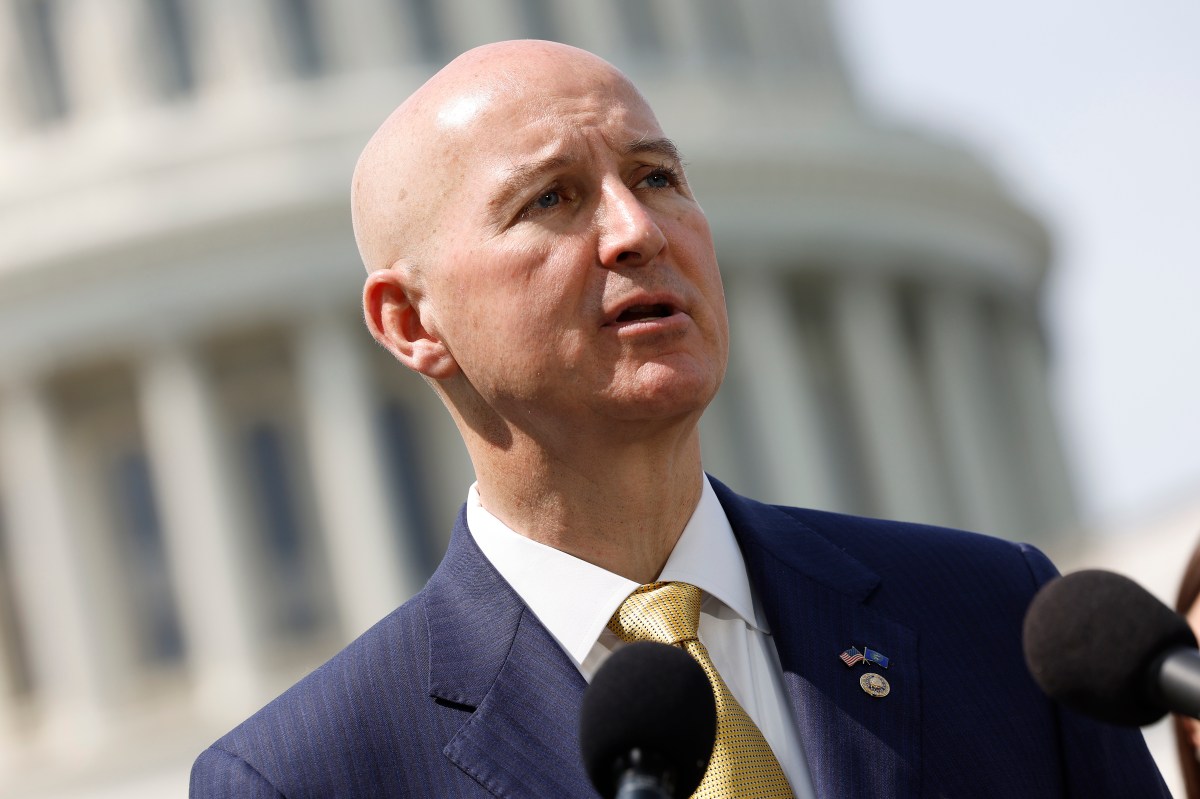
Republican Senator Pete Ricketts enters the 2026 election cycle as the favorite in deeply red Nebraska, but Dan Osborn is giving him a run for his money and could become the first independent elected to the U.S. Senate from the state in 90 years.
Polling shows a tight contest, and while Ricketts is leading, Osborn is raising more money. And a chaotic Democratic primary—marked by allegations of “planted” candidates—may ultimately shape whether Osborn can consolidate anti‑Ricketts voters in November. Those dynamics have turned what would normally be a safe Republican seat into a closely watched race in the midterms. And, if Ricketts loses, Republicans risk losing control of the Senate and making President Donald Trump ineffective in his final two years in office.
“Housing is unaffordable. This is the main reason I’m doing this this year is because I have a daughter who said, ‘I don’t think I’m ever going to be able to afford a house,'” Osborn previously told Newsweek.
Nebraska Primary Election Results
Ricketts easily cleared his Republican primary after facing four challengers on Tuesday. He was declared the winner by the Associated Press at 9:03 p.m. ET, with 78.3 percent of the vote. It wasn’t surprising given polling that showed Ricketts as the clear favorite.
The bigger story in Nebraska has been the unusual proxy battle playing out on the Democratic side. State Democratic leaders openly backed Osborn—despite his independent status—rather than fielding a traditional nominee, a strategy designed to prevent vote‑splitting in the general election and give Osborn a clean head‑to‑head matchup against Ricketts.
That plan unraveled, though, when two Democratic contenders—Cindy Burbank and Bill Forbes—entered the primary. Forbes has been accused of being a Republican “plant” meant to siphon votes from Osborn in November. Forbes told the Nebraska Examiner that he’s not going to get into political drama, but he sidestepped the question as to whether he’s actually loyal to Ricketts.
“I just believe in doing what makes sense and getting things done for regular, hard-working Nebraskans,” he said. “Washington feels pretty broken right now, too much arguing, not enough results.”
While the Democratic Party has accused Ricketts of helping Forbes to try to increase his chances of winning against Osborn, Will Coup, a Ricketts campaign spokesperson, dismissed the accusations as a “conspiracy theory” to the Nebraska Examiner. Coup added that Ricketts has had “no role” in the Democratic primary.
The outcome of the Democratic primary matters, though. If a Democrat remains on the November ballot, Osborn’s path is likely to narrow. Burbank has said she’ll drop out of the race if she wins the primary to help Osborn. If she does, the race becomes a rare one‑on‑one contest between a Republican incumbent and an independent challenger.
Pete Ricketts’ Chances of Losing to Dan Osborn in Nebraska
On paper, Ricketts should cruise. Nebraska has not elected a Democrat statewide since 2006, and an independent hasn’t won a U.S. Senate election in the state since 1936. Republicans have controlled both Senate seats since 2012. Trump carried the state by double digits in 2020 and 2024, and Ricketts has the advantages that come with incumbency, party infrastructure and national GOP support.
Yet public polling paints a more fragile picture.
Multiple surveys conducted since late 2025 show Ricketts and Osborn locked in a tight race. A Tavern Research poll released in May found Ricketts trailing Osborn 47 percent to 42 percent when voters were presented with a head‑to‑head matchup, while the senator comfortably beat every Democratic alternative surveyed. An Impact Research poll in February showed Ricketts leading Osborn by 1 point, well within the margin of error.
Even more concerning for Republicans is who is driving Osborn’s competitiveness. The Tavern Research poll showed independent voters breaking decisively toward Osborn—by margins as wide as 60‑plus points—while he also pulls a meaningful share of Republicans and Trump voters that a Democratic nominee cannot. Seventeen percent of Trump voters said they would vote for Osborn.
Why Dan Osborn Has a Path to Victory
There are 620,689 registered Republican voters in Nebraska, according to data reviewed by Newsweek. There are also 280,919 nonpartisan voters. If Tavern Research’s polling holds true, Osborn could walk away with 168,551 votes from nonpartisan voters and 86,896 Republican votes, for a total of 255,447.
Democrats overwhelmingly break for Osborn at 92 percent, which would give him 301,396 additional votes if the survey results hold. That leaves Osborn with 556,843 votes.
For Ricketts, if the survey results hold, he’d have 471,723 Republican votes, 56,183 nonpartisan votes and 6,552 Democrat votes for a total of 534,458 votes, which puts Osborn ahead. Of course, this is contingent on every single person casting a ballot, the survey results being completely accurate, and it doesn’t factor in Libertarian voters, who are likely to break for Ricketts, and Legal Marijuana NOW voters. With Libertarian votes, Ricketts is within 4,000 votes of Osborn’s total.
Osborn’s appeal is rooted less in party ideology and more in biography and message. A Navy veteran and former industrial mechanic, he has framed himself as a working‑class populist running against what he calls a billionaire‑backed political establishment. That pitch resonated in 2024, when he lost to Senator Deb Fischer by 6 points—far closer than analysts expected in a safe Republican state.
“You would see my sign next to Trump signs, and then you’d go a block over, and you’d see my signs next to Harris signs,” Osborn previously told Newsweek. “So what my campaign was able to do is bring people together around policy and around issues, not over party or a president.”
Fundraising momentum has also shifted. Osborn outraised Ricketts in the first quarter, pulling in roughly $1.2 million compared with the incumbent’s $1 million—a symbolic milestone even though Ricketts still leads in total cash on hand. Much of Osborn’s haul came from small‑dollar donors, reinforcing his grassroots appeal.
Osborn also benefits from Democratic coordination. The Nebraska Democratic Party has formally endorsed him and signaled its intent to rally behind his campaign in November, a strategic bet that an independent is the only viable vehicle for defeating Ricketts.
Pete Ricketts’ Strengths and Vulnerabilities
Ricketts’ strengths remain substantial. He is a former two‑term governor, a sitting U.S. senator, and the beneficiary of heavy financial support from national Republican committees and aligned super PACs. He has already demonstrated a willingness to spend aggressively, launching negative ads against Osborn months before the general election.
Republican registration also gives Ricketts a built‑in floor that Osborn must overcome. Even polls showing a tight race assume near‑universal Democratic support for the independent—a condition that may not fully materialize if a Democratic nominee remains on the ballot or if partisan polarization hardens late in the cycle.
A Ricketts spokesperson previously told Newsweek that the incumbent Republican “has consistently worked for and voted to secure the border and cut taxes for Nebraska workers, families and seniors.” He described Osborn as “bought and paid for by his liberal, out-of-state, coastal donors.”
But Ricketts’ vulnerabilities are becoming harder to ignore.
Polling consistently suggests he starts the race with higher unfavorability than Fischer did in 2024. Among independents—the decisive bloc in Nebraska statewide elections—Ricketts trails badly. That gap exposes the senator to a coalition that crosses traditional party lines, blunting Republican advantages.
There is also risk in nationalization. If the race becomes a referendum on Washington Republicans, corporate donors or billionaire influence—frames Osborn actively promotes—Ricketts may find it harder to localize the contest, particularly in Omaha and Lincoln suburbs where margins matter most.
Osborn does not need to win over Democratic voters—they are already inclined to support him. His margin comes from independents and disaffected Republicans, a coalition that polling suggests remains intact even after sustained Republican spending.
Still, the path is narrow. Ballot access hurdles, potential vote‑splitting and a flood of late Republican money could reset the race. National analysts remain cautious, noting that Nebraska’s Republican lean gives Ricketts room to recover even from early deficits. But if current trends hold—and if Democrats clear the field—Nebraska could produce one of the cycle’s biggest Senate surprises.
Read the full article here
