

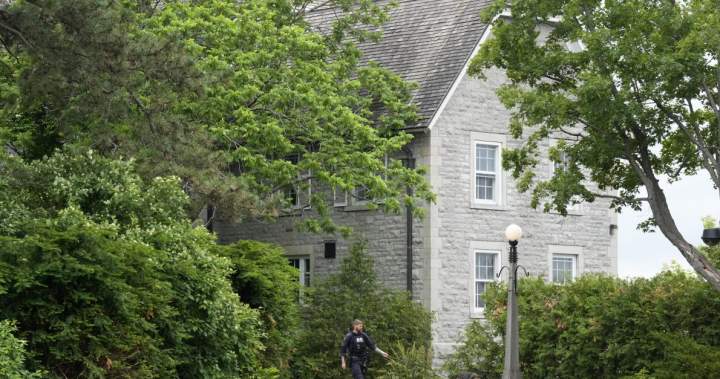
The planned restoration of 24 Sussex Drive has renewed the prospect that the derelict official residence of Canada’s prime ministers could become a building on par with those of other world leaders.
Prime Minister Mark Carney said at Friday’s announcement that 24 Sussex is a “symbol of the office” and must serve as a home and workspace for prime ministers. Carney said that while he will never live in the building, it should be repaired for prime ministers to come.
Official residences around the world have faced their own sagas of disrepair and renewal. Some, like a famous white building in Washington, are still evolving.
Here’s a look at how 24 Sussex compares to other official residences in the G7.
The National Capital Commission says the residence at 24 Sussex was built in 1868 but has only been used as the Canadian prime minister’s official residence since 1950, after its purchase by the federal government.
The 35-room main stone building is approximately 12,000 square feet in size and sits on 5.3 acres of land on the bank of the Ottawa River. The property also includes a smaller coach house, a pool house and two security guard kiosks.
The main house is divided into private quarters and a state area used for official functions hosted by the prime minister.
Former prime minister Justin Trudeau did not move into 24 Sussex when he was elected in 2015, though he did use the building for some social events during his tenure.
24 Sussex was listed as in “critical” condition by the NCC in 2021 and was closed the following year for “health and safety reasons” — including an infestation of rats.
Trudeau and his successors have instead lived in Rideau Cottage, a 22-room, 10,030 square foot brick house built in 1867 on the grounds of Rideau Hall, which is the Governor General’s official residence.
Carney said Friday that the winning design proposal for 24 Sussex from a national competition will be announced by Canada Day next year.
A fundraising campaign will be launched to raise all or most of the cost of the project. It will be managed by the Rideau Hall Foundation.
Carney declined to offer an estimate of how much the renovations will cost and said the budget is part of the competitive process.
Perhaps the most iconic official residence for a G7 world leader, the White House at 1600 Pennsylvania Ave. has served as the private home and workspace for the president of the United States since it was first opened in 1800, after eight years of construction.
The original building was famously burned by British forces from what was then Upper Canada in 1814, during the War of 1812. It was torn down and reconstructed, with then-president James Monroe taking residence in 1817.
Get daily National news
Get daily Canada news delivered to your inbox so you’ll never miss the day’s top stories.
Several of the most notable features of the modern-day White House — including the West Wing, the East Wing, the Rose Garden and the Oval Office — were added to the building over the ensuing decades.
The current structure is 55,000 square feet in size and contains 132 rooms, 35 bathrooms and six levels, according to the National Archives.
It sits within the 77-acre President’s Park, which also encompasses the Eisenhower Executive Office Building, the U.S. Treasury Building, Lafayette Square and the Ellipse.
Zillow estimated in 2017 that the estimated property value of the White House is about US$400 million.
In 2025, U.S. President Donald Trump approved the demolition of the East Wing, which is set to be replaced with a 90,000-square-foot ballroom, which remains under construction.
The British prime minister’s official residence and office is probably the only one in the G7 more famous for its front door than the overall structure, with the gold-plated “10” providing a backdrop for several key moments in U.K. political history.
The 342-year-old townhouse in the City of Westminster, London, was gifted by King George II to Robert Walpole, the first prime minister of Great Britain, who took residence in 1735.
Originally three houses, the structures were combined into a single interconnected property that houses 100 rooms that include private residencies, government offices, including the cabinet meeting room and dining and reception rooms for official events.
Although the offices at 10 Downing Street have been used by most prime ministers, not all of them have lived there, opting instead for their own homes as the building fell in and out of disrepair throughout the 18th, 19th and 20th centuries. Several refurbishment projects have been completed to preserve and modernize the building, with more planned for the future.
Since 1997, most prime ministers other than Rishi Sunak have opted to live in the larger flat above 11 Downing Street next door to No. 10.
The British real estate site Yopa says a “conservative” estimate for the property’s value, adjusted for inflation, is roughly 6 million pounds.
First built in 1929, the Japanese prime minister’s official residence is a two-story mansion whose design was inspired by renowned American architect Frank Lloyd Wright.
The 62,000-square-foot building sits in the Nagatachō district of Tokyo, close to the emperor’s Imperial Palace.
The combined residential and office facility became cramped by the 1990s, however, prompting the construction of an adjacent five-storey prime minister’s office building that opened in 2002 at a cost of 43.5 billion yen ($381.6 million).
The government says the new building, known locally as the Kantei, occupies 1.6 times the land area and is 2.5 times the floor area of the old residence.
The modern building houses government offices and cabinet meeting rooms, reception rooms where foreign leaders are welcomed and entertained and a national crisis management centre. It’s equipped with solar panels and a rainwater storage system.
The older building was retrofitted and underwent significant interior remodelling, and has served as the prime minister’s private residence since 2005.
There are rumours that the private residence is haunted as it was the site of two deadly coup attempts in 1932 and 1936, the first of which resulted in the assassination of then-prime minister Inukai Tsuyoshi.
The French president’s official residence and office was completed in 1722 as the home of Louis Henri de La Tour d’Auvergne, the governor of the capital region of Île-de-France. It was first given the name Hôtel d’Évreux.
After changing hands between a series of French elites, in 1848 it was decreed the residence of the first president of the French Republic, Louis-Napoleon Bonaparte, who lived there until a 1852 coup elevated him to emperor.
It has served as the head of state’s official residence since 1871, after the end of the Franco-Prussian war, with presidents adding modifications in the decades since. Not all presidents opted to live in the palace until the modern Fifth Republic began in 1958.
The palace’s interior is 120,300 square feet — 3,229 of which are private apartments — and sits on 3.7 acres of parkland, according to the French president’s office. The building contains 365 rooms on three floors.
The largest official residence in the G7 and the world, the sprawling Chancellery complex, or Bundeskanzleramt, is eight floors, more than 693,000 square feet in size and stands 118 feet tall — more than eight times the size of the White House.
It was completed in 2001 at a cost of roughly 238 million euros and replaces the previous Reich Chancellery building, used from 1878 to 1945, when it was seriously damaged during the Second World War and subsequently demolished by occupying Soviet forces.
The reunification of Germany in 1990 led to Berlin being chosen as the modern capital, sparking a design competition for new federal government buildings.
German political journalists and locals have come to refer to the Chancellery as the Waschmaschine, or “washing machine,” due to the building’s cube-like architecture and a large porthole-shaped window in the upper office of the chancellor.
The Bundeskanzleramt includes a pneumatic tube system for sending original and classified documents between offices.
An extension that will add hundreds of new offices, a daycare and a helipad is set to finish construction in 2027.
The Chigi Palace sits in the historic Piazza Colonna in the heart of Rome and is the oldest official residence in the G7, with construction taking place in the late 1500s. During its history, it has hosted royals and, in 1770, a concert by Wolfgang Amadeus Mozart.
The building wasn’t owned by the Italian state until 1916. Following the First World War, Benito Mussolini named the palace as the home of Italy’s foreign affairs minister.
In 1961, the palace became the official meeting place of the Council of Ministers — Italy’s cabinet body — and the prime minister’s residence.
The five-storey complex is roughly 28,800 square feet in size, according to an official appraisal from 1915 that set a sale price of 4 million lira, or $121,635 — $3.28 million today when adjusted for inflation.
Italy’s current Prime Minister Giorgia Meloni opted not to live in Chigi Palace, instead staying at her family’s suburban home in southern Rome.
Read the full article here
