

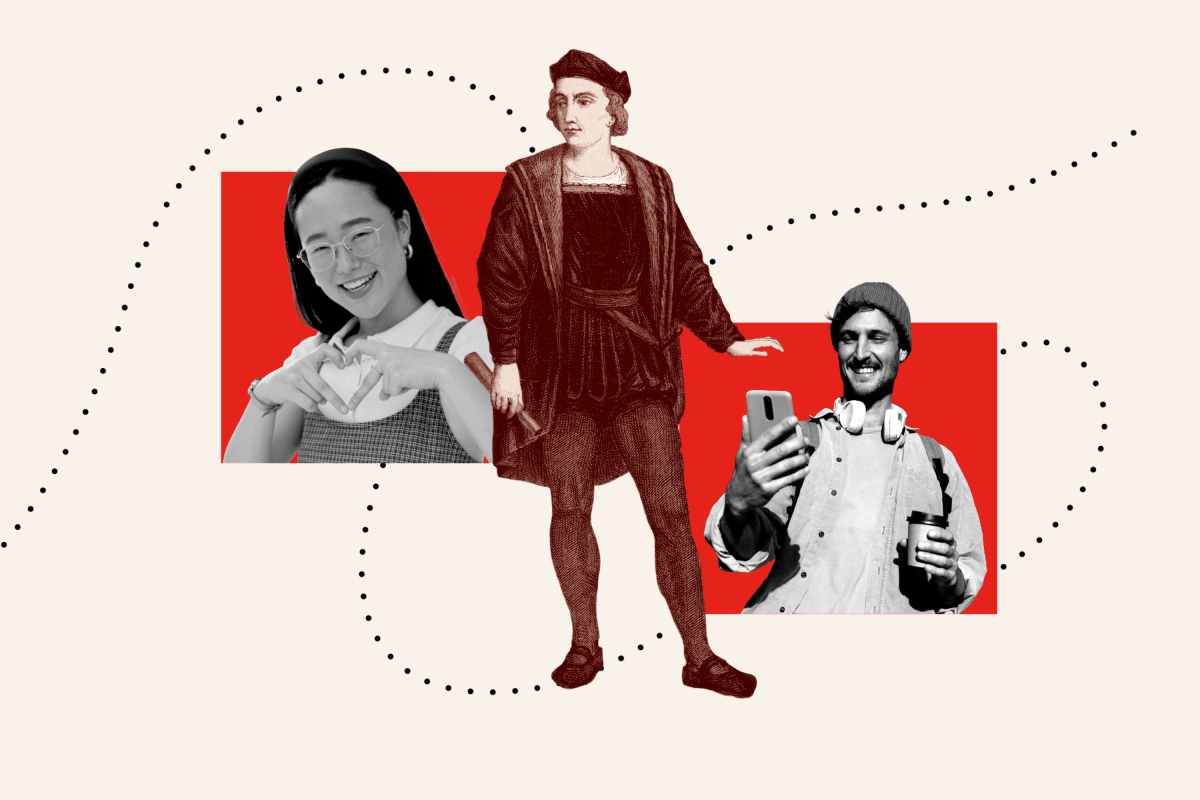
Quiet quitting. Silent walking. Rawdogging commutes. While you may not have heard these exact terms before, you definitely know the actions.
Slacking at work, going for a walk without any technology, or traveling without using your phone, reading a book or listening to music.
Some of the most everyday, mundane actions have been repackaged by Gen Z with a catchy title and presented via viral videos and posts as though they’re a brand-new thing.
And people are noticing.
Urban Dictionary describes the Columbus generation as the “official unofficial generation nickname for Gen Z,” using the example: “I just discovered Quiet Walks! It’s where you take a walk without your technology with you!”—otherwise known as “just walking.”
The name comes from explorer Christopher Columbus, known as the man who “discovered” America—leading to its European colonization—despite long-established communities and indigenous people already living there.
The terms “Christopher Columbus generation” and “Columbusing” have seen spikes in searches in the past year. Gen Z’s new nickname comes after a series of high-profile viral moments in which influencers and content creators appeared to have discovered something for the first time, not realizing that it has been around for years—and in some cases, decades.
Searches for “quiet quitting,” “silent walking” and “Coke float” experienced major spikes on Google Trends when the terms—even if not the actions—first entered the zeitgeist over the past few years.
In August 2022, “quiet quitting” had a 100 percent spike on search trends, with Coke float having the same spike in February 2026. The newest phenomenon, “Silent walking,” has been rising steadily over a number of years and had a 100 percent spike in March of this year.
But is the title of the Christopher Columbus generation fair? Is it even true? Experts are divided on the subject.
Why Gen Z Is Known as the ‘Christopher Columbus Generation’
In 2025, the internet became obsessed with “Coke floats,” by putting McDonald’s soft serve ice cream into Coca-Cola. This, of course, is just the ice cream float—invented in 1874 and long a staple at diners, with one online reaction at the time complaining: “TikTok has people putting McDonald’s ice cream into their Cokes and acting surprised that it’s delicious. Does Gen Z really think they invented the Coke float?”
Then there’s “quiet quitting”—the idea of doing the bare minimum at work without actually giving your notice, which sparked a major worldwide conversation about how to keep workers happier in a role. Of course, the idea of doing the bare minimum at work while looking for a new role has always been around, but without the Gen Z title.
Who of the older generations wasn’t shocked by the reaction to Sabrina Carpenter bringing out the pop icon Madonna at Coachella, only for some Gen Z commentators to confidently complain that they had never heard of her?
Blogger Blair Channing Rae shared a Threads post to her account @iwritergirl2.0, where she argued that the “‘who is Madonna?’ discourse” was more than a “generational gap—it’s an exposure gap that gets misread as a time gap.”
She argued that as a member of Gen X, she “didn’t live through the Etta James or Frank Sinatra era” but still knew of them “because genuine music lovers don’t just absorb what’s current. It’s one thing not to recognize someone immediately, it’s another to dismiss them as irrelevant simply because they predate your algorithm.”
Channing Rae told Newsweek that “the funniest thing about Gen Z isn’t what they don’t know. It’s the confidence with which they don’t know it.”
‘I’ve never heard of Madonna, so she must not matter’ is not a young person’s mistake. It’s a posture—one older than they are. What looks like ignorance is actually a claim: that significance begins at the moment of personal encounter, and that anything outside that encounter can be safely dismissed.”
And it’s not just iconic musicians, but slang, that some may consider internet speak.
“The words didn’t appear on TikTok,” Channing Rae said. “They’ve been alive in Black American speech for 30+ years, often longer—carried, shaped and spoken by people who were never credited and are still not being credited now.”
“To call that discovery is to perform the exact erasure the discovery depends on,” she said. “Gen Z believing that they discovered language is a generation that has never had to ask where language comes from.”
Yaron Litwin, a cultural expert and CMO of the Canopy Parental Control App, thinks the label is “funny, but a little bit unfair to Gen Z,” who are subject to mockery by both older and younger generations.
“Every generation is guilty of ‘rediscovering’ old trends and ideas, but it seems that Gen Z stands out as the first ones to instantly rebrand them en masse via social media,” Yaron told Newsweek. “Platforms have created endless pressure to turn normal life into content, and Gen Z will often give in to that pressure, creating an assembly line of new-old ideas like rawdogging and bare minimum Mondays.”
While Gen Z makes up 27 percent of the United States’ social media audience, compared to 36 percent millennials and 29 percent Generation X, according to data from Statista, the way Gen Z approaches and is influenced by social media is unique.
Andrew Selepak, a media professor at the University of Florida, points out that Gen Z is the first generation that is “both influenced by social media and more aware of the downside of social media and modern life.”
“We turned Gen Z into a petri dish of online activity with little understanding of the long-term consequences of spending so much time looking at a screen,” he said. “We all have a natural nostalgia with the past, even if we didn’t live it, because we are always told how much better things were in the past.
“We shouldn’t be surprised that Gen Z is rediscovering things from the past and making them their own, and maybe even better. They have more options to draw from and more information available to them than any generation in the past.”
As for whether it’s fair to call Gen Z the Christopher Columbus generation, he said: “They are less like Columbus discovering what already existed and more like Thomas Edison and taking what exists and improving upon it to make their lives better.”
Is Calling Gen Z the Christopher Columbus Generation Missing Major Point?
Calle Foster, a generational dynamics expert and leadership coach, mentioned a glaring point that people are missing when they refer to Gen Z as the Christopher Columbus generation: “[It’s] a strange choice, considering they’re the generation that’s done the most to challenge the false history that turned this colonizer into a hero.
“Gen Z activism was the driving pressure that led to Biden’s 2021 formal federal recognition of Indigenous Peoples’ Day, alongside Columbus Day,” she said. “So calling them Columbus to mock them is condescending and tone-deaf in a way that says far more about the people coining the label than the generation they’re trying to tear down.”
Indigenous Peoples’ Day has been celebrated for decades under various names, with Indigenous people advocating for an established day since the 1970s. Its purpose is the celebrate Native American history and culture while acknowledging the challenges the community continues to face.
In 2021, then-President Joe Biden issued the first presidential proclamation of Indigenous Peoples’ Day, after indigenous communities’ advocacy became amplified thanks in part to social media.
As Foster put it: “The ‘Christopher Columbus generation’ label is less of a clever critique and more of a generation older than Gen Z punching down, using the name of a colonizer to do it, and missing the irony entirely.”
Has Every Generation Done This?
Experts agree that every generation has rebranded or reimagined things from generations before. Selepak pointing out millennials’ love of vinyl and bellbottoms, and Foster pointing out that “boomers rebranded bohemianism as counterculture, Gen X rebranded loner youth as slacker culture, [and] millennials rebranded basic life skills as ‘adulting.’”
Gen Z, Foster said, “is doing the exact same thing every generation has done. The difference is that social media amplifies it faster so it feels more apparent. It isn’t new behavior.”
Consumer insights expert and the founder of Front Row Insights, Jayne Charneski, also points out that “millennials did this constantly.”
“’Life hacks’ were often just commonsense behaviors repackaged for the internet, the ‘side hustle’ just reframed second jobs as identity and ambition, and ‘self-care’ turned basic well-being practices into a defined lifestyle category,” she said.
“Gen X did it too—they had ‘slackers’ who were disengaged and underperforming at work—today’s quiet quitters.”
As she put it: “Every generation ‘Columbus-es’ culture—it just used to happen slowly through magazines and movies and subcultures and word of mouth, and now it happens at scale on social media in real time.”
How Does Gen Z Get Their Information?
Gen Z—not unlike other generations—are major consumers of social media, with YouTube being the biggest hitter for 18- to 24-year-olds, at 96 percent, according to 2023 data from Statista.
TikTok was second, at 72 percent, and Instagram was next at 69 percent, followed by Snapchat at 56 percent and Reddit at 55 percent. While TikTok usage was high among Gen Z, only 50 percent of the general population reported using it.
The younger the generation, the higher the TikTok usage. According to the Pew Research Center, 95 percent of Americans age 13 to 17 reported using the app.
And, according to Business of Apps, Gen Z spends an average of four hours a day on different apps.
The way Gen Z gets their information is different from other generations. According to a report published on ResearchGate, Generation X still gets most its information from traditional media, while Gen Z gets theirs mostly from satire sites and apps.
Although it also said that Gen Z was found to be better able to spot fake news than other generations. While they may be able to suss out what’s fake, that doesn’t seem to extend to old—so here’s to the next 2026 trend Gen Z repackage as new.
Read the full article here
