

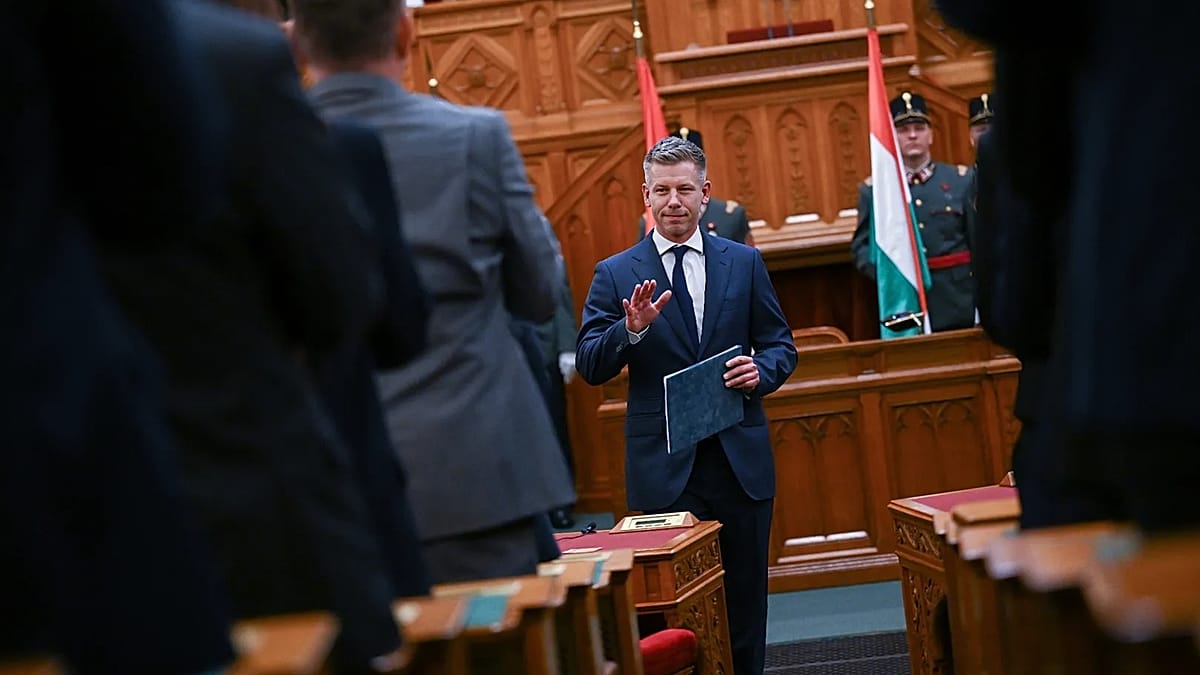
Hungary’s government has ended the country’s state of emergency in a move that new Prime Minister Péter Magyar said represented a return to “normality.”
“As of today, after four years, the wartime state of emergency in Hungary is ending, and with it we are also putting an end to the decree-based emergency rule introduced by the Orbán government six years ago,” Magyar said in a post on X.
The emergency governance framework was first introduced by the government of previous Prime Minister Viktor Orbán in 2020 as part of measures in response to the COVID-19 pandemic.
It was later extended in 2022 after Russia’s full-scale invasion of Ukraine, with Orbán citing security and humanitarian risks stemming from the conflict.
The state of emergency gave the government the power to rule by decree which the European Parliament said at the time was “totally incompatible with European values.”
Russian ambassador summoned
Meanwhile, Hungary summoned the Russian ambassador on Thursday over a massive drone attack near the border with Ukraine, marking a stark shift of tone by Magyar towards Moscow after years of cozy relations with the Kremlin under Orbán.
The ambassador, Evgeny Stanislavov, is expected at arrive at the foreign ministry around noon to speak with Hungarian Foreign Minister Anita Orbán about strikes that hit the Ukrainian region of Transcarpathia on Wednesday. The region is home to a sizeable Hungarian minority.
“The Hungarian government strongly condemns the Russian attack on Transcarpathia,” Magyar said during a press conference in Ópusztaszer on Wednesday when he announced the summons.
“She will tell him the same and ask for information on when Russia and Vladimir Putin plan to finally end this bloody war that began more than four years ago,” the prime minister added.
The Russian government has not made any public statements on the summons.
Russia fired at least 800 drones in a massive daytime barrage on Wednesday targeting about 20 regions of Ukraine including Transcarpathia, Ukrainian President Volodymyr Zelenskyy said.
It killed at least six people and wounded dozens, including children. Lasting hours, it was one of the longest-lasting attacks by Moscow in the war.
Zelenskyy called the summons in Budapest an “important message” and thanked Magyar for his comments.
“Moscow has once again shown itself to be a common threat not only to Ukraine, but also to neighbouring countries and Europe as a whole,” Zelenskyy said on social media.
Additional sources • AP
Read the full article here
