

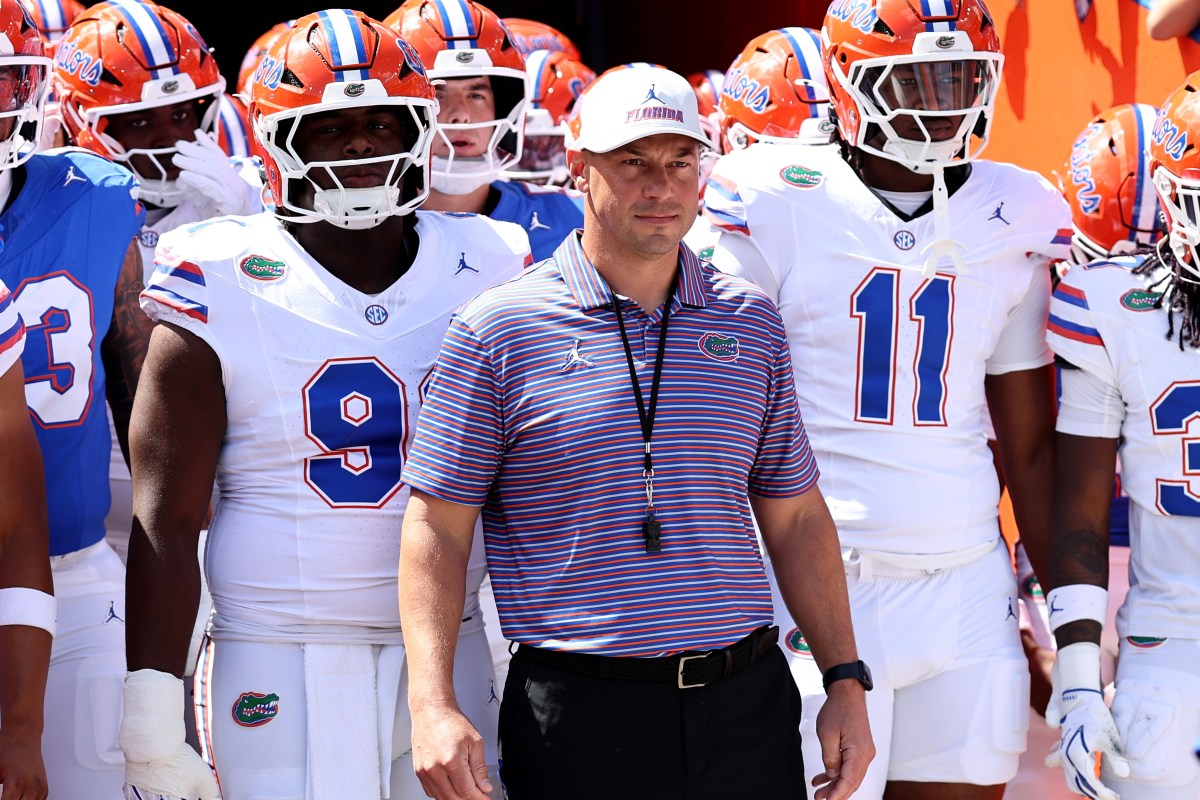
When the Florida Gators hired Jon Sumrall, it was one of the biggest splashes in college football.
Florida was bringing in one of the fastest-rising coaches in the sport, a program-builder who had developed a reputation for toughness, recruiting energy, and modern roster management.
After years of disappointing results and mounting pressure in the SEC arms race, the Gators wanted a reset that felt aggressive, ambitious, and built around winning national titles.
That is why Sumrall’s latest comments are so jarring.
According to On3’s Keith Niebuhr on Thursday, Sumrall openly acknowledged Florida is lagging behind the sport’s financial heavyweights in NIL and revenue-sharing support.
“I think there are certain teams that are, I would say, $15 million above us at minimum in college football right now and in our conference. For us to have championship expectations and standards year in and year out, we’ve got to make sure we’re pushing the envelope to get resources like that,” Sumrall said.
Sumrall made it clear that the solution, in his eyes, is to invest more.
“The more you’re investing in our program, the more access I’ll give you,” he added.
More news: Paul Finebaum Slams CFP Expansion, Warns It Could ‘Destroy’ College Football
Florida is not some rebuilding Group of Five program trying to scrape together boosters. This is one of the sport’s historic brands that dominated across multiple eras behind legendary names like Steve Spurrier, Urban Meyer, and Tim Tebow.
Florida had every built-in advantage imaginable, from elite recruiting territory and massive fan support to SEC television money and one of the most recognizable brands in college athletics.
The Gators have won national championships in 1996, 2006, and 2008, and have long operated as a top-tier athletic department overall.
But college football in 2026 is no longer won by tradition alone.
Programs like Texas, Miami, Ohio State, LSU, and Oregon have turned NIL into an arms race, pouring massive resources into collectives, donor networks, and revenue-sharing structures.
According to Front Office Sports, each of those programs invested more than $40 million into their 2026 rosters, with Texas leading the pack at an eye-popping $47.9 million.
Florida was nowhere near that tier.
The Gators failed to place inside the top 10, finishing behind programs like Notre Dame, Texas A&M, Alabama, Tennessee, and even Texas Tech.
A decade ago, Florida could lean on history, facilities, and “The Swamp” to bring in top recruits.
Now, they want to know the revenue-share numbers before they want to know the playbook.
Sumrall believes the Gators are falling behind financially and that it’s hurting Florida’s ability to compete with the sport’s elite.
More news: Bill Belichick Jokes NFL Should Rename Lombardi Trophy After Tom Brady
More news: Brenden Rice, Son of Jerry Rice, Signs with Packers, Lands on 5th Team in 2 Years
College football is drifting toward an uncomfortable truth: blue-blood status means less than collective spending power.
Indiana winning this past season proved that coaching and culture still matter, but the broader trend is undeniable.
The richest programs are building deeper rosters, navigating transfer portal chaos more effectively, and stockpiling elite talent at a level few schools can realistically match.
And Sumrall, barely into the job, just publicly challenged Florida to keep up.
Read the full article here
