

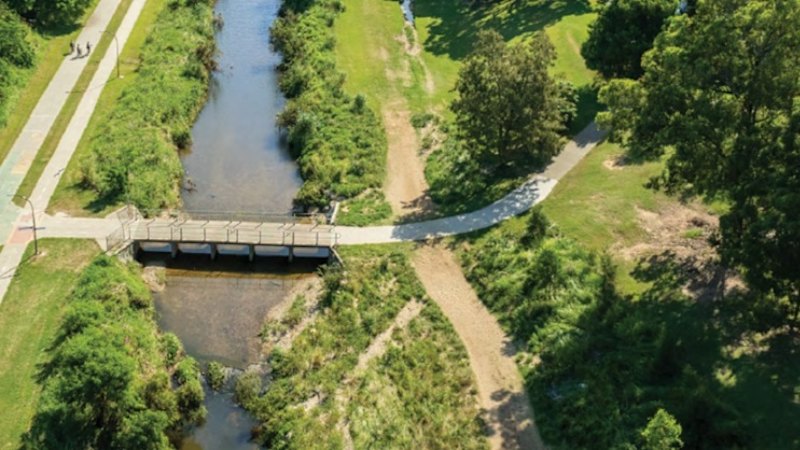
For every kilogram of sediment in two Brisbane creeks, there are more than 4000 tiny pieces of potentially harmful plastic, a new study has found.
Queensland University of Technology researchers dredged sludge from Kedron Brook, Enoggera and Bulimba creeks four times over a year in 2024, with roughly 4400 plastic particles found in one kilogram of Kedron Brook’s sediment.
Approximately 4100 particles were found in the same amount of Bulimba Creek’s mud, while Enoggera was the cleanest of the three, with 2800 pieces of plastic per kilogram.
Microplastics are ubiquitous and can be found in water, earth and in the air. As a result, the broken down plastics have been discovered in every human tissue type, and while the health threats are not fully understood, it has been linked to colon and lung cancer.
PhD candidate Heshani Mudalige said the amount of plastics found in the three Brisbane creeks depended on the gradient, the seasons, and where the creek flowed.
“Kedron Brook’s microplastic load is strongly influenced by its running through commercial and industrial areas, including the Brisbane Airport precinct,” she said, noting that the creek’s highest load was in March following heavy summer rains.
Mudalige said impervious areas in the Kedron catchment likely brought more microplastics into the creek.
She said Enoggera likely had the lowest load because the creek’s flow was regulated by the dam.
Mudalige said 2021 research on the Brisbane River had found about 500 items of plastic per kilo of sediment.
She said it was the first time Kedron Brook sediment had been tested for microplastics.
Associate Professor Prasanna Egodawatta said the study would fuel future research into how microplastics moved through Brisbane’s urban water systems.
“This study is a first step towards quantifying land-based microplastic inputs to Moreton Bay via the stormwater pathway,” Egodawatta said.
While the three creeks do not flow into water treatment plants that could lead to human consumption, Mudalige said the plastics could still pose a danger if they reached the sea.
The findings of the QUT research were published in the journal Environmental Pollution.
Mudalige is also working on tracking the amount of PFAS “forever chemicals” and heavy metals in the three creeks, with papers to be published in the near future.
Start the day with a summary of the day’s most important and interesting stories, analysis and insights. Sign up for our Morning Edition newsletter.
From our partners
Read the full article here
