

For Larry Warsh, collecting started early, but his latest project returns to a more specific obsession: Keith Haring’s ability to turn line, object and public space into a shared language.
As co-editor of Keith Haring in 3D, an art book published to accompany the major exhibition at Crystal Bridges Museum of American Art, Warsh argues that one of the most recognizable artists of the 20th century is still not fully understood.
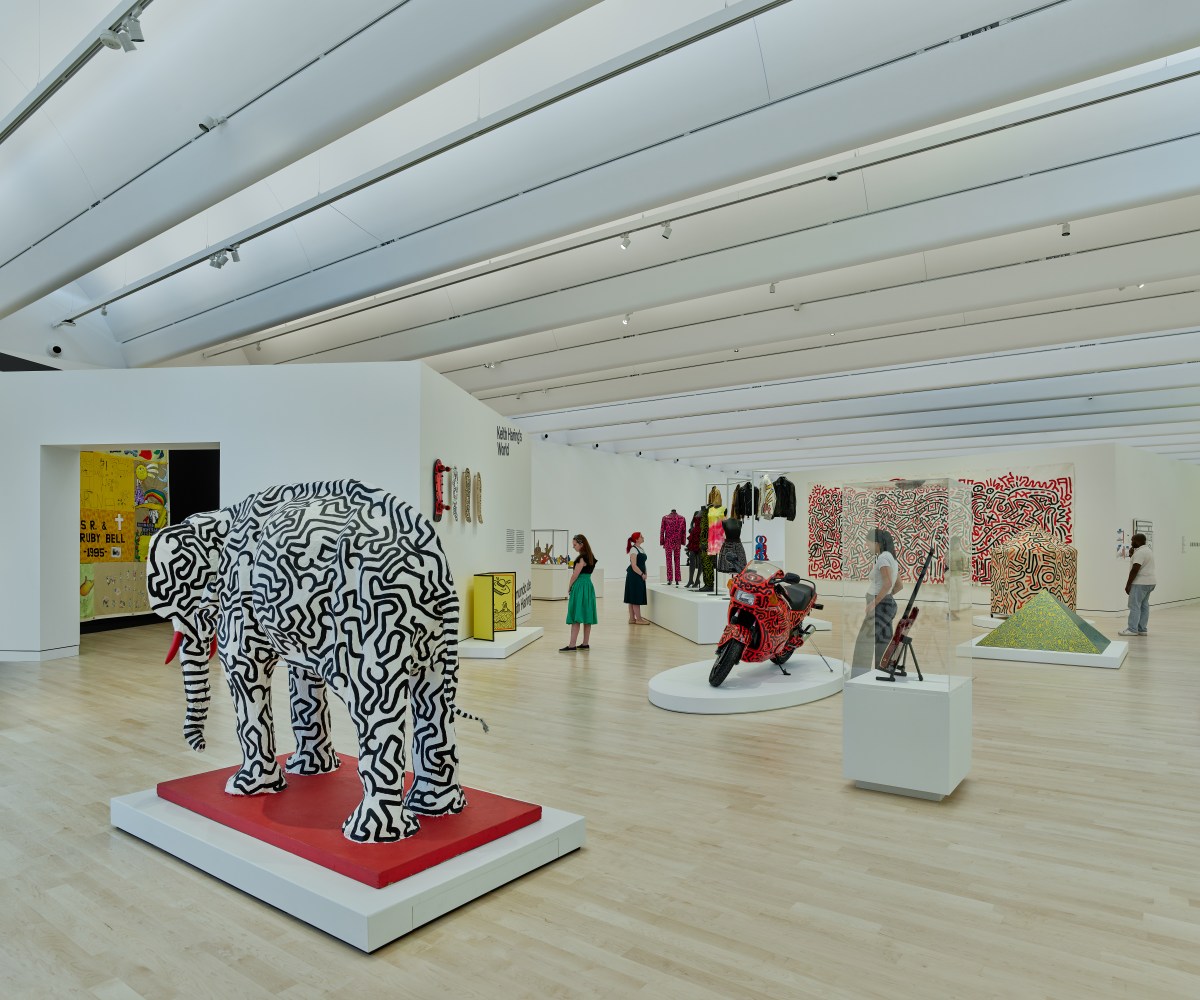
The Bentonville, Arkansas, show—running from June 6, 2026, to January 25, 2027—is the first major exhibition devoted to Haring’s three-dimensional work, bringing together sculptures, totems, masks, painted objects, clothing, boomboxes and even a 1963 Buick Special to show how far his practice extended beyond the picture plane.
Finding a Way Into Art
Warsh describes his early relationship to art in simple, tactile terms.
“I always loved art,” he says, recalling a family environment filled with objects made to be looked at closely. One uncle, in particular, widened the frame.
“He took me to galleries and auction houses when I was around 12,” Warsh says, and those visits revealed how objects could hold “history, taste, and energy.”
His collecting life began long before the downtown scene came into focus.
“I began collecting all kinds of things—antiques, silver, baseball cards,” he says, describing a habit of looking that never left him.
Moving near Astor Place changed the scale of that interest. In early 1980s New York, he found himself close to the artists and clubs that would define a period, including Keith Haring, Jean-Michel Basquiat and Kenny Scharf.
For Warsh, that proximity now helps explain why Crystal Bridges’ exhibition matters: it places Haring’s object-based work back inside the downtown networks that shaped it, rather than treating sculpture as a side note to the better-known paintings and subway drawings.
“Collecting, for me, has always involved instinct,” Warsh says. “You look ahead, you take risks, and you trust a feeling.” In Haring’s work, he felt “a force in the work and in the moment around it,” a charge tied to the artist and to the city forming around him.
The Downtown Triangle
The scene Warsh remembers was communal and electric.
Haring, Basquiat, and Scharf were linked through friendship, proximity, and a wider downtown ecosystem where clubs, studios, sidewalks, and galleries fed one another.
“It was a time, a place, and a collective spark,” Warsh recollects. The famed collector still speaks of its texture with clarity, naming spaces such as Fun Gallery and figures such as Patti Astor, who helped convert raw energy into momentum.
Many others moved through the same orbit. Warsh points to Futura, Rammellzee, Tseng Kwong Chi and Rene Ricard as part of a living network whose experimentation helped define the cultural identity of downtown New York. “There was a whole community,” he says, and Haring belonged fully to it.
Art for Everyone
For Warsh, one of Haring’s lasting achievements was understanding scale—not just visually but socially.
“Keith understood audiences in a very direct way,” he says of Haring’s widespread appeal. Haring wanted to make images and objects that people could encounter in motion, in shops, in the street, and in daily life.
The Pop Shop, which opened in 1986 at 292 Lafayette Street, extended the logic of the subway drawings into retail without abandoning the artist’s public mission.
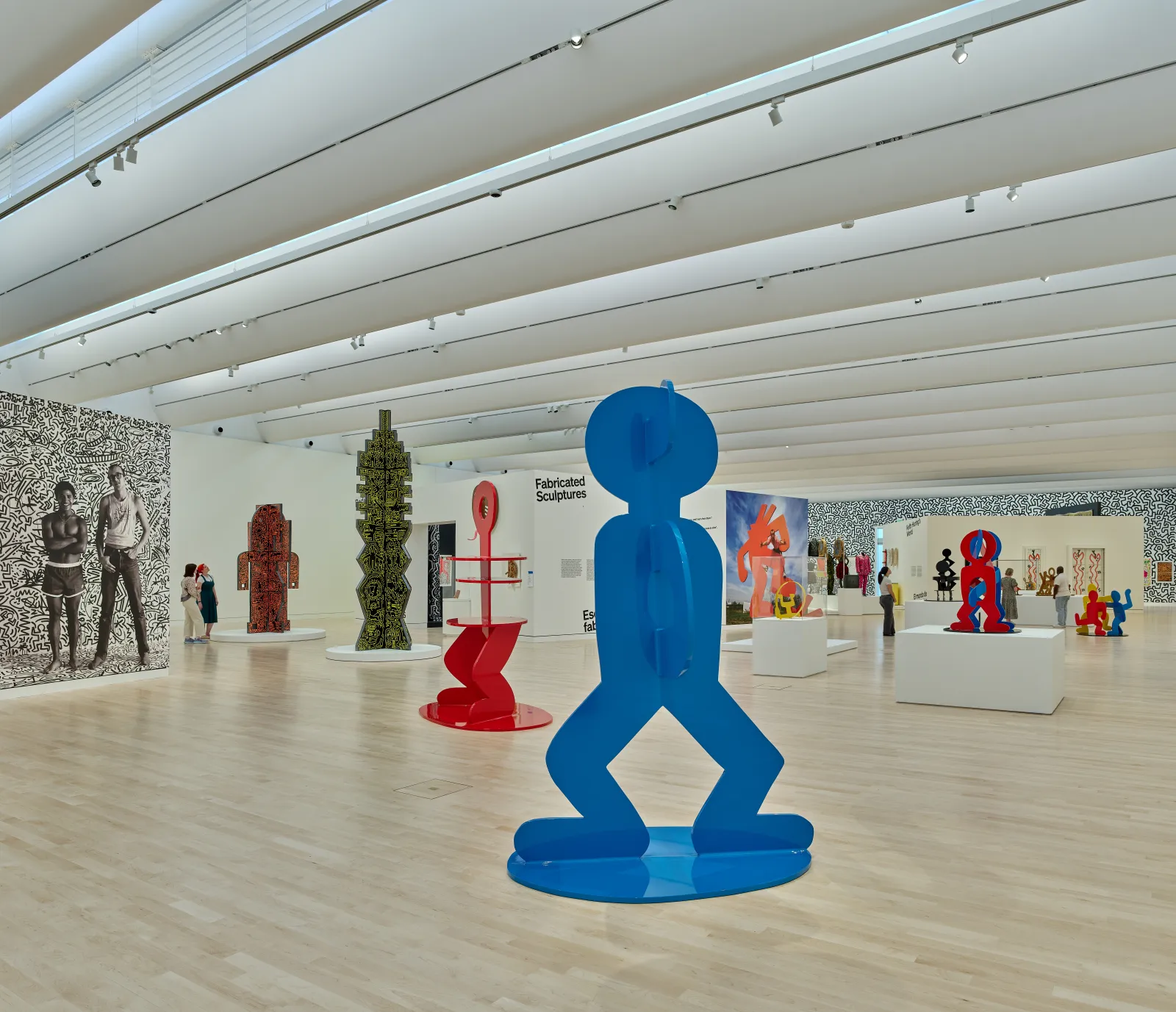
That same idea runs through the Crystal Bridges exhibition, which emphasizes how Haring translated his graphic language into things viewers could move around, through and, at times, feel physically addressed by.
Haring’s relationship to commerce, in Warsh’s view, belongs to a larger lineage. He notes artists such as Andy Warhol and Salvador Dalí as earlier figures who understood how art could move through public culture without losing force.
“He wanted his images out in the world,” Warsh says. “He wanted everyday objects to carry his vocabulary.” Haring’s own words echo the same philosophy: “The Pop Shop makes my work accessible. It’s about participation on a big level.”
Warsh also sees stewardship as central to Haring’s continued presence. Museums remain vital, though books, products, and public-facing collaborations have carried the work to audiences whose first encounter may happen far from an institution. Haring himself insisted on art as communication, writing, “The use of commercial projects has enabled me to reach millions of people.”
When Warsh talks about Haring’s found-object works—painted refrigerators, doors, windows and shelves—he returns to practicality as much as experimentation.
“Keith began by painting on what was around him,” he says. Canvas was not always the point, or even available. What resulted was a body of work that now looks central to understanding Haring’s three-dimensional thinking.
Crystal Bridges builds that case by showing how ordinary materials became sculptural surfaces, and how Haring’s line could adapt to bulk, weight and inhabitable form without losing speed or wit.
He sees those works as evidence of an artist who did not separate medium from momentum.
“He was making work because he was inspired,” Warsh says, “because he saw possibility in the materials around him, and because every object could become a surface for invention.”
That idea is central to the Bentonville presentation, which brings together sculptures, painted appliances, masks, totems, skateboards and a Haring-painted motorcycle to argue that three-dimensional work was not peripheral to his practice. It was one of the clearest expressions of it.
Generosity as Legacy
Generosity, in Warsh’s telling, belongs near the center of any account of Haring. Many works in exhibitions came from friends because Haring gave them away.
His foundation later extended the same spirit through support for organizations engaged in AIDS care and children’s education. Warsh remembers an artist deeply involved with people, someone who painted in hospitals, donated work to benefit auctions, and moved through the world with unusual openness. “He was an extraordinarily giving person,” he says.
“When people talk about Keith Haring’s legacy,” Warsh says, “generosity belongs at the center of the conversation.” But the Crystal Bridges exhibition also presses a broader point.
By focusing on sculpture and objects—works long overshadowed by murals, prints and paintings—it argues for a fuller view of Haring as an artist who thought in space as instinctively as he thought in line.
For Warsh, that is the real payoff of Keith Haring in 3D: not simply recovering overlooked works, but showing that Haring’s vision was always bigger, stranger and more physically expansive than the standard version of his story suggests.
Read the full article here
