

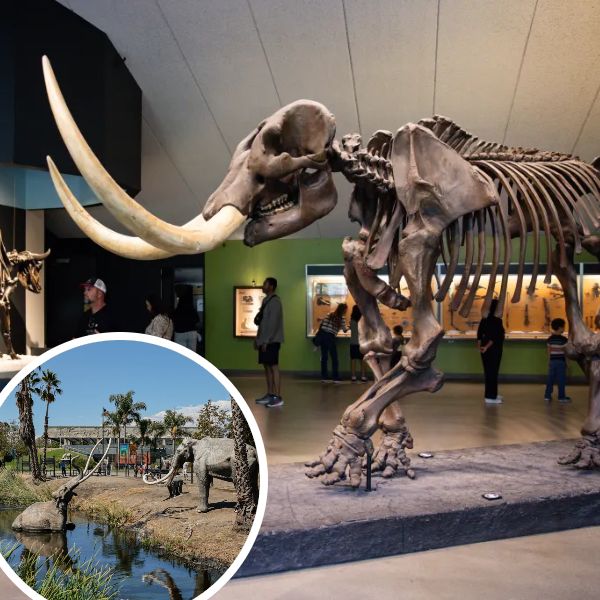
LA’s one-of-a-kind landmark may be focused on the Ice Age, but the prehistoric relic needs an update.
La Brea Tar Pits, an active paleontological research site in Hancock Park, Los Angeles where discoveries are made daily, is undergoing a two-year transformation. The Ice Age Fossil Site digs fossils in the heart of L.A. for visitors to watch.
The $240 million renovation will modernize the museum, which opened in 1977, with new exhibition galleries, visible research laboratories, expanded collections storage, a theater and a rooftop terrace overlooking the tar pits and surrounding park.
But locals aren’t all happy.
“Yes, the museum needs a facelift. But it doesn’t need a three year overhaul. They’re just going to screw it up and make it full of video screens and take away all of the charm that everyone loves about the museum. I really hope they don’t take away the hill,” a user on social media complained.
The beloved landmark at Hancock Park was originally formed around a group of tar pits, where natural asphalt seeped up from the ground for tens of thousands of years. Over many centuries, the bones of trapped animals have been preserved.
The site serves as a working paleontological research center and exhibition space. It documents the Ice Age by housing and studying over two million specimens of extinct plants and animals, including mammoths, saber-toothed cats and dire wolves.
The museum does active digging and excavations where visitors can watch paleontologists uncover prehistoric fossils in real time. It operates a visible fossil lab where scientists clean, study and catalog the bones found.
There are thousands of Ice Age fossils and skeletons to analyze. This is not merely an exhibit for visitors, but serves as a global hub for research, where scientists can study ancient ecosystems.
The revamp is scheduled to be completed just in time for the 2028 Olympic games. Multiple L.A. institutions like the Los Angles County Museum of Art and the California Science Center will undergo revamps.
The museum’s makeover is part of the Natural History Museums’ of Los Angles broader Reimagine project, which is aiming to reenergize L.A. cultural institutions before the Olympics.
There will be more visible research labs and collection displays, plus an immersive theater and a rooftop terrace with views of Hancock Park.
During the museum closure, portions of Hancock Park will stay open so visitors can still watch researchers make live fossil discoveries. Exhibitions, museum ticketed experiences and public admission will be temporarily paused.
The two-year transformation is to make more room for the findings, as massive mammoths and millions of microfossils need more space nearly 50 years after the museum’s opening.
The new spaces will also reportedly support more sustainable infrastructure and improve community access to the world’s windows into the Ice Age. There will be a new research space, updated exhibitions and expanded environments .
One new addition will be the Samuel Oschin Global Center for Ice Age Research, which will study how ancient ecosystems responded to climate change and extinction, looking at these topics in a present-day context.
While Los Angeles residents appreciate the renovations, many on social media have questioned why the improvements weren’t made sooner, independent of the upcoming Olympic Games.
“Couldn’t have done this sooner for the locals, children, academics and Americans. Gotta wait to have nice things in our communities until guests come I guess,” commented one user on the LA Times Instagram.
And others are skeptical of renovations ruining the museum, with fears of overmodernization and it becoming highly infiltrated with technology.
President and Director of the National History Museums of Los Angles County, Lori Bettison – Varga, said the main goal of the renovation continues to be to “preserve the fossils in our care” in a statement to the L.A. Times.
Read the full article here
