

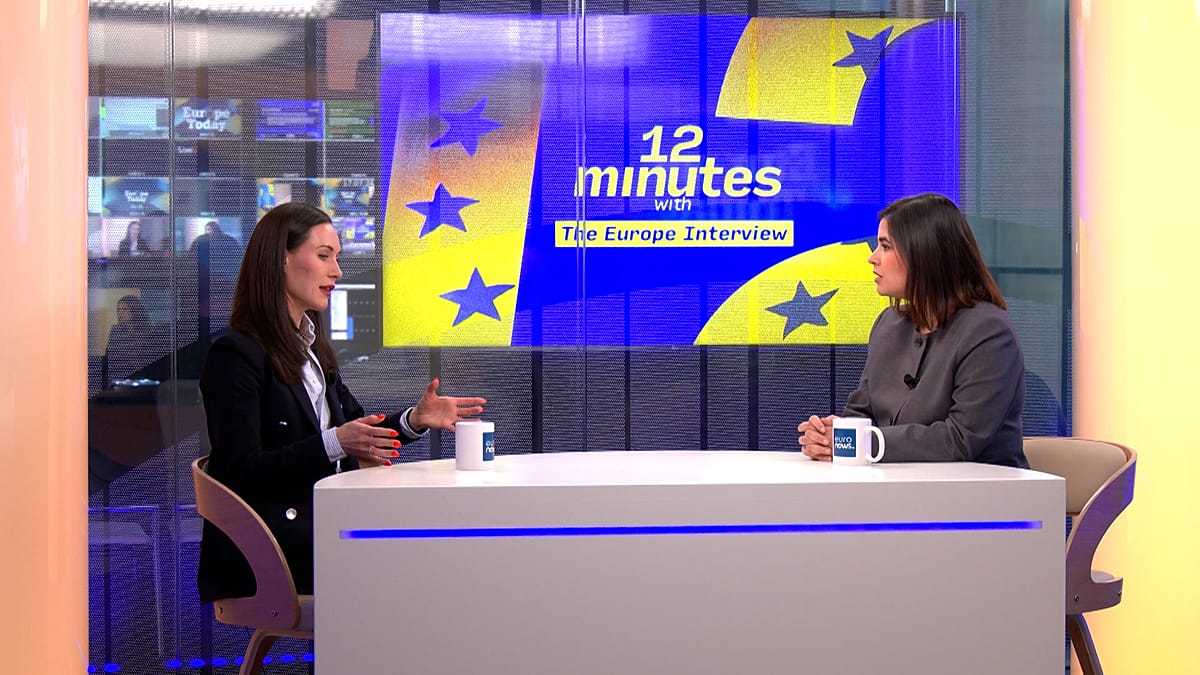
Former Finnish Prime Minister Sanna Marin told Euronews that the European Union must recognise that it needs Ukraine and the lessons it has learnt from the war waged against it by Russia for its own defence.
She argued that, if it does not take note of Ukraine’s expertise, the EU’s increased spending on defence will be money down the drain.
“When we are building our own defence capabilities and hopefully reaching that 5% target that we have set together in NATO, it also and actually even more so, depends on where we use that money, not only how much [money we invest], but where we use it, she said on Euronews’ interview programme 12 Minutes With.
“If we use it in the wrong way, with old-fashioned, traditional models that cost a huge amount of money and not the ones that are actually used on the battlefield, then we will just waste every euro that we spend,” she added.
Last summer, NATO members confirmed their commitment to spend 5% of their GDP on defence by 2035, more than double the current target of 2%.
The EU is also upping investment, including through its Security Action for Europe (SAFE) programme, a €150 billion loan instrument designed to boost defence production and industrial capacity.
Marin welcomed these moves but stressed that this increased spending will require on-the-ground expertise, which she argued only Ukraine can provide.
“Ukraine has the largest, most functional and modern army with modern warfare experience, and without Ukraine, we are vulnerable,” she told Euronews’ Europe Editor Maria Tadeo.
She added that the EU “needs to understand that we are as dependent on Ukraine and Ukrainian capabilities as Ukraine is dependent on our help. We need to understand how badly we need them.”
Russian threats and changing warfare
According to Marin, this type of enhanced readiness is needed as she “cannot rule out” the possibility that Russia, which she called an “enemy”, is “preparing for war with Europe.”
“We as Europe, we are in jeopardy because Russia is, as we speak, preparing itself. It is modernising its army and preparing itself for much wider fights,” said Marin, who now works as an adviser for NGO the Tony Blair Institute for Global Change.
Last year, German defence chief General Carsten Breuer said Russia may attack NATO in the next four years. Swedish Chief of Defence Michael Claesson said at the end of last year that Russia is likely to test NATO’s collective defence pledge — dictating that an attack against one member is an attack against all — very soon.
Ukraine’s recent attacks on Russian oil and gas infrastructure last week prompted Moscow to issue a warning to European countries and industries against funding Kyiv’s long-range drone production.
The Kremlin warned that “the moves of European leaders are increasingly dragging these countries into the war with Russia”.
Additionally, Marin noted that changing warfare, including through drones, cyberthreats and AI to map out critical infrastructure, highlighted the urgency of receiving technical support from Ukraine.
“We need their capabilities when it comes, for example, to building drones, innovating and transforming military capabilities,” she said.
The use of these new technologies underlined the fact that the threats posed by Russia are no longer limited by geography or to NATO’s eastern flank alone.
A report by the International Centre for Countre-Terrorism (ICCT) published earlier this year found that Russia has planned or carried out at least 151 hostile operations in Europe — including in Belgium, the Netherlands and Denmark — since invading Ukraine in February 2022. This includes drone activity, airspace violations and cyberattacks.
“We know the pressure, because we are near Russia, but you need to also understand in Portugal, in Spain, in France, that you’re not safe even though you’re further away from the border, because of the new threats and because of these new technologies,” Marin said.
“You can plant drones anywhere. You can map out critical infrastructure with AI at a speed that you don’t even understand. So you also need to be prepared elsewhere and not fool yourself that you are safe.”
‘Focus on our own game’
Asked whether she is concerned about US President Donald Trump’s comments on NATO, including calling it a “useless, paper tiger”, Marin said she continues to support Finland’s decision to join in 2023.
“At the same time, we have to understand and realise that NATO is a different organisation now than it was when we [Finland] and Sweden joined because of the changing relationship between the US and Europe,” she said.
“It has already changed, and this is a fact that we cannot escape. And it means that we need to focus on our own game,” Marin said, adding that Europe can no longer rely on US presence and capabilities.
She argued that Europe must also hold more discussions on its own nuclear deterrence. France is the European Union’s only nuclear power, yet Europe has usually relied on the American nuclear umbrella as the ultimate security guarantee.
But France has floated the idea of other European countries playing a bigger role in deterrence. This week, French and Polish leaders discussed holding joint exercises.
“I would be prepared for different scenarios. When it comes to the relationship between the US and Europe, we cannot only walk the path that we wish to be on, we have to walk the path that we might end up on,” she said.
Marin emphasised that she wants the US to be a key player in NATO. “We want a US presence in Europe, we want US nuclear deterrence to be there also in the future. I don’t see these as ruling each other out, but we need to prepare for every scenario.”
Read the full article here
