

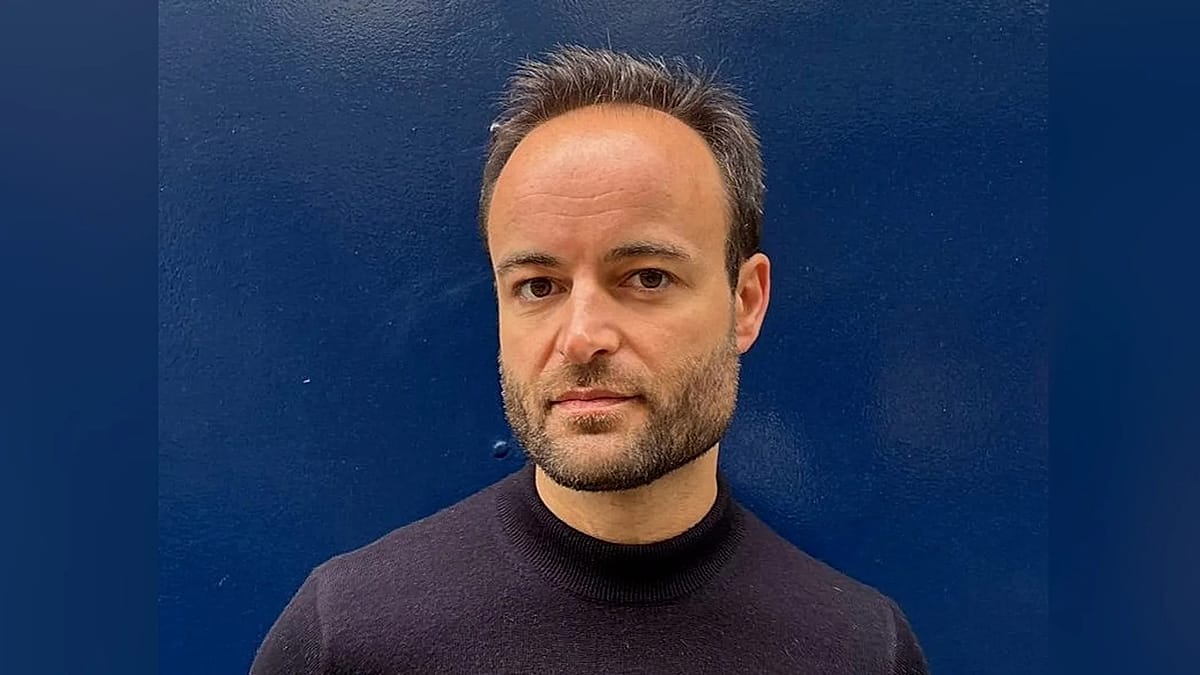
Frenchman Louis Arnaud spent two years behind bars inside Tehran’s Evin prison, a place notorious for torture and executions, following his arrest by Iran’s Islamic Revolutionary Guards (IRGC) on 28 September 2022.
Recounting his experiences in an interview with Euronews, he remembered a place he described as “the den of evil,” stressing the exceptionally inhumane conditions inside section 209, the block which houses political and foreign prisoners.
Aged 35 at the time of his incarceration, Arnaud’s round-the-world trip was cut short when he was accused of taking part in the mass protests that broke out against the death of Mahsa Amini, a 22-year-old Kurdish-Iranian woman who died in police custody, after being arrested for allegedly wearing her hijab improperly.
Arnaud has always maintained his innocence.
The memories of Evin prison continue to haunt Arnaud, as he recalls a place where captives are crammed into windowless cells and where the lights never go out.
“The lights dissolve any notion of time passing; they constantly search your body. In your cell, there’s nothing; it’s devoid of everything. You eat, you live, you sleep on the floor. They took us out for a walk like animals once a week, blindfolded, to get 20 minutes of fresh air and that’s it,” Arnaud told Euronews.
A torture designed to intensify psychological pressure on detainees, “all this dehumanisation and extreme pressure in prison never stopped, even when you were asleep. The goal was to force out fantasy espionage confessions.”
Although Louis Arnaud pleaded his innocence to Iranian judges, it was to no avail. It was a similar story for Cécile Kohler and Jacques Paris: the last French hostages officially held by the Iranian regime, who returned to France on 8 April after several months of house arrest at the French embassy in Tehran.
Although Arnaud, Kohler and Paris were all incarcerated in the same prison, they never crossed paths, except for one indirect encounter.
“We would only receive news when a new inmate arrived from outside or another changed cells. But on my last night in prison, I was thrown into a cell I’d never seen before, where I found a poem [by French poet Gérard Nerval] inscribed on the wall. I knew straight away that Cécile, who has a degree in literature, had written it,” Arnaud explained.
“I told myself that she had to save herself through literature and poetry. It was a particularly powerful moment because as I caressed the poem, it was as if she had left it there for a gate to open. It was as if I was with her at that moment.”
Protest movement inside Evin
The death of Mahsa Amini in September 2022 sparked mass protests across Iran, with word of possible regime change making its way inside the country’s prisons.
“At first, the sentiment was ‘let’s protest, although we know it won’t achieve anything, we’ll lose anyway.’ Then there was this change of perspective, where people were saying, ‘It is actually possible, we can achieve a revolution, and we must have one,'” explained Arnaud.
In January 2026, protests again shook Iran, fuelled by anger at the country’s authoritarian government and the spiralling economic crisis.
However, the movement was subject to intense repression by the regime, with security forces killing thousands and arresting at least 50,000 people across the country, according to human rights organisations.
“The revolution of 2022 failed and in January 2026, Iranians attempted to stage one again” said Arnaud. “In any case, Evin remains not just a prison, but also a bastion of resistance.”
Internal resistance
In his book “La Résistance Intérieure,” Arnaud details how the relationships he built with other detainees shaped his spirit of resistance.
“I met a prisoner who had been part of the 1979 revolution, who had already been arrested, tortured and spent several years in prison,” he said.
“He is a man who, even today, is regularly arrested and told he will be killed. Yet in prison, he was always smiling. It was as if everything slipped through his fingers, as if death threats had no hold on him.”
This encounter led Arnaud to change his behaviour in prison. “I realised I was obedient, lowered my eyes and begged to call my family. But then I understood even when you are in chains, even in the worst prison in the world, it’s still possible to refuse servitude, to refuse to be the victim that they want to impose on us. You don’t have to be a victim in life.”
According to Arnaud, it was this paradigm shift which allowed him to survive his time behind bars, triggering the “inner revolution” that he details in his book.
“You don’t have to have been taken hostage to know about injustice, to know the feeling of having to endure things in your life. I aim to speak out for Iranians, to help them, but also to face up to the trials and challenges of everyday life, to live life more serenely.”
Despite a tentative ceasefire in place between the US, Israel and Iran, the Frenchman has struggled to stay in touch with other former inmates over the course of the conflict.
“There’s a bit of Internet access, but it’s very difficult to access the news. The Internet is heavily controlled. Iranians can be arrested, executed for a message on X, so I’m extremely careful not to ask any questions about the war and their environment.”
“My aim is just to care for Iranians as another human, about how Iranians feel and to tell them that they are not alone and that we are talking about them here too, today and that I am doing everything I can to carry their voice.”
Read the full article here
