

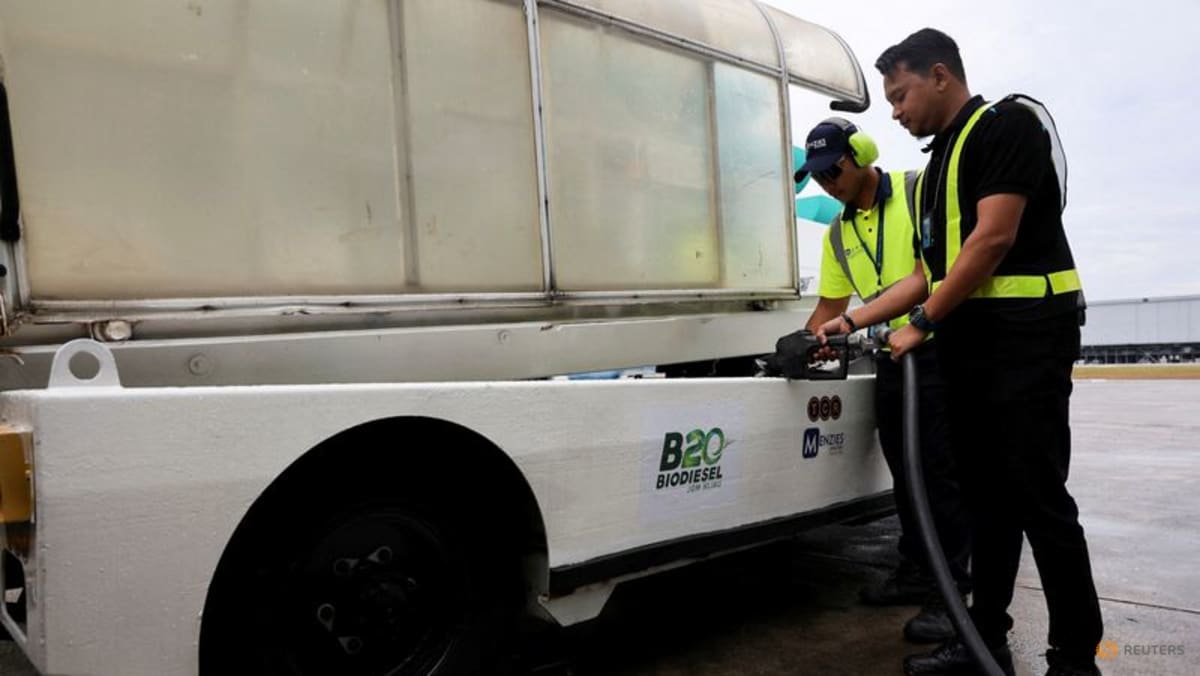
“The first thing we need to do is to upgrade all those infrastructures (but) upgrading infrastructure is not a day’s job. (It) might take one or two years to complete (and) also involves high capital expenditure,” he said.
About 600 million ringgit (US$151 million) is needed to upgrade the terminals and infrastructure to meet a B30 mandate.
SUPPLY AND COST ADVANTAGE
There are about one million diesel vehicle owners in Malaysia, including users of pick-up trucks, vans, buses and SUVs, underscoring the scale of the shift.
Despite infrastructure constraints, industry players say supply is sufficient.
The Malaysian Biodiesel Association (MBA) estimates producers can supply an additional 400,000 tonnes of biodiesel to meet demand for B15.
“We have a total production capacity of 2.4 million tonnes per annum. Last year, we produced around 1.3 million tonnes of biodiesel, of which 1 million tonnes were used for the national biodiesel blending programme,” said the association’s president Tee Lip Teng.
“So, we have adequate production capacity to cater for … the additional demand of 400,000 tonnes of biodiesel.”
Cost is another driving factor.
“Diesel today is close to 6.2 ringgit a litre, whereas biodiesel would be about 4.5 ringgit a litre. There’s an economic incentive; there’s no reason why industries would not embrace cleaner business,” said Unnikrishnan Ramachandran Unnithan, CEO of SumWin Group, a Johor-based firm offering sustainable products and services.
LAGGING REGIONAL PEERS
Industry experts say that Malaysia should not stop at B15, or even its 2030 target of B30.
They point to neighbouring Indonesia, which already offers a B50 blend at the pump.
Malaysia’s biodiesel usage lags far behind despite being the world’s second-largest palm oil producer.
Officials say the difference lies in energy dependency: Malaysia has more domestic fuel supply and is less reliant on imports, reducing the urgency to move as aggressively.
According to the International Energy Agency, Indonesia imported 35.2 per cent of its crude oil in 2023, nearly double Malaysia’s 15.6 per cent.
UNTAPPED POTENTIAL
Even so, experts say Malaysia is underutilising its potential.
The association said that of the country’s roughly 20 million tonnes of palm oil produced annually, only about 1.3 million tonnes – or 6.5 per cent – is used for biodiesel.
“We have so much potential to increase the usage of palm oil for the benefit of the whole country,” said the MBA’s Tee.
He urged policymakers to accelerate the transition and avoid reverting to lower blends once external pressures ease.
“So, (let’s) get to B15 as soon as possible. The industry is ready. The oil companies are ready. When we get to B15, we don’t look back. We don’t go back down to B10 when the (Iran) war stops,” he added.
Still, challenges remain. Some motorists are wary of higher biodiesel blends, citing concerns about potential long-term engine damage without proper modifications.
Even so, the government maintains that biodiesel will play a crucial role in Malaysia’s strategy to achieve net-zero carbon emissions by 2050.
Beyond cost and energy security, biodiesel also offers significant environmental benefits, producing up to 80 per cent fewer greenhouse gas emissions than conventional diesel.
Read the full article here
