

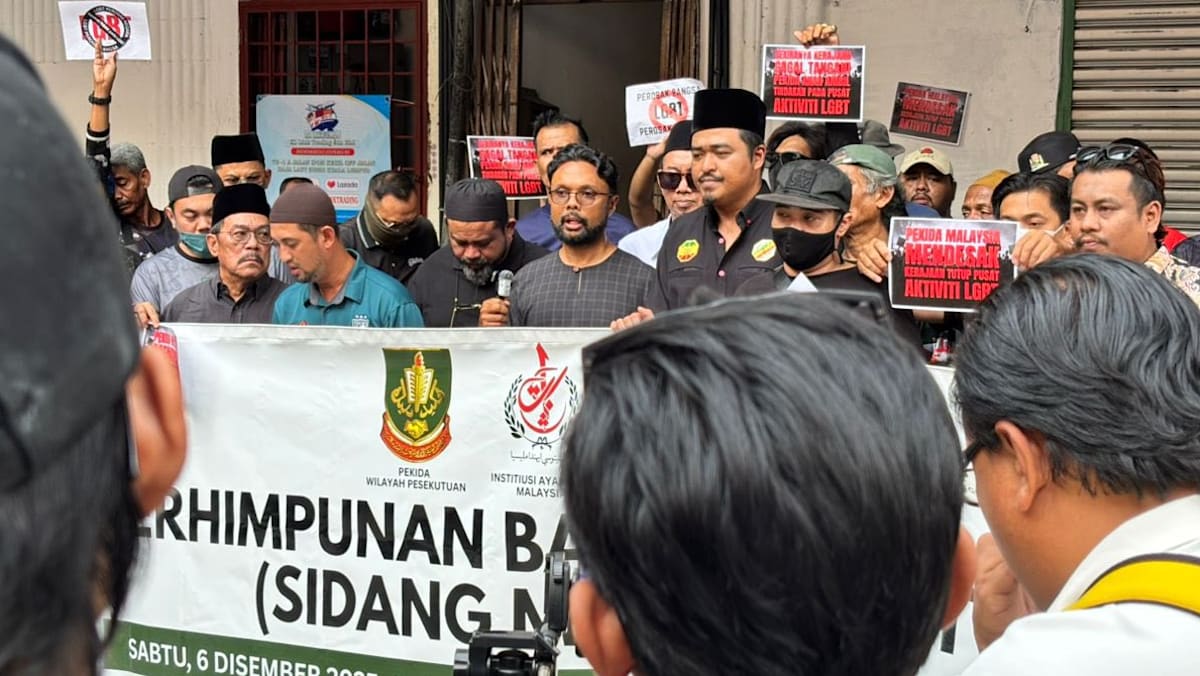
Some observers and groups in Malaysia told CNA that they support the government’s recent enforcement moves.
Samsul Draman, a professor at Kulliyyah of Medicine, a university hospital at Malaysia’s International Islamic University, said the government has “done its part”.
“I hope it (the government) can maintain this momentum and continue improving,” said Samsul, who founded Kuantan-based non-governmental organisation (NGO) Persatuan Insaf Pahang.
It focuses on transgender rehabilitation using methods such as Islamic spiritual guidance, sponsoring Umrah pilgrimage trips to Mecca and Madinah in Saudi Arabia as well as breast implant removal surgeries.
On the spa raid on Nov 28 last year, Samsul was previously quoted by Berita Harian as saying that “deviant” behaviour was becoming increasingly widespread in Malaysia, and that HIV prevention treatment such as taking pre-exposure medication was often misused by homosexual couples and “indirectly encourages homosexuality”.
Samsul told CNA that with the support of the authorities, between 2017 and 2021, his NGO had “indirectly” helped close eight “prostitution centres” in Kuantan where transgender males and females allegedly ran small-scale sex work operations.
“Regular government enforcement is also helping significantly to close these centres,” he added.
Firdaus Baharuddin, an executive committee member of Pertubuhan-Pertubuhan Pembela Islam (PEMBELA), a coalition of Islamic NGOs, also said he agrees with the government’s actions, citing Malaysia’s laws.
“Same-sex relations remain criminalised under both the Penal Code and Syariah laws, and the constitution does not protect against discrimination based on sexual orientation or gender identity,” said Firdaus.
“Moving forward, we would expect the government to take a firmer and more consistent stance in enforcing existing laws without ambiguity or selective application … and in full accordance with due process,” he said.
“At the same time, Malaysia should remain cautious about the uncritical importation or promotion of external cultural norms and social practices that are not aligned with the country’s legal framework and the values that have long shaped Malaysian society.”
PEMBELA, which has over 58,000 followers on Facebook, held a rally in March 2012 to protest against any attempts to promote homosexuality, voicing concerns over Malaysia’s participation in the United Nations (UN) Human Rights Council conference that month to discuss LGBTQ rights language.
Malaysia later opposed the expansion of LGBTQ rights language at the UN discussion.
Rafidah Hanim Mokhtar, a professor in gender and cardiovascular physiology at the Universiti Sains Islam Malaysia, said that recent enforcement aligns with Malaysia’s “legal and sociocultural framework”.
Referring to Jejaka’s “glamping” event, Rafidah told CNA that health-related programmes – including those promoting HIV prevention and support – need to be conducted with “careful consideration of prevailing laws, public sensitivities and moral norms”.
“Health authorities therefore carry a responsibility to ensure that initiatives … are communicated and implemented in a manner that does not create public misunderstanding or the perception of endorsing particular lifestyles that may conflict with national laws and societal values,” said Rafidah, who is also president of Islamic NGO WAFIQ, which advocates for women rights and preserving the “sanctity of a family unit”.
Read the full article here
