

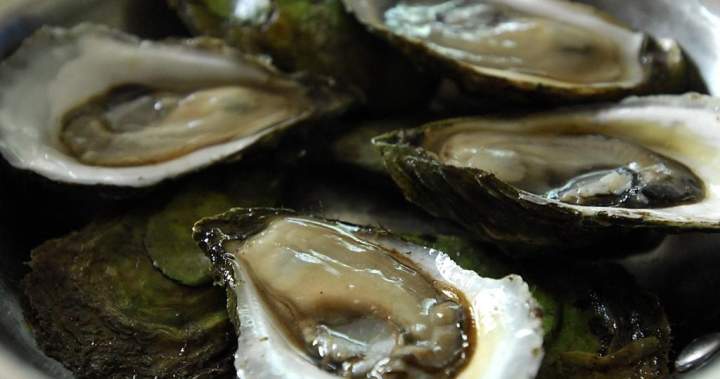
New Brunswick’s provincial government has announced programs to help oyster producers as the industry deals with disease affecting the the animals.
MSX (multinucleate sphere unknown) and dermo diseases do not affect human health or food safety, the province notes, but they do kill oysters.
The diseases have been increasing mortalities in the oyster population and Agriculture Minister Pat Finnegan says the issue has grown fast and furiously.
“A lot of growers were caught with this with no way to recover and get to next year, so we had to be very quick in finding some support,” he said.
The package announced Monday includes more than $12 million in financial support, measures to help the workforce and commitment to further research.
Measures include up to $8 million over three years for an employee retention support fund, up to $3.5 million to help producers affected by oyster death with inventory losses and site cleanup, and up to $265,000 to help producers assess risks and evaluate options for business adaptation.

Get daily National news
Get daily Canada news delivered to your inbox so you’ll never miss the day’s top stories.
The province is also dedicating funds to enhance disease testing.
According to the province, oyster production generated $35.7 million in farm gate value in 2024 and supports about 650 seasonal jobs.
Serge LeBlanc, president of the New Brunswick Shellfish Association, says employee retention is a key area of concern for the industry during this crisis.
“We want to keep good people working for us, that we have, and that was one our worries, to keep them around,” he said.
“All of these programs are going to help.”
He also said that he doesn’t believe the industry could have gone on much longer without addressing the problem.
“It’s a lot of loss to absorb, it’s extreme. We are aware that we can lose oysters, it’s part of farming, but to this extreme was not expected,” he said.
The province is also committing $100,000 to the Canadian Atlantic Shellfish Health Network, a collaborative initiative focused on research and surveillance information sharing related to the diseases.
“We are all fishing from the same waters, and that disease is the same whether you’re in Cape Breton or P.E.I.,” said Finnegan.
Read the full article here
