

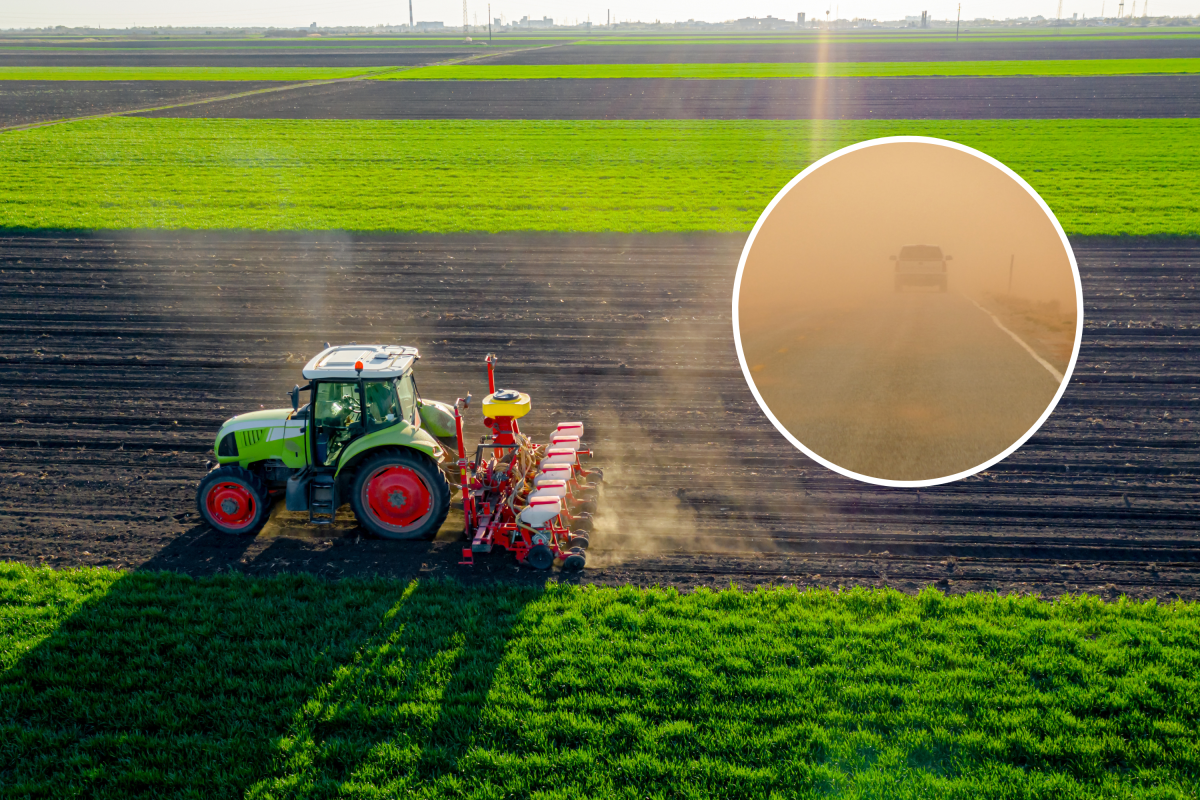
A growing weather hazard is drawing increased attention from meteorologists in Illinois, as springtime dust storms, fueled in part by changing agricultural practices, pose an escalating risk to drivers across the state.
Once considered less common in the Midwest, blowing dust events have become more frequent in central Illinois during the spring planting season, particularly on windy days when bare fields are exposed. National Weather Service (NWS) officials say evolving farming techniques may be unintentionally making topsoil more vulnerable to being whipped into the air, creating sudden and dangerous visibility hazards on roads and highways.
“We believe that farming practices are evolving,” NWS meteorologist Mike Albano, who works at the Central Illinois office, told Newsweek. “The way in which farmers plant with high-speed precision planters, essentially, it’s grounding the topsoil to a finer powder than it used to be over the previous decades. Those high-speed precision planters, we think, are contributing to [the] blowing dust and reduced visibility across the state.”
The result can be walls of dust that form rapidly and without much warning, reducing visibility to near zero in seconds. For drivers, that sudden loss of sight can be deadly.
Illinois Blowing Dust Advisory For 1 Million People: What We Know
On Tuesday, NWS meteorologists at the Lincoln, Illinois, office issued a widespread blowing dust advisory that will remain in place for roughly 1 million people until 7 p.m. local time Tuesday. The advisory could be upgraded to a dust storm warning later in the afternoon, Albano said, as temperatures rise and wind picks up.
In addition to visibility concerns, the dust can also irritate airways.
“Persons with respiratory problems should make preparations to stay indoors until the storm passes. Be ready for a sudden drop in visibility to near zero,” the advisory said. “If you encounter blowing dust or blowing sand on the roadway or see it approaching, pull off the road as far as possible and put your vehicle in park. Turn the lights all the way off and keep foot off the brake pedal. Remember, ‘Pull Aside, Stay Alive.’”
The advisory is in place for Knox, Stark, Peoria, Marshall, Woodford, Fulton, Tazewell, McLean, Schuyler, Mason, Logan, DeWitt, Piatt, Champaign, Vermilion, Cass, Menard, Scott, Morgan, Sangamon, Christian, Macon, Moultrie, Douglas, Coles, Edgar and Shelby counties.
Later in the morning, NWS Chicago issued a similar warning for Livingston, Ford, Iroquois, La Salle, Grundy, Kankakee and southern Will counties in Illinois and Benton, Jasper and Newton counties in Indiana.
Deadly Consequences on Illinois Roads
The danger of dust storms became tragically clear in May 2023, when a powerful dust storm in central Illinois caused a massive pileup on Interstate 55. Multiple vehicles slammed into one another amid near-whiteout conditions, killing several people and injuring dozens. Investigators later said many drivers simply could not see what was ahead of them until it was too late.
Meteorologists now warn that the factors behind that deadly storm were not a one-off.
In 2025, a similar blowing dust event stretched far beyond its rural origins, with dust plumes reaching into the Chicago metropolitan area. While that storm did not result in fatalities, it underscored how far-reaching and disruptive these events can be, especially when strong winds combine with expansive, exposed farmland.
Why Dust Storms Are Becoming More Common
Blowing dust requires a precise combination of ingredients: loose, dry soil; strong winds and minimal vegetation to hold the ground in place. Springtime often checks all those boxes in Illinois.
After fields are tilled and before young crops emerge, acres of farmland can sit largely unprotected. High-speed planters, while efficient and widely adopted, can leave behind finely pulverized soil that is especially vulnerable to being lifted by gusty winds.
Newsweek reached out to the U.S. Department of Agriculture by email for comment.
While drought conditions can intensify the problem by drying out the soil, NWS meteorologists stress that drought is not always necessary for dust storms to form. That has prompted more frequent monitoring by NWS offices across Illinois, particularly on days when wind advisories overlap with active agricultural work.
For example, as of the most recent U.S. Drought Monitor map, which was published last Thursday, none of central Illinois was struggling with drought. Only a small pocket of the region was considered “abnormally dry,” the first level on the U.S. Drought Monitor scale.
Until the past five to 10 years, blowing dust was a more common hazard west of the Mississippi River, often affecting the Southwest, Albano said. The threat is now expanding into the Midwest.
Blowing Dust Advisory vs. Dust Storm Warning
The NWS uses different alert levels to communicate dust-related threats, depending on their severity and potential impact.
A Blowing Dust Advisory typically covers a larger area. They are more proactive, Albano said, and are issued when widespread or localized blowing dust is expected to reduce visibility, typically to around a mile or less, making travel hazardous but not necessarily life-threatening. These advisories alert drivers to use caution, slow down and be prepared for sudden changes in conditions.
A Dust Storm Warning, on the other hand, signals a far more dangerous situation. This warning is reserved for events in which visibility may drop below a quarter-mile, or even to zero, creating conditions that can quickly lead to multi-vehicle crashes. Dust Storm Warnings are relatively rare in Illinois but are becoming more of a concern as these events increase. Such alerts will activate an alarm on most cellphones similar to a tornado warning, signaling people of danger.
Dust Storm: How To React
Safety experts say knowing how to react can make the difference between life and death when a dust storm hits.
If you are driving and encounter blowing dust, slow down immediately and look for a safe place to pull off the roadway—away from traffic lanes if possible. If visibility drops suddenly, do not assume the road ahead is clear. Turn off your lights once stopped so other drivers do not mistakenly follow your vehicle off the road.
Above all, do not stop in a travel lane. Many fatal crashes during dust storms occur when vehicles continue driving blindly or stop in the roadway, where they are struck from behind.
If you are outside of a vehicle, seek shelter indoors and avoid breathing dust if possible, as fine particles can irritate the lungs and worsen respiratory conditions.
Midwest Dust Storms: What Happens Next
As planting seasons grow more technologically advanced and weather patterns continue to deliver stronger wind events, meteorologists expect blowing dust to remain a challenge in Illinois and the broader Midwest. Albano said NWS offices are monitoring such events closely and will issue alerts if the situation calls for them.
In the meantime, Illinois residents are urged to take dust alerts as seriously as winter whiteouts or severe thunderstorms, as they can develop with little warning and have life-threatening consequences.
Read the full article here
