

Recalling a “frank and fruitful discussion” with Chinese counterpart Dong Jun last year at the ASEAN Defence Ministers’ Meeting Plus talks in Kuala Lumpur, Koizumi reiterated that Japan believes it is essential to have “persistent, candid dialogue and communication” without turning away from difficult issues.
Koizumi added that the Japanese defence ministry would continue to use “every available opportunity to communicate firmly with the Chinese side”.
“Please give my best regards to my counterpart Dong Jun,” he said, addressing Chinese delegates in the audience.
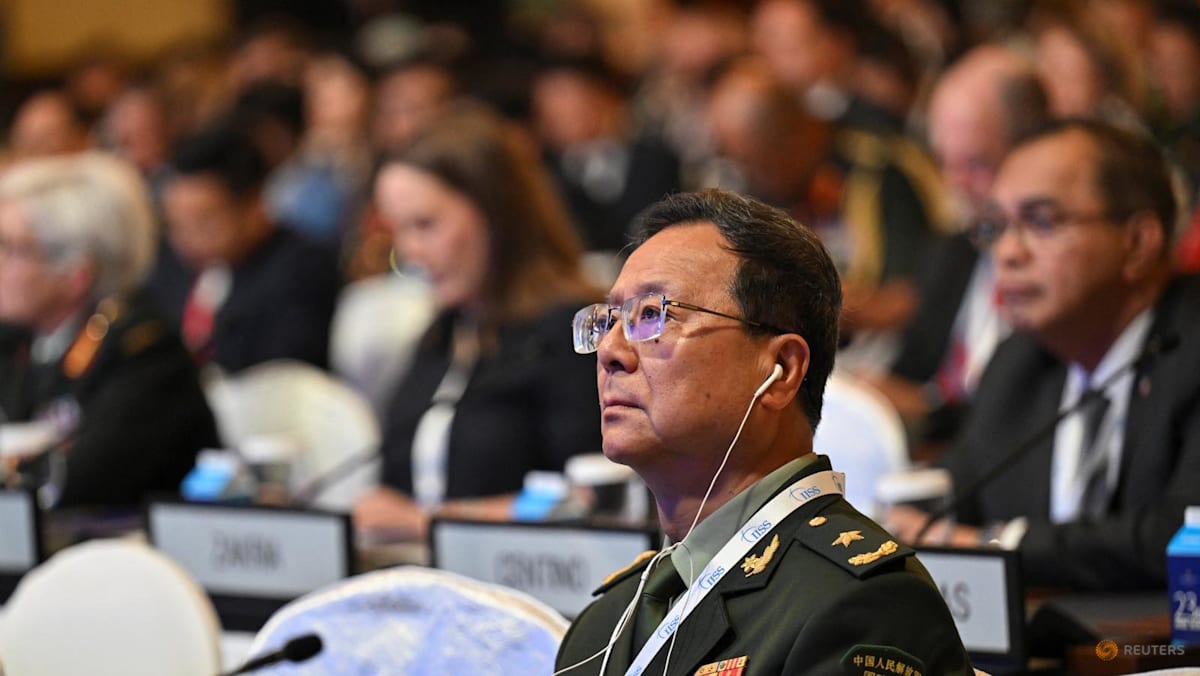
At the summit a day earlier, Major General Meng criticised Japan’s efforts to revise its “pacifist constitution” and the three non-nuclear principles, as well as its pursuit of the deployment of allied nuclear weapons on Japanese territory.
“Today, some forces continue to openly glorify war crimes, promote distorted narratives of WW II history, attempt to challenge the verdicts of the Tokyo Trial, and seek to whitewash the history of aggression,” Meng said.
“Some have even taken concrete steps to break through the constraints of the post-war peace framework,” he added.
He also questioned if a country that has “never fully eradicated the remnants of militarism” can claim the moral authority to lecture others about defence cooperation on the international stage.
“Can it earn the trust of the international community, especially the Asian countries that once suffered under its aggression? I have serious doubts,” Meng said.
ILLEGAL INTRUSION AND FREEDOM OF NAVIGATION
At the session, Dutch Defence Minister Dilan Yeşilgöz-Zegerius addressed an incident earlier this week involving Dutch frigate De Ruyter, which Beijing had accused of “illegally intruding” into the Paracel Islands in the contested South China Sea.
Beijing claims sovereignty over most of the resource-rich South China Sea, while Southeast Asian countries including Vietnam, Malaysia, Brunei and the Philippines have competing claims.
The Netherlands said the HNLMS De Ruyter was sailing through the South China Sea for diplomatic, security and economic reasons.
Yeşilgöz-Zegerius reiterated that the ship had followed its planned route in “full accordance with international law – operating in waters where freedom of navigation applies and without entering territorial waters”.
Read the full article here
