

Updated ,first published
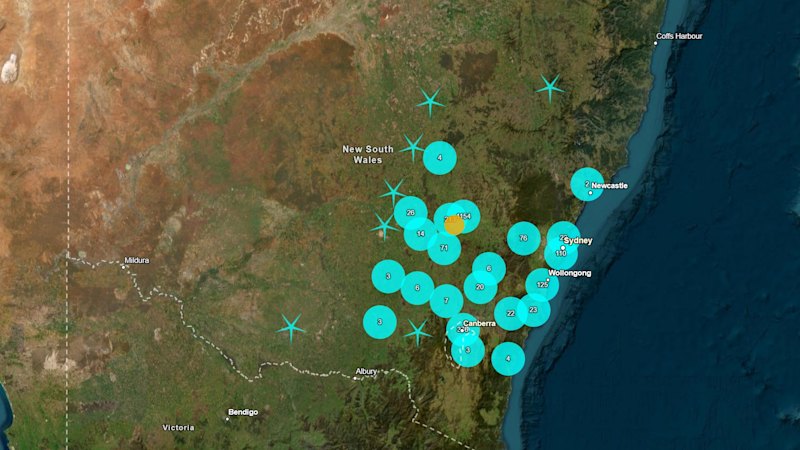
Locals near a gold mine in NSW’s central west are anxious about the mine’s potential impact on earthquakes and tremors after a record quake hit the area on Tuesday night, shaking the ground as far away as Sydney and Batemans Bay.
The 4.5-magnitude quake struck close to the Cadia goldmine, about 35 kilometres south-west of Orange, at 8.19pm on Tuesday.
Nearby residents reported 10 to 15 seconds of rumbling, and compared the sound to a jumbo jet. Those closest to the epicentre said it was like a bomb going off.
“It was like an explosion underneath the house,” said Bruce Reynolds, the mayor of Blayney Shire, who lives 12 kilometres from the epicentre.
Reynolds said it felt more violent and sudden than a 4.3 magnitude quake that struck in a similar location on Good Friday in 2017.
“This one was different,” he said. “This is possibly the biggest that we’ve seen in this local area in modern history, since the Richter scale was first used.”
Miners were evacuated from the Cadia goldmine on Tuesday night and underground operations have paused. The operator of the mine, Newmont Cadia, confirmed its seismic sensors detected the quake and all underground staff safely returned to the surface.
The earthquake’s two aftershocks, of magnitudes 2.4 and 2.2, hit close to one of the mine’s tailings dams, which hold tonnes of waste slurry.
Part of a dam wall at the mine collapsed in 2018 in the days after two 2.7-magnitudes earthquakes struck the area. A subsequent expert report found the quakes didn’t substantially contribute to the collapse.
Reynolds acknowledged “a number of members in the community have anxiety and some concerns about a potential link between the earthquake activity and the mining activity”.
A seismologist from Geoscience Australia told Central Western Daily in 2023 there had been high levels of seismic activity around the Cadia mine in recent years – about 60 earthquakes of magnitude two or above in the last eight years within 30 kilometres of the site.
The data, however, is not detailed enough to pinpoint whether there is a direct cause-and-effect between mining operations and seismic rumbles.
In some cases, mining, fracking, and other human activities such as wastewater injection can induce earth tremors, but it’s very difficult to draw a direct link between a mine and specific earthquake, senior seismologist at Geoscience Australia Dr Phil Cummins said.
“Mining can change the ‘stress field’ across the earth, and a change in the stress field can potentially trigger an earthquake,” he said. “The problem is that our network that we use to monitor earthquakes nationally is just too coarse to be able to determine that mechanism with any accuracy.”
Extracting and depositing large amounts of material underground – and moving water around – can change how tectonic stress is distributed and influence seismic activity, he said.
“Some papers have been able to correlate the change in seismic activity with changes in mining activity, particularly for things like fracking, and draw a correlational relationship,” he said.
Dense, local monitoring of seismic activity over a long period of time would be required to better understand if specific mining activities trigger tremors or earthquakes.
Cummins said there had been four earthquakes above 3.5 magnitude in the immediate vicinity of the Cadia mine since 2017. The quake on Tuesday night was the largest ever felt in the area, he said.
Premier Chris Minns was asked on Wednesday morning if he had been briefed on a possible link between earthquakes and the mine.
“We don’t believe it’s linked, or I’ve been given no information that it has been linked. I was briefed about it late last night,” Minns said, adding he would update the public with any new information.
Earthquakes can happen across the continent due to forces exerted on the boundaries of the Australian tectonic plate. “Even though those boundaries are very far away, the stress is slowly building up in the Australian crust – so earthquakes can happen anywhere,” Cummins said.
More than 2000 people reported feeling the recent quake to Geoscience Australia. Couches jumped in Mittagong, houses creaked in Lawson, windows rattled in Bathurst and cats acted up in Caringbah, people reported on social media.
“The weak shaking extends as far as Batemans Bay in the southeast, which is a couple of hundred kilometres at least,” Cummins said.
Police are not aware of injuries or damage. NSW Recovery Minister Janelle Saffin had been in touch to offer support, Reynolds said.
Because the Richter scale is logarithmic – meaning each number represents a 10-fold increase in severity – a 4.5-magnitude earthquake is about 1.6 times bigger than a 4.3-magnitude quake, but twice as strong in terms of energy released.
with William Davis
The Examine newsletter explains and analyses science with a rigorous focus on the evidence. Sign up to get it each week.
 Angus Dalton is the science reporter for The Sydney Morning Herald.Connect via X or email.
From our partners
Read the full article here
