

Here’s the skinny on looking slim — horizontal stripes are in!
Fashionistas of varying physiques have long been force-fed the belief that wearing horizontal stripes makes the body look short and fat.
Well, that’s a big fat lie, according to eye-widening new data, debunking the antiquated myth about lined patterns and width.
“The pencil stripe style, characterized by horizontal stripes, makes the figure appear slimmer,” authors of the April 2026 study revealed.
But, there is a thin line between the type of stripes that actually flatter the figure and the stripes that simply do not, warn the experts.
Researchers from the National Yunlin University of Science and Technology conducted a trio of experiments to determine the slimming effect — a styling technique that uses optical illusions to make one’s frame appear longer and leaner — of striped clothing.
The probe comes amid the booming thin-is-in fad, charged by formerly plump VIPs who’ve shrunk in size with the help of anti-obesity jabs, like Ozempic, and weight-obsessed influencers who’ve recently resurrected the “heroine chic” fashion craze of 1990s.
It’s a trendy slender agenda.
“Since most people want to appear taller and slimmer, fabric patterns can significantly affect the perceived overall appearance of clothing,” noted the insiders. “However, when two-dimensional lines are applied to three-dimensional forms, they may produce different visual impressions and cause optical illusions.”
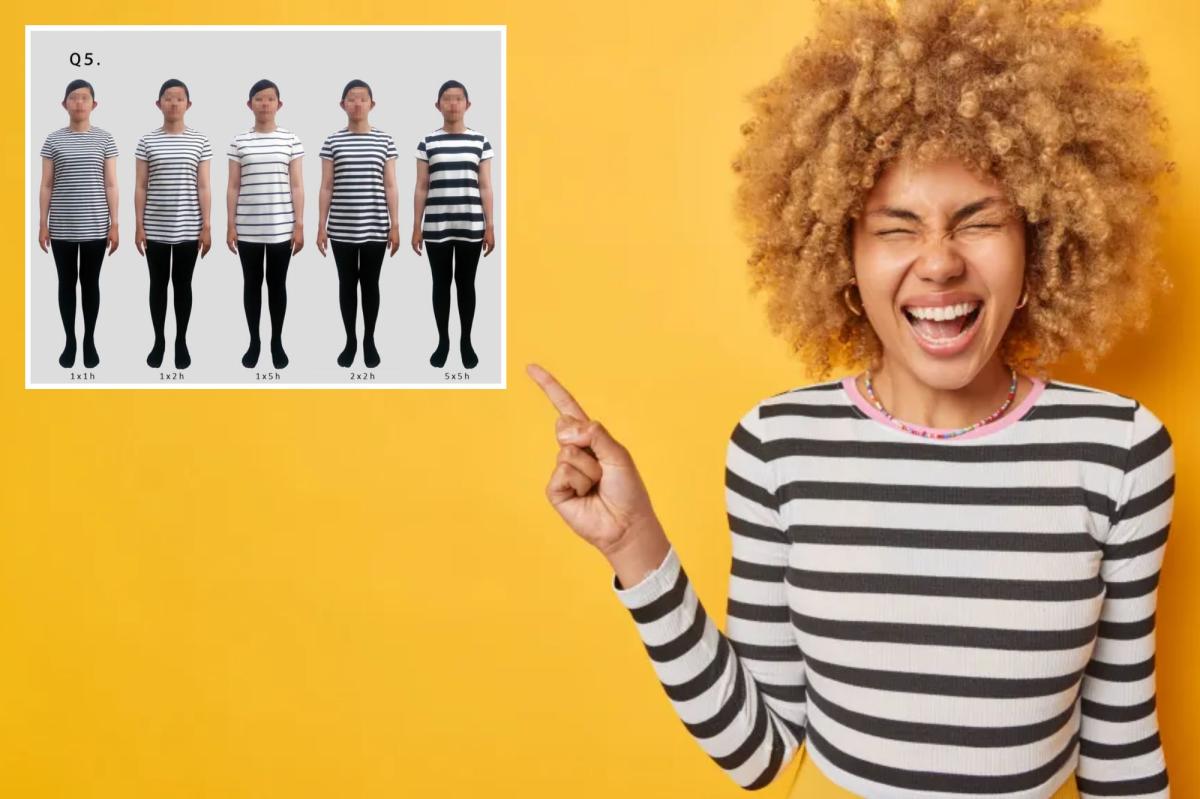
The analysts surveyed 241 respondents, male and female undergraduates, evaluating their individual perceptions of a female model’s body image across several photos of her wearing white dresses patterned in black stripes.
Each frock was designed with stripes spaced at one, two or five centimeters apart. The stripes, ranging from thin to wide, ran either horizontally or vertically from the neckline to the hem.
Stripe types were classified as either “equidistant,” meaning the spacing was uniform, or “pencil,” indicating that the spacing between lines was wider than the lines themselves.
Participants were asked to identify the style that made the model’s body look slimmer, enhanced her figure more effectively and was more visually appealing.
For the first experiment, the undergrads compared photos of the model in horizontal stripes with five different spacing types. The students then compared her look in vertical stripes for the second experiment. Lastly, they compared the effects of horizontal and vertical stripes across five garment styles on body image perception.
Investigators found that the slimming effect is influenced by three key factors — the stripe directions (horizontal or vertical), stripe type (pencil or equidistant), and stripe spacing (thin or wide).
“Contrary to expectations, neither pencil nor equidistant vertical stripes consistently appeared slimmer,” wrote the authorities. “Whether in a sleeved or sleeveless women’s dress, it is generally agreed that horizontal pencil stripes can make the wearer appear slimmer.”
However, horizontal stripes don’t always do the trimming trick.
“As the stripe spacing increases, the horizontal stripes become visually dispersed… and the slimming effect diminishes,” said the scientists. “Therefore, not all horizontal pencil stripes can make the wearer look slimmer.”
And, not all vertical stripes are bad for the body — great news for folks who dress like Beetlejuice.
“The equidistant stripe featuring vertical stripes, can also make the figure look slimmer,” the clinicians continued, quashing the notion that “only horizontal stripes make you look slimmer.”
Read the full article here
