

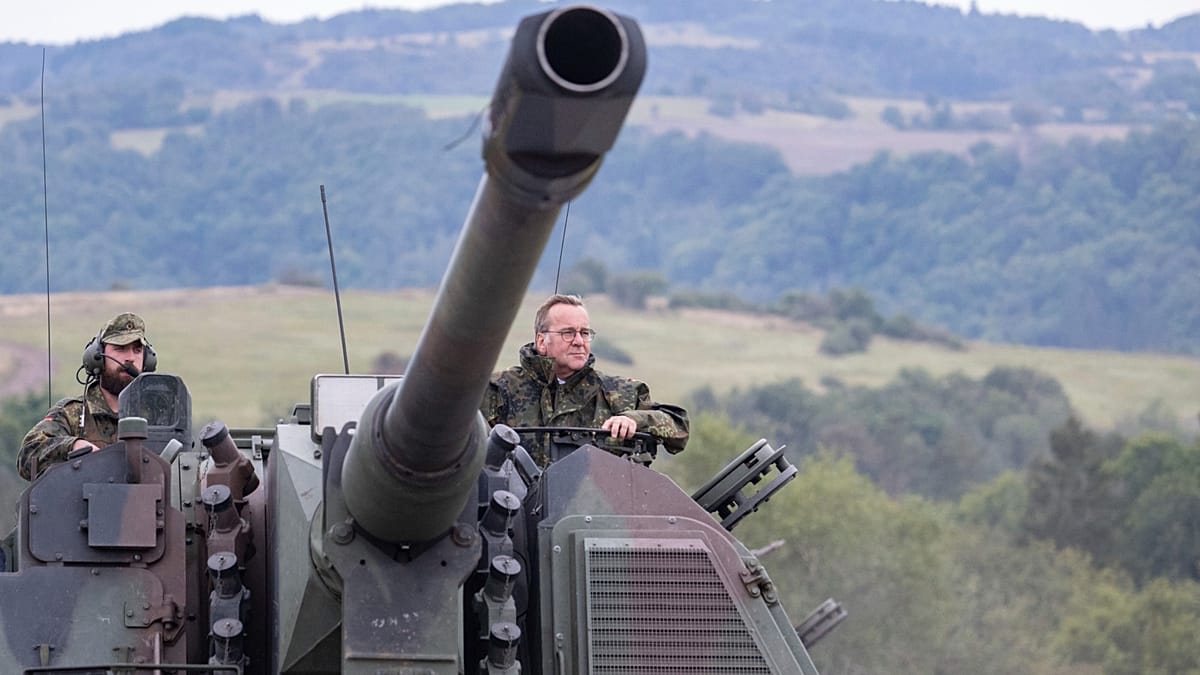
German defence minister Boris Pistorius unveiled for the first time a military strategy for the Bundeswehr and Germany as a whole on Wednesday.
“Our goal is clear: we will continue to strengthen the Bundeswehr’s operational readiness – and we will do so at pace,” he said.
Pistorius said the strategy had been driven primarily by Russia’s full-scale invasion of Ukraine and the developments on the battlefield and in the defence industry, which show that armed forces must constantly adapt, even to challenges “that may not yet be foreseeable.”
Pistorius warned the threat environment had worsened significantly in recent years, with the international order being challenged more than at any time in recent memory.
“In other words, the world has become more unpredictable and, yes, more dangerous,” he said.
Against this backdrop, the German government has examined how threats may evolve, which scenarios are plausible, and which potential conflicts Germany needs to prepare for.
In a post on LinkedIn, German security expert Dr Christian Mölling called the strategy an “important first step,” which “should not be mistaken for a moment after which everything changes overnight.”
“Historically, German military planning has been strongly shaped by NATO requirements. That will not fundamentally change – nor should it,” he continued, adding that “what is new, however, is that Germany is now formally articulating national military objectives, priorities and room for manoeuvre, which it can then bring into NATO and Europe.”
Fundamental rethink
A fundamental rethink lies at the heart of the new strategy. In future, the German army will focus less on fixed force numbers and more on specific capabilities.
“It’s not about the exact number of tanks, aircraft or ships over the next 10, 15 or even 20 years,” Pistorius said, arguing that what matters is what the forces can actually do.
This approach was echoed by the Armed Forces’ inspector general Carsten Breuer. “We are now looking at the impact we can achieve,” he said.
In practice, that means capabilities will no longer need to be tied to a single system – the outcome is what counts. Priority areas include air defence, long-range strike capabilities and the ability to wage modern, data-driven warfare. New technologies such as artificial intelligence are also set to play a much greater role.
Focus on ‘deep strikes’
Another key pillar of the strategy is so-called “deep strike,” the ability to hit targets far behind the front line. Pistorius and inspector general Carsten Breuer made clear that such capabilities will become increasingly important. This includes long-range precision weapons designed to take out enemy supply routes, command centres and critical infrastructure at an early stage.
Against the backdrop of the war in Ukraine, this approach is seen as crucial to weakening enemy structures early and easing pressure on one’s own forces. At present, the Bundeswehr has only limited capability in this area. Its main system is the Taurus cruise missile, a German-Swedish weapon with a range of more than 500km, placing it at the lower end of the deep strike spectrum.
In future, however, Germany aims to significantly expand its ability to strike such targets with precision – and at greater distances. One example is the planned procurement of the JASSM-ER cruise missile for the new F-35 fighter jet. With a range of around 1,000km, it would extend the Bundeswehr’s reach well beyond current systems. Both the aircraft and the missile are produced by US defence giant Lockheed Martin.
Parts of the strategy remain secret
Parts of the strategy are deliberately being kept under wraps, according to Pistorius. Concrete scenarios and potential deployment plans will not be made public, as this would give adversaries too much insight. “Otherwise we might as well add Vladimir Putin to our email distribution list,” he said.
Alongside the strategic overhaul, the German government is planning a significant expansion of the Bundeswehr. The aim is to reach a total strength of 460,000 personnel, combining active troops and reserves. Germany currently has around 184,300 active soldiers and roughly 860,000 reservists. The increase is to be carried out in several phases. The immediate goal is to boost operational readiness rapidly by 2029. In the years that follow, new capabilities are to be developed – also in anticipation of incoming weapons systems.
The defence ministry says it is taking a pragmatic approach to recruitment. To ensure enough personnel, more applicants will be accepted than there are posts available. “We are allowing for overbooking,” Pistorius said.
Reservists move into focus
Expanding personnel is central to the entire strategy. Without sufficient troops, new capabilities cannot be developed or sustained over the long term. Reservists are set to play a much larger role, no longer seen as a backup but as an integral part of the armed forces. “We explicitly see the new reserve on an equal footing with active troops,” Pistorius said.
Their role will be particularly important at home. In a crisis, Germany is expected to serve as a logistical hub for Europe, with troop movements, supply lines and critical infrastructure needing protection, tasks that would largely fall to reservists.
“We need the reserve to ensure Germany can function as a logistical hub in a crisis or defence scenario. In that sense, our reserve is the hinge between the military and civilian society,” Pistorius said.
At the same time, the Bundeswehr is set to become more agile organisationally. The defence ministry aims to cut bureaucracy and streamline processes as part of a broader reform push. Plans include digital workflows to replace paper-based systems, fewer reporting requirements, and greater use of technologies such as artificial intelligence.
“Reporting obligations will only remain where they add real value,” Pistorius added. The strategy itself is not intended to be fixed.
“These strategies are living documents,” the defence minister said, and will be regularly updated as threats and technologies evolve.
Read the full article here
