

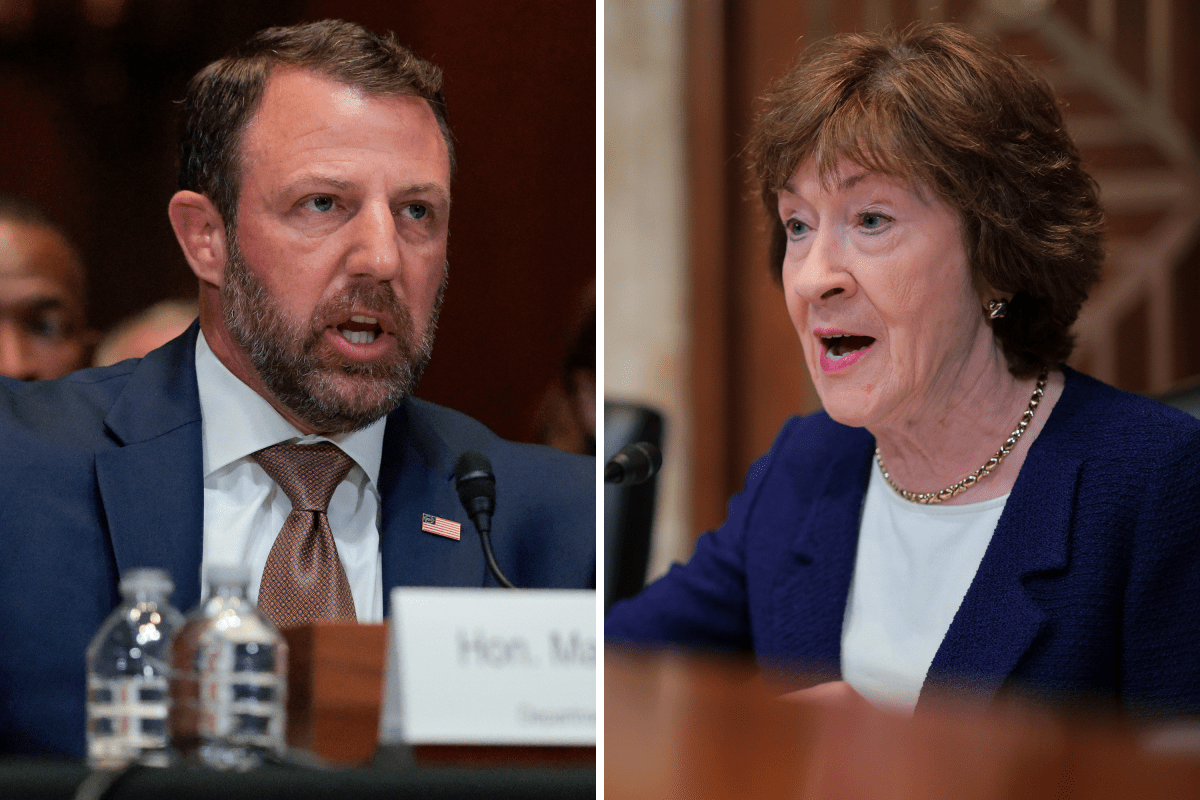
Homeland Security Secretary Markwayne Mullin has been grilled by GOP Senator Susan Collins over the Trump administration’s $100,000 H‑1B visa fee, as lawmakers raised concerns about its impact on workforce shortages in the healthcare industry.
During a Tuesday Senate Appropriations Committee hearing on the Department of Homeland Security’s (DHS) budget for fiscal year 2027, Collins, a Maine Republican who serves as committee chair, pressed Mullin to consider exemptions for employers in rural areas, citing the burden the policy places on hospitals and other essential services.
Why It Matters
The H‑1B program allows U.S. employers to hire foreign workers in specialized fields, including technology, engineering, and medicine, when qualified domestic candidates are not available.
The Trump administration has imposed a $100,000 fee on certain H‑1B visa petitions, a move aimed at tightening oversight of the high‑skilled worker program and steering employers toward hiring higher‑paid American labor.
Supporters of the policy say H‑1B visas remain essential for filling gaps in industries such as healthcare, technology, and engineering, where employers often struggle to find qualified workers domestically. Critics, however, argue the program can undercut wages and displace U.S. employees, particularly in sectors with a larger existing workforce.
Collins Presses DHS on Rural Needs
Collins pointed to a case in northern Maine where a rural hospital paid the fee to recruit a surgeon from overseas, arguing that healthcare providers in underserved areas face different challenges than companies operating in sectors with larger domestic labor pools.
Mullin said the department has limited flexibility to grant waivers on a case-by-case basis, but said that the fee has been widely used to accelerate application processing.
Mullin Claims 200,000 Have Paid Fee
“We had 286,000 applicants a year to date for the H-1B visas. Out of those, over 200,000 of them paid the $100,000 to be able to come in, because it allows us to process them in a little bit faster manner,” Mullin said.
Newsweek has been unable to independently verify the figure and has contacted the DHS for comment and clarification.
As of February 15, the Trump administration had received 85 payments after the new fee was implemented at the start of 2026, according to a DHS filing.
Mullin added that applications submitted with the $100,000 fee are typically processed in about 15 days, compared with roughly seven and a half months for applicants seeking exemptions or alternative pathways.
“I would suggest that there’s a huge difference between bringing in a computer expert from another country to work in wealthy California and Silicon Valley versus a much-needed surgeon to work at a rural hospital,” Collins said during the hearing.
Congress Weighs Competing Visions for H-1B Program
Each fiscal year, 65,000 visas are available under the regular cap, with an additional 20,000 visas reserved for applicants holding advanced degrees from U.S. institutions. Certain employers, such as universities and nonprofit research organizations, are exempt from the cap.
Lawmakers in both parties have raised concerns about the steep fees’ effects on industries that depend on foreign labor, particularly healthcare. A bipartisan group of 100 lawmakers sent a letter in February to then Homeland Security Secretary Kristi Noem, warning the $100,000 fee could worsen staffing shortages and strain already underfunded hospitals.
In September 2025, President Donald Trump signed a presidential proclamation introducing the fee.
Since then, lawmakers have introduced competing proposals. In 2025, Senate Judiciary Committee Chairman Chuck Grassley, an Iowa Republican, and the panel’s top Democrat, Senator Dick Durbin of Illinois, unveiled legislation to overhaul the H‑1B and L‑1 visa programs by raising wage requirements and increasing federal oversight, arguing the system has been used to reduce labor costs.
Representative Bonnie Watson Coleman, a New Jersey Democrat, introduced legislation in March 2026 that would nullify the administration’s fee requirement. In contrast, some Republicans have pushed in the opposite direction. Representative Greg Steube of Florida has proposed legislation to eliminate the H‑1B program entirely, arguing it disadvantages American workers.
Meanwhile, 175 investigations have been opened into companies potentially abusing the H-1B visa program for skilled foreign-born workers.
Legal Challenges to $100,000 H-1B Visa Fee Continue
A federal judge in Boston heard arguments May 29 in one of several lawsuits challenging the Trump administration’s $100,000 fee on H-1B visas, but did not immediately rule.
During the hearing, U.S. District Judge Leo Sorokin questioned the breadth of the administration’s legal authority to impose the fee, which has drawn challenges from states, business groups and employers.
The litigation continues on multiple fronts. The U.S. Chamber of Commerce appealed after losing a challenge in federal district court in December 2025, and the U.S. Court of Appeals for the District of Columbia Circuit later agreed to expedite the appeal. A separate lawsuit in California also remains active.
The fee remains in effect pending further court decisions.
Read the full article here
