

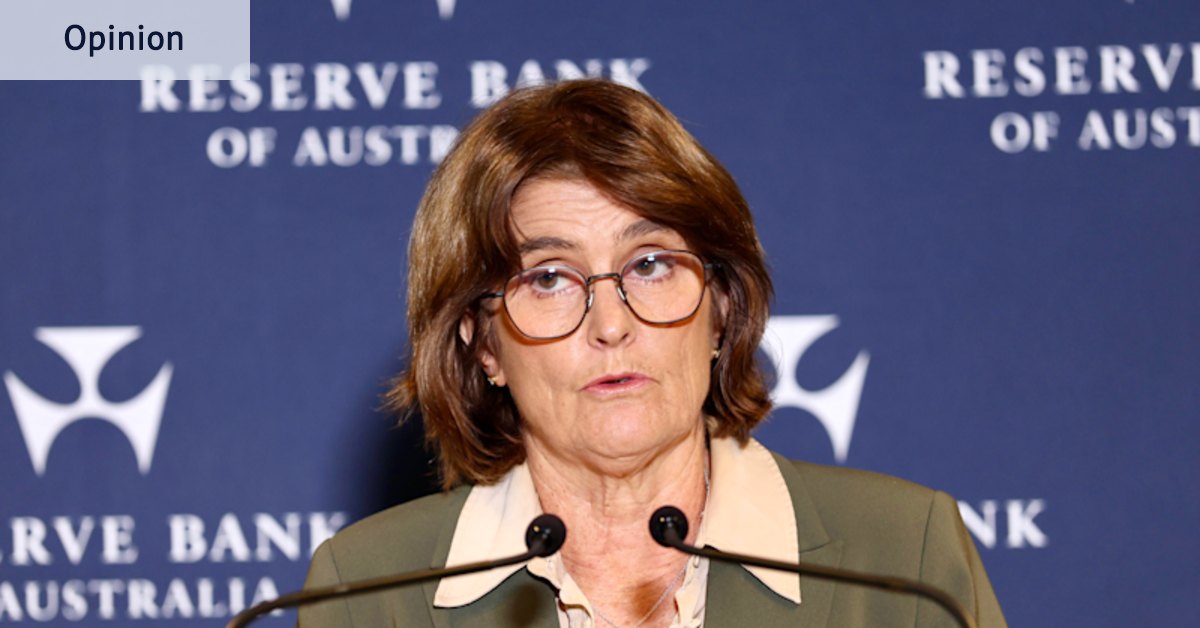
It was a sad sight to see and hear the governor of Australia’s Reserve Bank almost wringing her hands in despair that she only has one tool to fight inflation and that is the blunt axe of interest rates (“How Trump is playing havoc with Reserve Bank forecasts”, May 6). Surely if the RBA governor needs additional weapons to fight inflation without causing irreparable harm to innocent families and businesses in current circumstances, then why isn’t the bank demanding other perhaps subtler tools to do its job properly. Lance Dover, Pretty Beach
There is a grim irony in current economic policy: faced with rising living costs, we respond by increasing interest rates and making those costs even harder to bear. Much of the pressure on household budgets is not driven by discretionary spending, but by unavoidable charges – insurance premiums, utility costs and council rates. These are not luxuries; they are fixed essentials. Yet while households are urged to economise, providers simply lift their base charges. Use less water or electricity and you are “rewarded” with higher account-keeping fees. In my case, significantly reduced water usage still resulted in a 6 per cent increase in base charge as well as cost per litre going up. This is not an isolated example – it is systemic. Replicate it across energy, insurance and local government charges, and the result is clear: those on fixed incomes are going backwards, regardless of how carefully they manage their consumption. While the Reserve Bank’s blunt tool of interest rates may sit outside this specific problem, governments are not powerless. At the very least, they could exert pressure on essential service providers to limit increases to CPI. Anything less entrenches a cycle where restraint by consumers is met with escalation by providers. Roger Hallett, Toowoomba (Qld)
Various alternatives have, after previous rate rises, been proposed instead of raising interest rates, which simply transfers large sums of money from mortgage holders to bank shareholders, thereby dampening the economic activity of those mortgagees. None have met with any enthusiasm from government, or even the economics community. Here is another suggestion, which, I believe has some merit: Instead of raising interest rates, impose a levy, yes, a tax, on mortgage payments, that each person must pay on top of their monthly repayment, equivalent in size to the desired interest rate rise, and use the money raised to pay off (part of) the national debt. At least those unfortunate mortgagees would feel that the impost is doing something for the country, rather than simply enriching bank shareholders. Banks would have no reason to raise interest rates they pay to depositors either, further reinforcing the intent of the RBA. Stein Boddington, St Clair
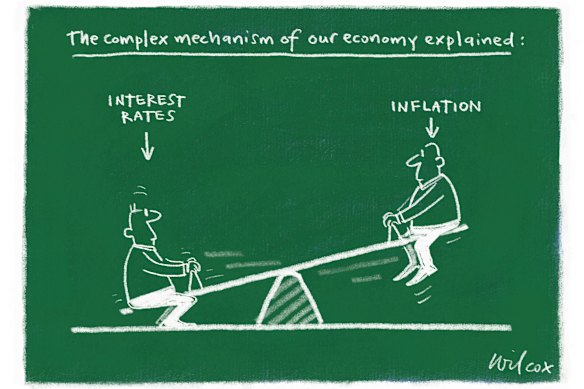
The purpose of an interest rate rise to combat inflation is to give people less money to spend and lower demand, at least for non-essentials (as if they haven’t been doing that). Now Labor and Treasurer Jim Chalmers plan to put money in people’s pockets to undo what the RBA is attempting to do. Jenny Greenwood, Hunters Hill
Without question, inflation is a serious problem and efforts to restrain its growth important (“Household handouts will fuel inflation, warns Bullock”, May 6). However – the fuel crisis notwithstanding – I am curious how we confirm the driver of price rises. Increased demand appears counterintuitive to a “cost of living crisis”, but if we are actually buying more, are there specific types of goods in that basket. I understand that measurement of a wide range of goods is necessary to monitor inflation, but suggest some products will not be constrained by interest rate increases, for some driving down demand would also be undesirable. So why are they included in the assessment? Rent is included – surely an objective of the RBA is not to increase homelessness, which would be a consequence of a decrease in demand for rental properties. Pia Deans, Lyneham (ACT)
RBA: Rather Blunt Axe. Mustafa Erem, Terrigal
Housing crisis demands urgent action
Elizabeth Mossop raises an important issue about Australia’s excessive house sizes (“New ways to get people into homes”, May 6). Research undertaken by the University of Melbourne in 2016 found that the homes of the 1950s had 30 square metres per person and that one generation later this had almost tripled to 87 square metres per person. This dramatic growth has been driven by having fewer people in each house and by the addition of media rooms, ensuites to many bedrooms and a general expansion of all spaces in the house. As the original research demonstrated, the large size leads to higher energy costs and a much higher purchase price. One way to make housing more affordable, as Mossop suggests, is to reduce the size of homes. Chris Johnson, Millers Point

I have two points to make about the current housing crisis. First, no one seems to have addressed one fundamental change that has taken place in the past 10 years or so. It seems nearly every time an existing house is sold, it is demolished to make way for a much larger but still single family home. The second issue is the lack of prefab homes in Australia. My son now lives in New Zealand, and he has a 46-square-metre “Cosy Home”. It was built off-site and delivered on the back of a semi-trailer. It only took a few months to build and is just fine for one person or a couple. It comes complete with a kitchen and bathroom/laundry alongside the living area and bedroom. The company now makes a longer version with a second bedroom. Looking at the harrowing story “Mother had been living in a tent for months” (May 6), and reading about the long, long wait time for even emergency housing, I ask why the government doesn’t set up a factory to produce these portable homes and roll them out continuously. Extra pods could be added to the original as the family grows. The factory/factories could provide training and ongoing work for people in country areas. If it remained government-owned, the costs could be kept under control. To me, it seems a win/win/win situation. Susan Rowe, Epping
The ongoing tragedy of the homeless – treated so badly by our society whose main practical solution seems to be to get our police force to sweep them uncivilly out of our sight and therefore out of our minds – is highlighted by the devastating death of a baby born in a tent. And yet, at the same time, there are practical solutions, including a thoughtful approach to new ways of getting more people into homes, by using both lateral approaches to building, and – as UTS Professor Elizabeth Mossop also points out – “resetting the housing landscape to ‘housing as shelter’ instead of ‘housing as investment’” . As she points out, too, this could be assisted by “much-needed tax reform”, and there is a clear need for that as the number of people under the poverty line increases while those well above it are buying – as we regularly see – homes for eye-watering millions of dollars. Anne Ring, Coogee
A newborn baby dies after the mother gives birth in a tent she’s been living in for most of her pregnancy. Embarrassing high numbers of homeless people. A seven-year wait for public housing in the Wagga Wagga area where the mother of the child lives. Homelessness, and housing in general, is the greatest crisis this country has. Do our leaders agree? Michael Jones, Birchgrove
Basic human needs
It’s not at all clear why your correspondent thinks voters will be “duped” in “funding their retirement” as a result of reducing tax concessions on investment properties (Letters, May 6). Does Riley Brown think that buying investment properties is compulsory, or else people will live in poverty in retirement? If so, the notion is ridiculous. My retirement will be extremely comfortable without any investment properties. Housing should never have been treated as just another investment class – it is a basic human need and a key ingredient of our social fabric. Any “investor” buying a property is potentially stopping a first home buyer achieving their dream. It’s about time this practice was given its long needed haircut. Brendan Jones, Annandale
Unfettered failure
Red tape can indeed result in delays but a fair bit of it exists for the safety and amenity of the community (Letters, May 6). Your “Stranded Sydney” pieces are highlighting a shocking failure by consecutive governments in allowing unfettered development unburdened by adequate infrastructure. Surely it’s time for governments to do what they once did – build properly planned social housing. And as for private development; overriding councils to allow vast new housing estates under-serviced by hospitals, schools, public transport, medical centres, childcare centres, green infrastructure, parks and sporting fields is not what people voted for. Unregulated home construction will replace one disaster – the housing crisis – with another: furious constituents in search of political representation outside the major parties (“Growing pains: hospitals on life support”, May 6). Alison Stewart, Riverview
Chinese can solve rail debacle
We now learn that a large-scale infrastructure project has been scaled back and is unlikely to ever achieve its potential (“Inland Rail’s final stages shelved amid warning on cost”, May 6). As we shake our collective heads in resignation, it’s time we faced the cold reality: The spirit that gave us the Snowy scheme – the original, not the leaky one – no longer seems capable of delivering projects worthy of the label “nation building”. But let’s think laterally. Here’s an idea to send the nation’s bureaucrats reaching for the smelling salts: let’s give the ball to the infrastructure gurus from China. Just the concrete and tracks bits, bypassing any Huawei-type security concerns. And no, such a plan would not reek of Belt-and-Road stigmata – just a straight up you build, we pay contract, end of job. Bradley Wynne, Croydon

What do we want? Inland Rail. When do we want it? BEFORE AUKUS! Robert Christie, Cleveland (Qld)
Surface suggestion
I was involved since 1991 in providing various rail planning studies to government which included a heavy rail link from Epping to Parramatta – part of which was ultimately initially reconfigured to just the Chatswood-Epping Rail link and later subsumed into Northwest metro – that utilised the former Carlingford line. I can assure your correspondent that those of us in the rail industry have plenty of wit and wisdom for dreaming up all manner schemes to better serve the commuters of metropolitan Sydney (Letters, May 6). Not all of them find favour with the government of the day, however. But I am intrigued that he seems to think that tunnelling west from Epping to Carlingford has already been done. So far as I know, it has not – though there is no reason why the light rail could not be brought to the surface and run down Carlingford Road to Epping to make that link, if passenger volumes can justify it and a simple means to transfer to the metro and heavy rail at Epping can be achieved. Peter Thornton, Killara
Small guys’ demise
I’m taken aback that Ross Gittins is taken aback by news that competition in Australia is waning as businesses expand (“Customers not served by capitalism”, May 6). Any shopper has noticed that butchers, fruiterers, hardware stores, plant shops and liquor shops have been steadily disappearing from the landscape for many years. It’s only old fool lefties like me who trot from independent grocery stores to independent butchers, to independent fruiterers, small plant shops, hardware stores and liquor shops (where we can) in a bid to keep the independents alive because we can see the end game coming. Those who do all their shopping at the big guys thinking they’re saving a few cents or minutes will be in for a big fat price shock when all the small guys are gone and there is no one left to compete. Pat Francis, Jannali

With his customary clarity, Ross Gittins explains the failure of market forces to contain prices. But what of the widespread practice of price-fixing? From vast corporations down to the local plumber, enterprises trading in the same sectors collude to protect their profits through undeclared agreements not to compete against each other on price. It is, of course, illegal, but government capacity to identify breaches and enforce the law is feeble. Capitalism itself is not the problem – it is the people who corrupt its principles knowing that consumers have no effective way to respond. David Salter, Hunters Hill
Long live libraries
Hear, hear, Cathie Warburton (“Young people being let down by lack of school libraries”, May 6). As you mention, there is no current national data on the provision of school libraries nationally. South Australia is the only state in recent years to address this. It’s also the base for the national advocacy group Students Need School Libraries, which has done a great deal in encouraging their state government to implement change in developing school libraries and the promotion of qualified staff. In 2010, a federal inquiry into school libraries and teacher librarians was conducted and a list of recommendations published. None have been implemented, yet they remain as relevant today as they did 16 years ago. One specifically related to the collection of national data. I call on the Australian Library and Information Association and the Australian School Library Association to make this happen. Without data, no government pays attention. Sharon McGuinness, Thirroul
Shared memories
Our daughter, who lives in the country, agrees with Mukul Desai (Letters, May 6). She has already sent me a eulogy, for me, that she wanted to share! Much appreciated. Most thoughtful and caring. Alison Stewart, Waitara
Lying in her hospital bed, my mum’s last words were a little more sardonic than the poignant eye contact made by Jim Pavlidis’ mother (“The night my mother died, she gave me a precious gift”, May 6): “I wish I weren’t dying so soon after your father. People will think I was devoted to him.” John Campbell, South Golden Beach
- To submit a letter to The Sydney Morning Herald, email [email protected]. Click here for tips on how to submit letters.
- The Opinion newsletter is a weekly wrap of views that will challenge, champion and inform. Sign up here.
Read the full article here
