

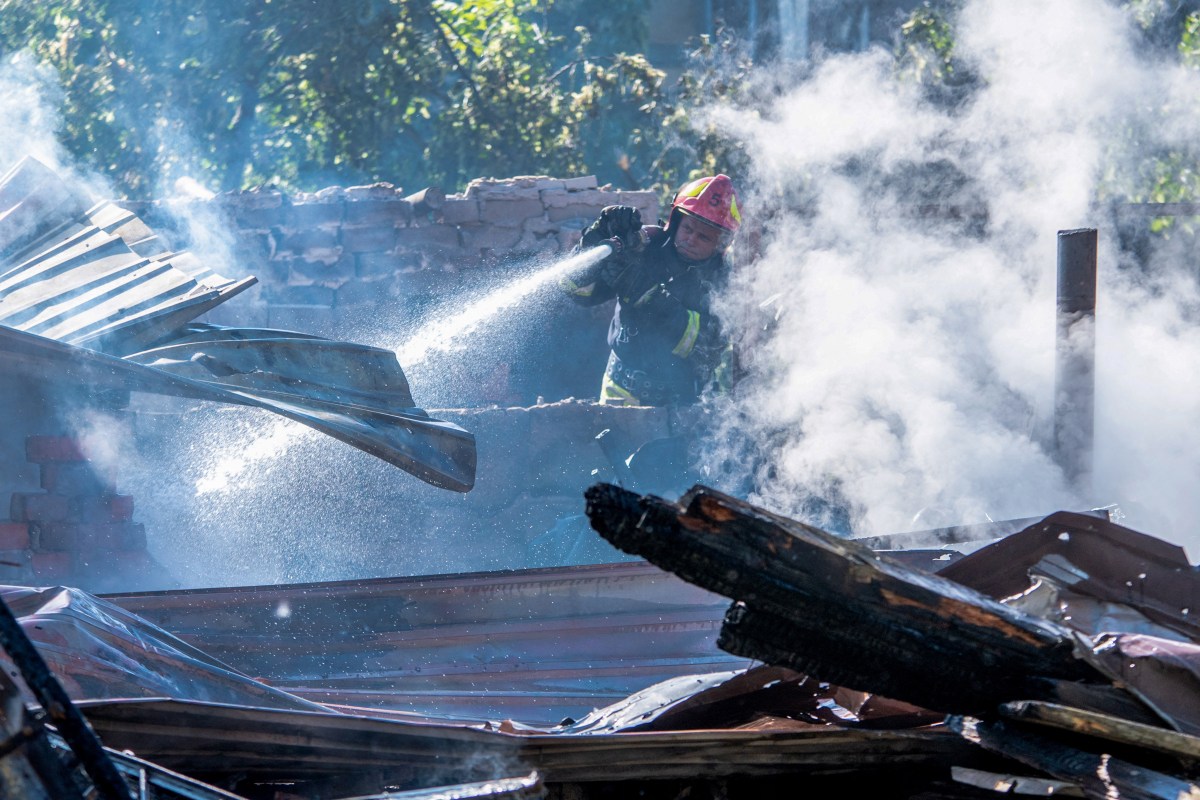
Russia launched one of its largest aerial assaults of the war overnight, firing 656 attack drones and 73 cruise, ballistic and hypersonic missiles at Ukraine, according to the Ukrainian Air Force.
At least 11 people were killed across Ukraine after one of Russia’s biggest aerial attacks of the war which comes as Moscow’s forces face battlefield setbacks.
The barrage also highlights how Russia has increasingly relied on mass drone attacks throughout 2026, enabled by expanded domestic production of Shahed-type weapons and growing launch capacity.
The attacks come as analysts say Russia is struggling on the battlefield.
“Ukraine has the upper hand, that is not a green light for a large-scale Ukrainian offensive, but it does mean Russia will lose lots of personnel and limited territory over the summer,” Mark Montgomery, senior director at the Foundation for Defense of Democracies, a think tank, told Newsweek.
Kyiv Bears Brunt of the Attack
In the Ukrainian capital, at least four people were killed and another 65 injured, according to Mayor Vitali Klitschko. Ukrainian officials said that at least seven were killed in Dnipro and 36 others were injured.
The eastern cities of Poltava, Kharkiv and Zaporizhzhia were also targeted with Ukrainian authorities saying their air defenses destroyed or suppressed 40 missiles and 602 drones.
The Russian Defense Ministry said on Tuesday that the strikes targeted defense production plants and transportation infrastructure used by Ukraine’s military and were carried out by long-range, high-precision air-, land- and sea-based weapons—including hypersonic aeroballistic missiles and attack drones.
The strike was a response “to the terrorist acts of the Kyiv regime,” the defense ministry said, likely referring to Russia’s condemnation of a strike on Starobilsk in the occupied part of Luhansk oblast on May 22 which Moscow said had killed 21 people. The death toll has not been independently verified and Kyiv said it targeted a military site.
On May 25, Russian Foreign Minister Sergey Lavrov had warned of plans to strike Ukrainian “decision-making centers” and urged Washington to evacuate its embassy in Kyiv. Moscow’s foreign ministry also urged foreigners to leave Kyiv.
Civilian Areas Hit
Russian forces struck the Podilskyi district in the capital, hitting a nine-story building collapsed following a reported double-tap strike, likely trapping people under the rubble, according to Klitschko.
Video posted on social media also showed people sheltering in Kyiv’s metro system to escape the bombardment.
In the city of Dnipro, 240 miles south of the capital, at least 49 buildings were damaged in attacks, with photos and videos posted online showing the extent of the destruction.
On May 24, Russia launched 90 missiles and 600 drones against Kyiv and the surrounding region in a barrage which included an Oreshnik intermediate-range ballistic missile (IRBM).
Those attacks damaged Ukraine’s Cabinet of Ministers, Foreign Ministry building, the Kyiv Opera Theater, the Ukrainian House, the Valeriy Lobanovskyi Dynamo Stadium, and the Chornobyl Museum.
Russia’s Battlefield Setbacks
Dara Massicot, a senior fellow at Carnegie Endowment for International Peace, a think tank, posted on X that it was notable that Monday night’s strikes on Kyiv included the use of 20 Iskandr and Tsirkon missiles.
According to the Institute for the Study of War’s latest analysis on Monday, Russian forces have lost 108 square miles of territory since December 2025 and only gained control or infiltrated 15 square miles during the same time frame.
The Washington Post reported Tuesday that Moscow’s escalating aggression was because it was facing increasing military and economic difficulties and could signal a push to revive peace talks in pursuit of a deal that favored Putin.
Read the full article here
