

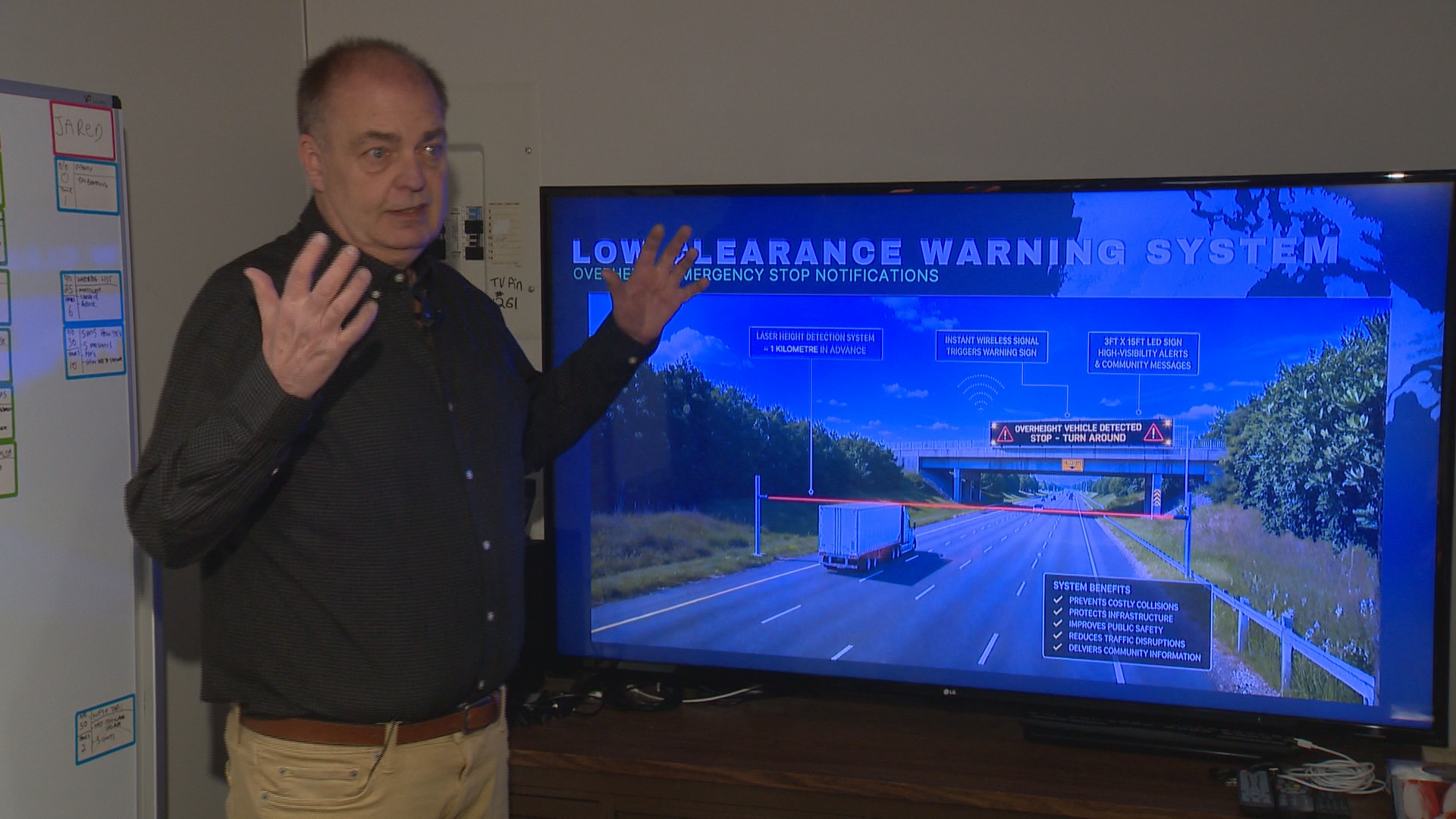
A local Saskatoon businessman says he has a potential solution to prevent oversized vehicles from striking overpasses, following four crashes earlier this year.
Vince Hardy, chief executive officer of ConX Wireless, says he took to the drawing board to think up a solution when he heard of the first strike in early March.
“The first overpass hit literally was like, ‘Wow, OK, I got to do this,’” he said.
Hardy’s early-detection design uses two laser devices that cast an invisible beam to measure a vehicle’s height as it approaches an overpass. If a truck breaks the beam, the system will transmit a signal to a large LED sign posted on the overpass with a message warning drivers up to a kilometre away.
The system can also notify police and city administrators of the breach and can act as a regular road sign when not in use, Hardy said.
“We kind of took it a step further to work the way it is,” he said. “They use similar products for assembly lines, conveyor belts, and airports for luggage. It’s very common.”
Hardy estimates that installing the technology would be a straightforward process that would take only a few days. He says that if he were given the green light from the city today, procuring the hardware from Germany would take the most time, estimated at a few weeks.
“Locally, we do the software for it between the device and the server. We do all of the assemblies here,” he said.

Get breaking National news
Get breaking Canada news delivered to your inbox as it happens so you won’t miss a trending story.
The City of Saskatoon said in an emailed statement to Global News that final repair costs following the four March overpass strikes have not been finalized.
“Some cost recovery details are associated with active claims, and preliminary figures cannot be shared until that process is complete,” said a city spokesperson.
Previous cost estimates shared by the city for the first two strikes totalled $750,000.
Hardy says his technology would cost around a quarter of that.
“We’re still awaiting them to contact us to at least learn about this to see if there’s a benefit to them or not,” said Hardy, adding that small-scale testing has him confident his system will help avoid future overpass strikes in the city.
Todd Grabowski, engineering manager for the City of Saskatoon, told Global News in a statement that people are welcome to reach out to the city directly for consideration.
“Ultimately, it’s important to note that professional drivers are responsible for ensuring the height of their vehicle or a load being hauled does not exceed the posted heights on overpasses in Saskatchewan,” Grabowski added.
At a city council meeting in March, Terry Schmidt, Saskatoon’s transportation and construction general manager, shared a report from city administration to council on the two initial strikes. Here, he shared that the administration is looking to pilot CCTV and overheight sensing devices at a location experiencing repeat strikes.
Repairs for three out of the four overpasses are also still underway, according to the city. Timelines of their completion depend on the condition and priority of each structure, with repairs for the remaining overpasses planned for later this year.
“There are liability risks that come with that if they are not operating, and a truck hits the bridge, then it becomes a liability issue, possibly. So we are looking at all of those things and will prepare a report on that,” Schmidt told council at the meeting.
Saskatchewan already uses electronic warning systems at two overpasses in Regina and Moose Jaw and has been doing so for around a decade. The highways ministry notes that these are planned for decommissioning in the future, as recent projects to raise the heights of the overpasses to the new ministry standard of 5.3 metres will be underway.
“Unfortunately, Saskatchewan’s extreme heat and cold continually cause malfunctions and the systems require heavy maintenance,” the ministry said.
“The ministry will always consider new and innovative ways to improve safety but the technology must be cost-effective, reliable and work consistently in Saskatchewan’s climate.”
The Highway 16 overpass that goes over Highway 11, the first to be hit on March 5, has since been fully repaired.
Tenders for fixing the 108th Street overpass over Circle Drive, the second to be struck on March 11, are currently open, according to the city.
The city spokesperson adds that the Canadian Pacific Railway overpass, which was the third to be hit on March 22, is being managed by the CPKC rail company.
Meanwhile, repairs to the McKercher Drive overpass over College Drive, which was also struck on March 22, are to be completed on a time-and-materials basis “when scheduling allows” through the bridge minor maintenance program.
Read the full article here
