

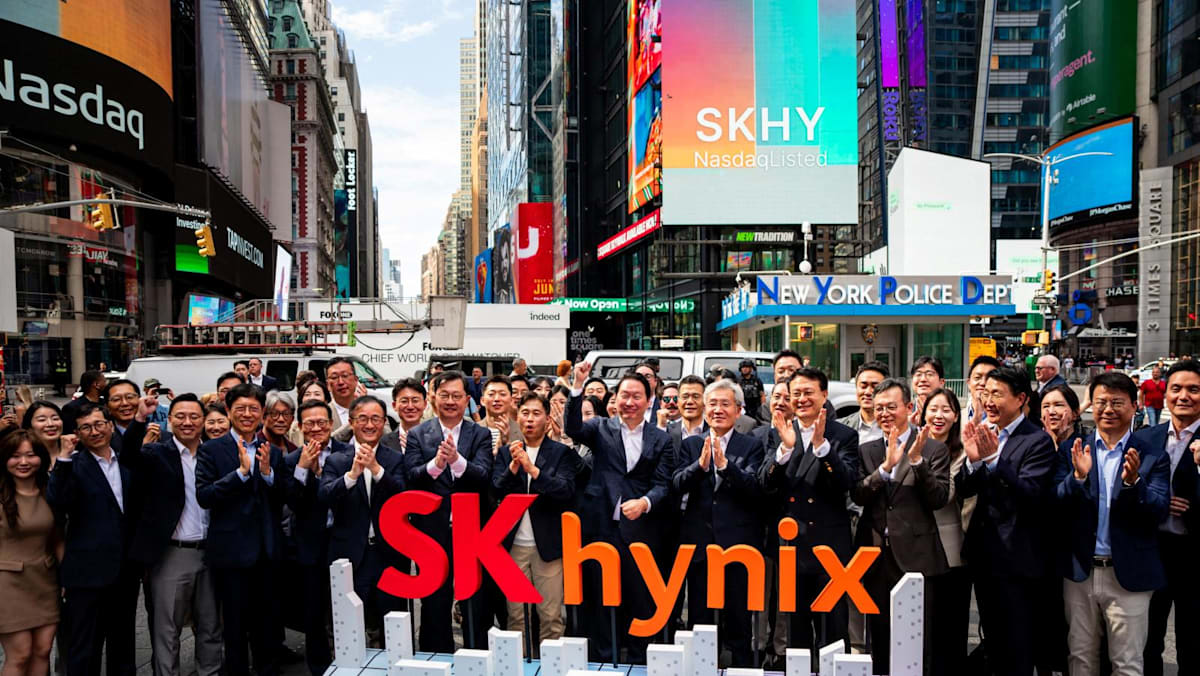
South Korean chip giant SK hynix started trading on Wall Street on Friday (Jul 10) after one of the world’s largest share sales.
Its debut marks the largest US listing by a foreign company, underscoring strong investor appetite for firms at the centre of the artificial intelligence boom.
But SK hynix’s rise to the top of the semiconductor industry was anything but smooth.
In one of the biggest turnarounds in South Korea’s corporate history, the company has rebounded from the brink of collapse to become one of the world’s most valuable semiconductor firms today.
FROM CRISIS TO COMEBACK
Founded in 1983 as Hyundai Electronics, the company went through a series of crises and ownership changes before eventually becoming SK hynix.
It came close to bankruptcy in 2001 as global chip prices plunged, surviving only after a bailout by creditor banks, led by state lenders.
Later, burdened by debt following aggressive expansion, it was at one point nearly sold to US-based Micron. The deal fell through, leaving the firm under creditor control for nearly a decade.
By 2003, its shares plunged to as low as 135 won (US$0.09), earning it the label of a penny stock in South Korea.
A turning point came in 2012, when telecoms conglomerate SK Group acquired the company and renamed it SK hynix.
The acquisition was widely seen as risky at the time, with Samsung valued at more than 10 times its size. But it laid the foundation for SK hynix’s eventual rise.
But the deal laid the foundation for SK hynix’s eventual rise.
Rather than competing head-on with Samsung in conventional memory chips, SK hynix focused on carving out an edge.
It placed an early bet on high-bandwidth memory chips (HBM) – a then-niche technology designed to process data at much faster speeds but was not widely used by data centre customers.
“We believed that it would be impossible to overcome Samsung in commodity Dynamic Random-Access Memory (DRAM) products,” former SK hynix HR executive Hyun Sun-yeop said.
“We were desperate to change the market dynamics. We needed a breakthrough.”
That breakthrough came in the form of HBM chips, which would later prove critical to AI computing.
They helped SK hynix recover from the global memory industry’s boom-and-bust cycle much faster than Samsung, and soar to record profits.
It even overtook Samsung as the world’s top DRAM maker in 2025.
“No one would ever have imagined that SK hynix would overtake Samsung,” said Shin Jae-yong, a business administration professor at Seoul National University.
“It is almost impossible for a runner-up to catch up with the market leader in this capital-intensive industry, which requires massive investment. HBM was the powerful driver behind how they turned the tables.”
Read the full article here
