

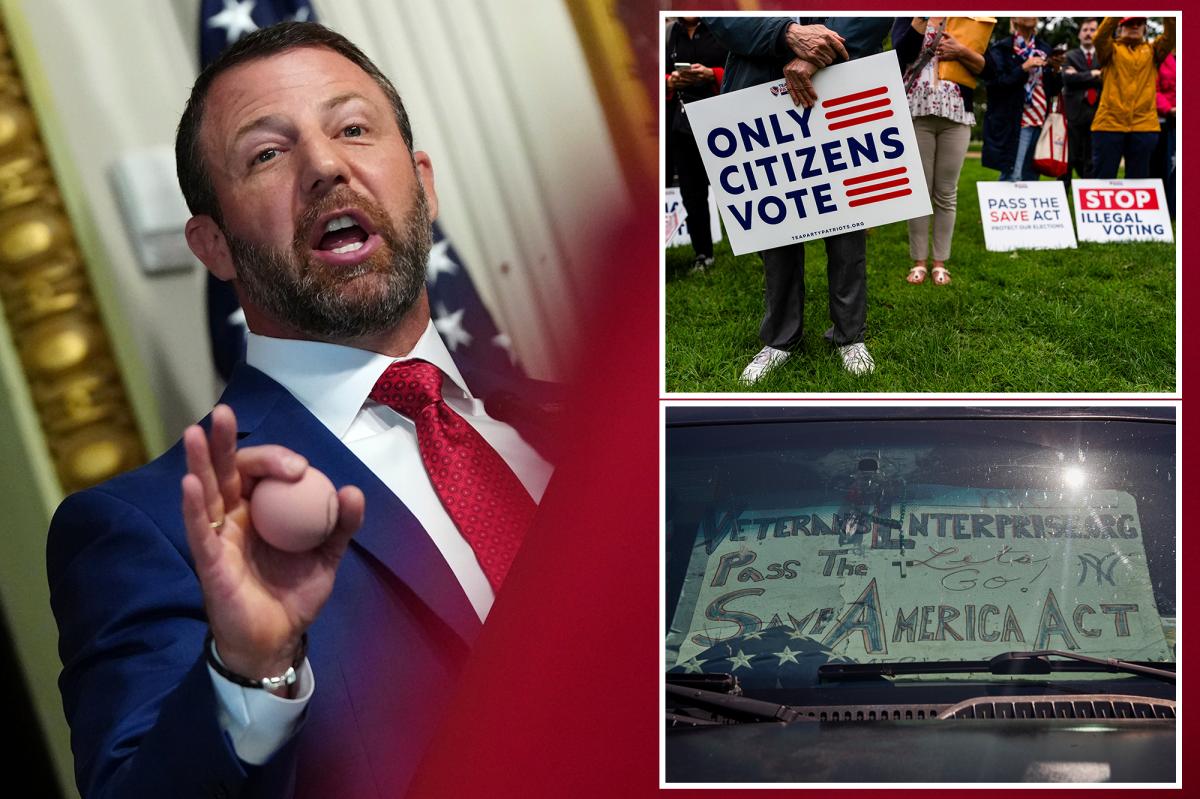
Homeland Security Secretary Markwayne Mullin warned states on Friday they must cooperate with DHS on election security measures or their federal funding will be yanked.
“We are going to make our security enhancements mandatory, meaning that if these states want a grant and they want to be reimbursed to work or to run federal elections, they’re going to have to implement security issues,” he said.
Mullin was following up on President Trump’s address to the nation on Thursday night where the president claimed China interfered in the 2020 election because Beijing didn’t want him to spend a second term in office.
The Homeland Security secretary announced new election security crackdowns for the states ahead of the November election.
Follow The Post’s live coverage of President Trump and national politics for the latest news and analysis
“We ensure that the midterm elections are going to be secure,” he said.
The New Requirements
The Department of Homeland Security has five specific requirements for states:
- States must submit a plan for transitioning away from unsecure electronic voting systems that use bar codes and QR codes to count votes and instead use equipment that accepts hand-marked paper ballots.
- After each federal election, states must conduct a manual audit of at least 5% of all ballots cast – a random selection to check for any machine errors or manipulation.
- States must reconcile the number of voters who participated in each federal election with the number of ballots cast.
- Within 120 days of accepting the grant award, states must use the reliable and free US Citizenship and Immigration Services’ Systematic Alien Verification for Entitlements (SAVE) system to verify the citizenship status of everyone listed in the state voter registration database.
- States must also use the SAVE system, or another authorized government system, to verify the citizenship of anyone working at polling places or operating election systems.
Without these steps, states risk losing $1 billion of taxpayer funds available for security measures through the Department of Homeland Security.
“We are going to make our security enhancements mandatory, meaning that if these states want a grant and they want to be reimbursed to work or to run federal elections, they’re going to have to implement security issues,” Mullin said.
Some states have already been notified about security issues.
Homeland Security sent letters to four states – California, New Jersey, Nevada and Pennsylvania – to warn them they have thousands of non-citizens on their voter rolls.
Those include:
- 190,832 non-citizens registered to vote in California.
- 35,152 non-citizens registered to vote in New Jersey.
- 15,903 non-citizens registered to vote in Nevada.
- 14,576 non-citizens registered to vote in Pennsylvania.
“We’re not trying to change the outcome. We’re trying to make sure that American people can trust our voting system,” Mullin said of the election-related measures.
The states pushed back, noting it’s already the law of the land that only Americans can vote in US elections and that provisions are already in place to check voters’ identification before they can cast a ballot.
“California law is clear: You MUST be a U.S. citizen to vote state and federal election [sic],” California Gov. Gavin Newsom wrote on social media. “Voter fraud is EXTREMELY RARE — and almost always committed by U.S. citizens.”
And Pennsylvania Gov. Josh Shapiro (D) told MS NOW’s Morning Joe that if the administration has “information, share it with us and let’s work together to address it. I think, at the end of the day, all they have is a bunch of conspiracy theories.”
Pennsylvania’s Secretary of State’s office noted that voters in the state “must take steps to verify their identity before they cast a ballot, including providing proper identification every time they register to vote, vote by mail, or vote at a new polling place.”
This is a common procedure in most states.
The White House documents
Trump has long claimed the 2020 election was “stolen” and, on Thursday night, he blamed China for his loss and charged the “deep state” with hiding crucial intelligence from him during his first term.
The White House released a tranche of documents on its website that the president said would back up his claims.
In his remarks, Trump pointed to specific instances that showed concerns China was trying to influence the election in favor of Joe Biden, who ultimately won in November 2020.
The documents, however, are full of contradictions, including an acknowledgement that while several nations have the ability to interfere in US elections, there is no clear evidence of a plan for interference.
“We assess that at least Russia, China, Iran, and North Korea have the capability to access and potentially manipulate data in US election related computer systems, but we do not know whether they have specific plans to interfere with the functioning of these systems,” read one piece of intelligence.
The files also note it would be difficult for these countries to manipulate the voting process on a large scale “without detection.”
Trump also claimed China had the voter files of 220 million Americans. However, many states make their voter data rolls widely available to the public. They are also available for purchase. Typically, both political parties obtain these rolls and use the voter information to try and get out the vote to help their candidates.
Beijing did want to see Trump defeated in the 2020 election and stepped up its rhetoric against his administration to try and influence public opinion. It also tried to manipulate public perception via social media.
“We assess that Beijing has taken some low-level, exploratory steps to denigrate the President and shape voter perceptions ahead of the election,” the intelligence read.
However, the intelligence also showed that officials didn’t see Beijing “trying to influence the outcome of the presidential election in favor of one candidate or another.”
Their assessment was that China believed the risk of interference “outweighs any potential gains.”
On the flip side, Russia didn’t want Joe Biden to win and attempted to influence American voters against him.
It’s unclear if the two countries’ efforts canceled each other out.
In the bigger picture, intelligence agencies worried about having Americans’ confidence in their elections undermined.
“We assess that adversaries could also make false claims about their ability to manipulate US election infrastructure as part of a broader effort to undermine confidence in US democratic processes,” the documents note.
“Much of the voting public probably knows little about the process of administering US elections, which could allow false narratives to gain traction.”
Such claims could be “impossible” to prove.
“Adversaries could make wholly fabricated claims, such as announcing that they have compromised all US voting machines, a claim that would be difficult and time-consuming — or impossible — for the US Government to disprove,” the documents note.
Curiously, the agency that compiled the presidential daily brief chose to leave out any election-related analysis. This was during Trump’s first term in office.
“We have deliberately massaged our one pending PDB to avoid any direct links to the election,” one email read.
It’s unclear why. There is a long email chain argument about foreign forces trying to influence the election. But the senders’ names are redacted. And much of the information in the emails is redacted.
John Ratcliffe, the current CIA director, was director of national intelligence in Trump’s first term and was part of the intelligence network that compiled the PDB. The CIA also had input as did the National Security Council.
What remains a question mark is if any illegal votes were cast in the 2020 contest and if any vote was changed.
The White House did not respond to a request for comment.
Sen. Mark Warner (Va.), the top Democrat on the Senate Intelligence Committee, brushed off Trump’s claims, saying they were old intelligence that had long been debunked.
He also pointed out to MS NOW that Trump’s own people were in charge at the intelligence agencies during this time period.
“Why didn’t they find any of these so-called allegations?” he asked.
Push to pass the Save America Act
Trump used his Thursday address to push for passage of the Save America Act. The legislation would require Americans to prove their citizenship when registering to vote and to show photo identification.
The president, however, has added a host of other provisions to the legislation, including a section to ban most mail voting, banning transgender women and girls from competing in women’s and girls’ sports, and restricting transgender medical treatments for minors.
The legislation has passed the House of Representatives but is stuck in the Senate.
Senate Majority Leader John Thune says he doesn’t have 60 votes necessary to move the bill through the legislative process and some of that resistance is from Republicans.
Republican Sen. Thom Tillis (N.C.) has been vocal in his opposition, arguing states do not have time to implement its measures before November’s midterm election.
“I will use every device I have available to slow down the wheels of government until people cop a clue and do the math,” Tillis said Wednesday on the Senate floor.
“What we’re going to do if we continue down this path is to convince the American people that you can’t count on your election results,” he noted. “And that is dangerous. That is irresponsible.”
Trump argues the Save America Act is essential for protecting elections.
“Our elections were left vulnerable to being rigged and stolen, and the trust of the American people was lost. This cannot be allowed to continue,” he said Thursday night.
Mullin expressed sympathy for Thune’s predicament.
“John is a good friend of mine,” Mullin, a former senator, said. “I think the Save Act should be passed tomorrow. I think it should have already been passed. There’s no excuse for it not being passed. However, he has a vote problem.”
Mullin noted Thune supported the Save America Act but can’t control individual senators.
“Everybody controls their own card,” he said.
Read the full article here
