

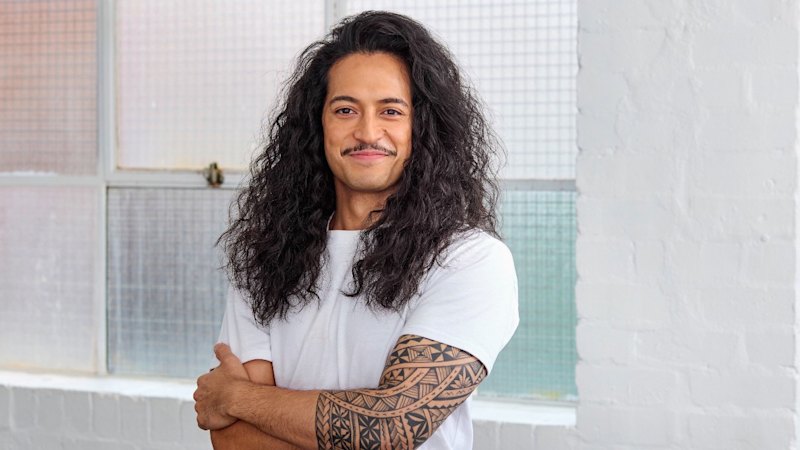
An out-of-date promotional portrait of Filipe Manu still gets used a lot because in it, he doesn’t look much like an opera singer.
The New Zealand tenor’s black hair curls down to his shoulders Fabio-style; a Clark Gable moustache smoulders on his upper lip; and a skimpy black vest reveals a geometric Tongan tatatau covering his left upper arm and shoulder.
These days, Manu’s hair is cut short, but the tattoo ain’t going anywhere. When he went to Austria in 2024 to sing Ferrando in the Wiener Staatsoper’s production of Cosi fan tutte, he sheepishly approached the director, Melbourne-born Barrie Kosky, to warn him about the ink.
“And he goes: ‘Oh yeah? Give me a look.’ And he’s like: ‘Great! I don’t care! I’ll put you in a singlet!’”
You don’t have to be an avant-garde director like Kosky to realise that singers like Manu are good for opera, for breaking down preconceptions and finding new audiences.
Manu is a Prince fan, grew up playing rugby union, and is the first person to have sung in Tongan at the Royal Opera House, Covent Garden.
Opera Queensland chief executive and artistic director Patrick Nolan says Manu has the “X factor”.
“He’s got a beautiful voice, but he’s also got charisma. Word quickly spreads when a special singer emerges, and particularly a tenor – for some reason, good tenors are harder to find.”
Indeed, Manu was still studying at the Guildhall School of Music and Drama in London when invited to make his Royal Opera House debut.
He has been a London-based freelance singer ever since, with appearances at Opera National de Paris, the Staatsoper Hamburg, Gran Teatre del Liceu and Glyndebourne.
He returns to Australia in May, both to headline Opera Queensland’s Festival of Outback Opera in Winton and Longreach, and to play Alfredo in Opera Australia’s La traviata in Melbourne (sharing the role with Oreste Cosimo).
Oddly enough, it’s a homecoming of sorts for Manu, who was born in Armidale, his parents having moved there from Fiji with Manu’s four older brothers.
Early memories of Australia centre on two photographs: a snap of his Tongan mum, Sesilili, leaving the hospital after he was born, and a postcard of the Sydney Opera House.
“For a long time, I thought the Opera House was the New England Hospital,” Manu recalls.
After the family relocated to Auckland, Sesilili worked two jobs to make ends meet, and secured Filipe a scholarship to Dilworth, an exclusive boarding school for disadvantaged boys.
There he came under the influence of Claire Caldwell, the school’s inspirational director of choral music.
“She took us to a lot of operas. At first, it was just a bit of fun to get out of class, but then I really started to understand it and fall in love with it.”
Caldwell, now a voice teacher and accompanist, recalls Manu’s first visit to the NZ Opera, seeing Verdi’s Macbeth at the Kiri Te Kanawa Theatre in Auckland.
“He spent the whole performance leant forward with his hands on his chin, just taking it all in. And he turned to me at the end and said, ‘Miss, how do I get to do that?’”
“In the Polynesian community, singing is so normal,” Manu says. “Everyone sings at church, it’s as normal as playing rugby, so it was a natural progression to join the choir.”
An oft-quoted story has Manu turning up to watch the Lexus Song Contest in 2010 after a game, still in his rugby shorts. It was the year Samoan soprano Aivale Cole took top prize.
“I just wanted Filipe to see another role model from the Pacific – that this wasn’t sort of a white privilege,” Caldwell says.
Another one of NZ’s biggest opera stars, Dame Malvina Major, encouraged him to apply for the University of Waikato’s Bachelor of Music program, for which he was accepted as a Sir Edmund Hillary Scholar.
Stints at the New Zealand Opera School and victories in the IFAC Handa Singing Competition and the Lexus Song Quest took him to Guildhall.
He made his Opera Australia debut in Cosi fan tutte last year, and it’s with OA that he’ll finally get to play Alfredo in Verdi’s middle-period masterpiece La traviata.
“I remember singing in the chorus for it back in New Zealand, and singing one of the minor roles in London. And every night, sure enough, it was the same scene that would test the tenor.”
He’s referring to the end of act two, when the spurned Alfredo gambles against Violetta’s new lover, the Baron Douphol. “Alfredo’s singing all these top notes, it’s fluctuating between these highs and lows … I’ve had to find a new technique and a new way to meet the vocal demands.”
The Festival of Outback Opera, now in its sixth year, has two flagship concerts under the stars: one on a cattle station near Longreach, and the other on a prehistoric plateau called the Jump-Up at the Australian Age of Dinosaurs Museum outside Winton.
Manu will be singing repertoire including Donizetti, Gounod’s Romeo et Juliette, and an excerpt from Mozart’s Mitridate that he describes as “a firework piece”.
“It goes from the lowest notes that I have to the highest notes that I’m yet to find,” Manu says.
With previous headliners including Kate Miller-Heidke and Sumi Jo, and opera stars rubbing shoulders with locals on dusty streets and in historic pubs, the event has helped redefine what opera can be.
Which brings us back to the tattoo.
“It’s very much part of who I am,” Manu says. “When they don’t want it, they can just put a long-sleeve shirt on me.
“It’s a very different climate now from what it was, you know, back when Dame Kiri Te Kanawa was performing.”
La traviata is at the Regent Theatre, Melbourne, May 8-16, and Manu is appearing in the Opera Australia 70th Anniversary Gala there on May 17. The Festival of Outback Opera is in Winton and Longreach, May 19-25.
 Nick Dent is a Culture Reporter at Brisbane Times, covering arts and things to do in the city.Connect via email.
From our partners
Read the full article here
