

Good morning. It is Angela Skujins holding the pen for today’s newsletter from Brussels, where it seems the spotlight is firmly 4,300 kilometres away in the South Caucasus.
Leaders from all across Europe are meeting today in Yerevan, Armenia, for the eighth edition of the European Political Community (EPC).
The meeting – boasting almost 50 heads of state on its invite list – will focus officially on a raft of issues, such as democratic resilience, hybrid threats and economic security. But it is the behind-the-scenes chatter which is expected to turn the most heads.
Romanian President Nicușor Dan has said on social media platform X he will prioritise a discussion about energy security. Polish Prime Minister Donald Trump took a different tack, and enthused the meet-up will emphasise the European-American “friendship”.
“And that there is no alternative to this. We need each other more than ever before,” he wrote on X.
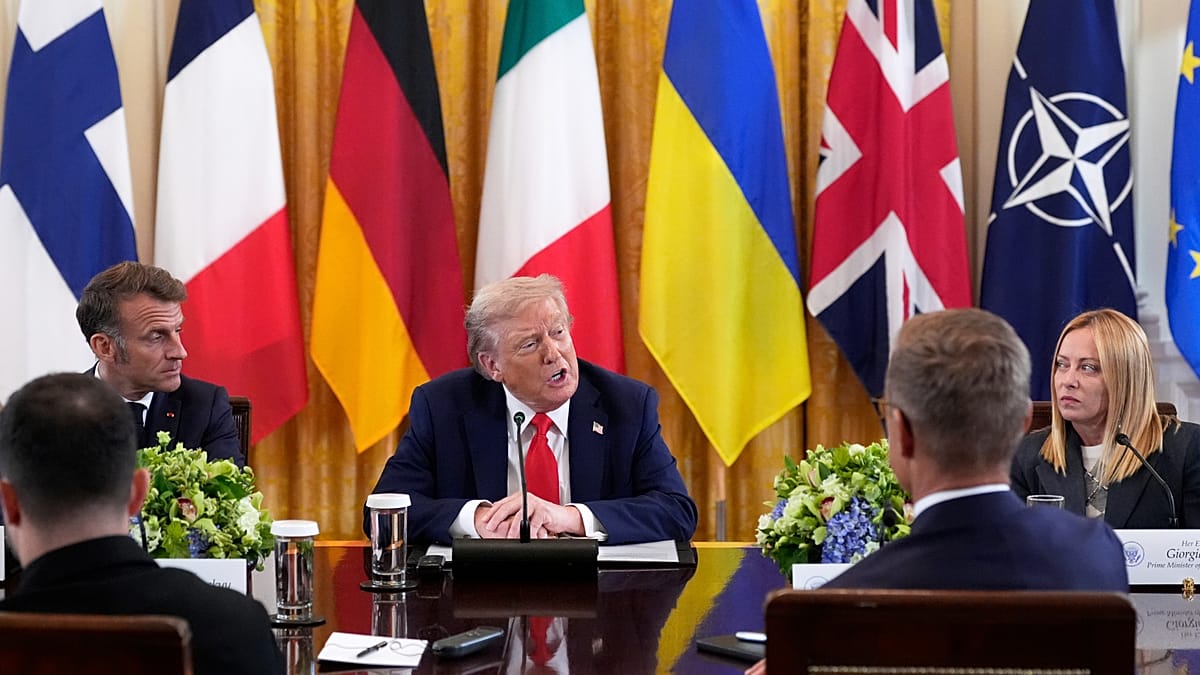
With Armenia sharing a land border with Iran, the conflict in the Middle East will loom large. Talks are also expected to be centred on the role of US President Donald Trump in Europe – and how leaders on this side of the Atlantic can weather recent announcements from US President Donald Trump.
The Republican leader announced over the weekend he would slap 25% tariffs on European cars and carparts, which will bruise the German economy – a major automotive heavyweight.
Bernd Lange, a lead Member of the European Parliament currently negotiating the implementation of the deal with EU member states, criticised Trump’s announcement. He said this showed “clear unreliability”, and accused the US of repeatedly “breaking its commitments” in its trade relations with the EU.
He told Europe Today that Trump is “really angry” against Germany and he is convinced he is targeting German car manufacturers. This is “really politically against Germany”.
On top of this, it was confirmed on Friday that Washington would withdraw roughly 5,000 troops from Germany, sending question marks flying over the NATO military alliance’s force posture in the region. Many see this as retaliation for German Chancellor Friederich Merz’ criticism of the negotiations surrounding the Iran war.
“The United States is and will remain Germany‘s most important partner in the North Atlantic Alliance,” Merz wrote on X.
This conversation in Armenia will only be made more interesting through the attendance of Canadian Prime Minister Mark Carney, marking the first time a non-European leader will join the format.
As Euronews’ Europe editor Maria Tadeo points out, the Liberal Party leader flew 11-hours for an 8-hour meeting – a big commitment to diplomacy.
The invitation, however, is not coincidental. For the past year, Europe and Canada have found themselves the target of US President Donald Trump’s fury, suffering twin tariff and annexationist threats.
As Jorge Liboreiro writes in, Carney has pitched a new alliance of mid-sized powers to face up to the US and China, while several polls have shown support among Canadians to (at least) consider EU membership.
The prime minister’s participation “demonstrates the close proximity between Europe and Canada,” a senior EU official said, who sought to tone down the prospect of a nascent anti-Trump coalition. “I don’t think more should be read into it.”
European Council President Antonio Costa, who will be co-chairing the EPC alongside Armenian Prime Minister Nikol Pashinyan, has publicly remarked why the invitation is important. “Europe and Canada are more than just like-minded partners — together we are building a global alliance to defend peace, shared prosperity and multilateralism,” Costa wrote on X.
But don’t expect any tangible outcomes from the EPC. The magic of the meeting is what occurs on the sidelines, with leaders’ backroom bilaterals immortalised through photographs showing politics in action.
‘No strategy’ behind Trump’s withdrawal of NATO troops from Germany, sources say
Senior NATO officials were not warned about US President Donald Trump’s decision to withdraw 5,000 troops from Germany prior to the Pentagon’s announcement on Friday.
As Shona Murray reports, questions about logistics such as from where and how the troops will be withdrawn have arisen among the alliance’s military circle. It is also unclear how the decision will impact the defence alliance’s overall force posture, several sources with knowledge of the situation said.
Trump on Saturday added that troop presence in Germany will be reduced “a lot further” than the initially announced 5,000, but the Republican president did not detail how much further or when those reductions are to be expected.
According to sources, the announcement which took senior NATO command by surprise is short on detail. Washington has not detailed whether the troops who’ll be departing Germany are from a rotation that won’t be replenished, an air squadron or if the troops are part of the core unit.
“We don’t know what these forces are, is it the core of a brigade? an air squadron?” former US ambassador to NATO, Ivo Daalder, told Euronews.
“There is no detail because Trump just made this number up,” another US source told Euronews.
Hungary’s Péter Magyar defends appointing relative as country’s justice minister
Hungary’s Prime Minister-to-be Péter Magyar has defended his decision to appoint his brother-in-law, Márton Melléthei-Barna, as Minister of Justice – despite promises to fight nepotism and corruption after winning at the country’s recent landslide April parliamentary election.
As Gábor Tanács writes, the incoming Tisza leader posted a six-minute video backing the appointment, stating: “We need to start putting our country back on track, bringing home EU funds, kick-starting the economy and improving public services.”
He said concerns regarding the family relationship inside the ministerial team are “understandable,” and that his sister, Anna Ilona, would be suspended from the judiciary where she worked as a judge.
It is unknown how Brussels will react to this news, as Magyar campaigning on a policy platform of cleaning up Hungarian politics and restoring checks and balances.
He has also recently met with European Commission President Ursula von der Leyen and European Council President Antonio Costa in the Belgian capital regarding resetting relations between Hungary and the bloc, and unlocking billions of euros in frozen EU funds.
This Brussels-Budapest relationship was strained during the 16-year tenure of outgoing Hungarian Prime Minister Viktor Orbán with concerns of rule of law violations and democratic backsliding.
More from our newsrooms
French interior minister vows tougher action against illegal raves
France’s Interior Minister, Laurent Nuñez, promised to clamp down on illegal rave gatherings after up to 40,000 people attended an event over the weekend in a community near his homestead. Alexander Kazakevich has more.
End of the rescue operation: Humpback whale “Timmy” released in the North Sea
The humpback whale that was rescued from a shallow Baltic Sea bay off the island of Poel has been released, the private rescue initiative has announced. However, it is unclear what condition the animal is in. Nela Heidner dives deep into the story.
We’re also keeping an eye on
- Finance ministers from the eurozone will meet in Brussels for a Eurogroup meeting focussed partly on the impact of the Middle East crisis on the economy.
- European Executive Vice-President Teresa Ribera and European Commissioner for Enlargement Marta Kos will be in Madrid to celebrate the 40th anniversary of the accession of Spain to the European Union.
That’s it for today. Maria Tadeo, Jorge Liboreiro and Shona Murray contributed to this newsletter.
Read the full article here
