

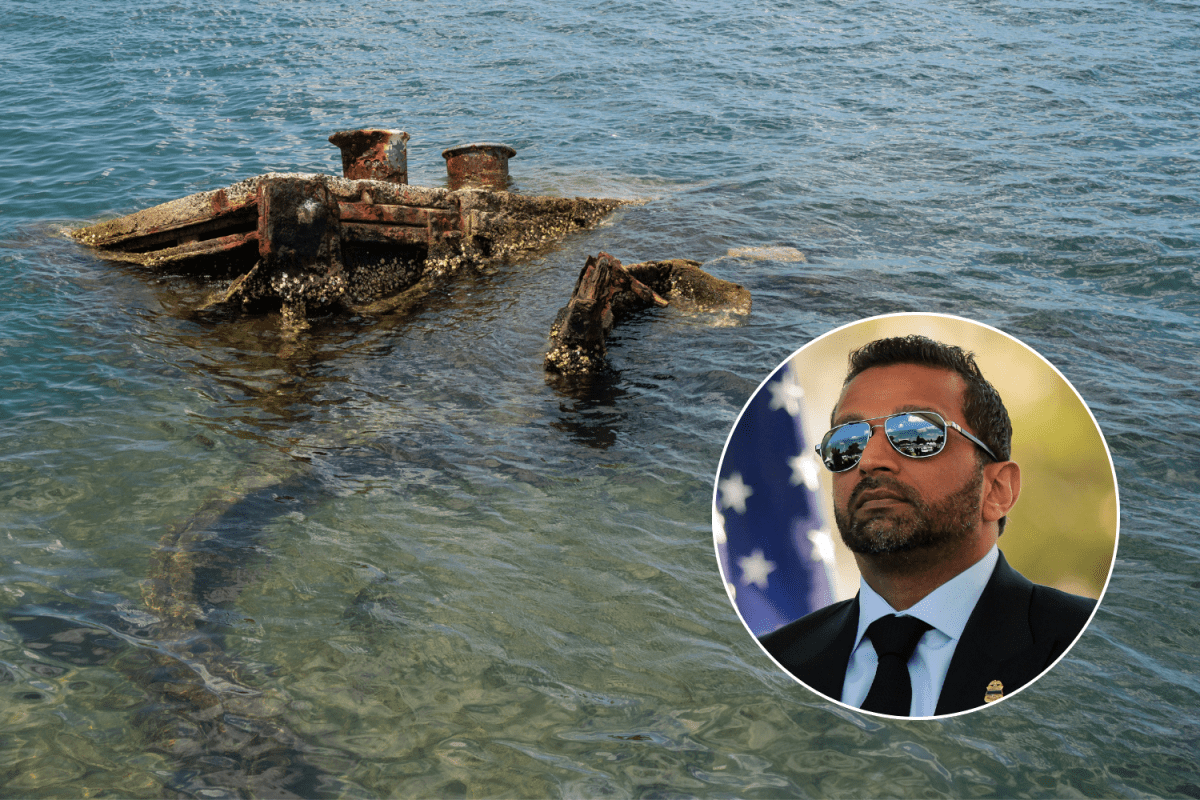
A rare snorkeling trip taken by FBI Director Kash Patel near the USS Arizona has put renewed focus on one of the most tightly controlled bodies of water in the United States—and the reason access is so restricted.
Patel joined what officials described as a “VIP snorkel” during an official visit to Pearl Harbor, Oahu, Hawaii, swimming close to the sunken battleship where more than 900 U.S. service members remain entombed since 1941.
The high-profile trip, arranged through military channels, has prompted questions about how a site widely treated as a war grave is accessed—and why, unlike almost anywhere else in America, the water itself is effectively off-limits.
It was permitted under long-standing but little-publicized exceptions that allow select visitors into the water under supervision.
A Shipwreck That Is Also a Tomb
The USS Arizona was destroyed in the Japanese attack on Pearl Harbor on December 7, 1941, when a bomb ignited its ammunition stores, triggering a catastrophic explosion.
Of the 1,177 sailors and Marines killed aboard, more than 900 were never recovered. Today, their remains still lie inside the wreck, which sits beneath the USS Arizona Memorial.
While the U.S. has hundreds of protected wrecks and restricted marine sites, the Arizona is not preserved primarily for archaeology or environmental reasons, but protected because it is a mass grave.
The U.S. Navy formally designated the wreck as a final resting place after determining that the damage was too severe to recover the dead. Many victims were either trapped within the ship or could not be identified in the aftermath of the explosion.
More than eight decades later, the site remains both a memorial and an active burial ground, where surviving crew members can still choose to have their ashes interred within the ship.
Why Diving Near the ‘USS Arizona’ Is Prohibited
Because of that status, the waters above the Arizona are tightly controlled by the Navy and National Park Service, and recreational snorkeling or diving is generally prohibited.
Officials consistently frame the restriction not as a matter of preservation alone, but of respect. The ship represents nearly half of all U.S. deaths during the Pearl Harbor attack and has become one of the country’s most symbolically significant military sites.
The limits extend beyond simply entering the wreck. Visitors are transported to the memorial by boat and are not allowed to touch the structure or the water around it, reflecting its treatment more as a cemetery than a conventional historic landmark.
Narrow Exceptions—and Why They Exist
Access to the water does happen, but only under tightly defined circumstances. Military divers and National Park Service teams regularly enter the site to monitor the wreck’s condition and manage preservation concerns.
Ceremonial missions are also permitted, particularly when the ashes of deceased survivors are placed inside the ship to reunite them with fallen shipmates—a practice that continues decades after the war.
Outside of those operations, a small number of supervised visits have been granted to officials and dignitaries as part of formal military engagements. These are not public or recreational experiences, and participants are instructed to keep their distance and avoid any contact with the wreck.
Patel’s snorkel trip falls into that category, though its optics have drawn scrutiny precisely because such access is so rare.
A Site Unlike Any Other in the US
The Arizona occupies a singular place in American waters. It is one of the few sites where unrecovered human remains on such a scale remain in place, where the wreck itself is legally and culturally treated as a grave, and where federal policy prioritizes commemoration over exploration.
The ship also continues to seep small amounts of oil into Pearl Harbor—sometimes described as “black tears”—a visible reminder that the events of 1941 are not entirely sealed off from the present.
Together, those factors make the Arizona fundamentally different from other restricted dive sites, including those protected for conservation or historical study. Here, the underlying purpose is not to study the past, but to preserve a place of mourning.
Read the full article here
