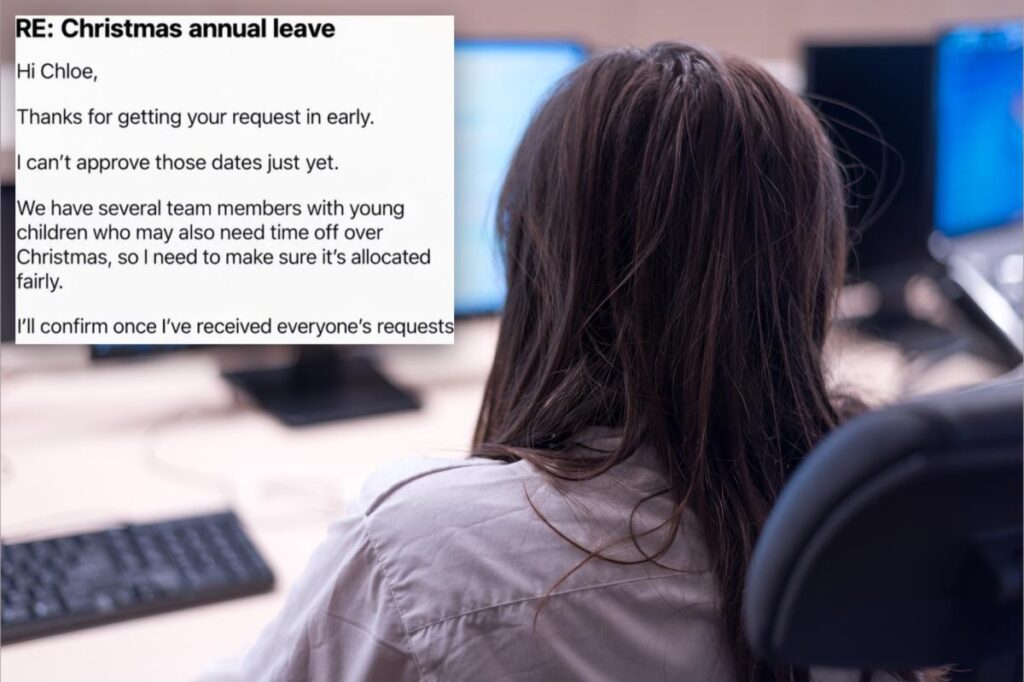
A woman’s annual leave request has highlighted a fiery debate that has long created tension in workplaces: Should employees with young children have priority?
The argument once again erupted online this week after a worker in the UK, Chloe, asked for time off over the Christmas holiday.
Despite submitting her desired dates in mid-September, she was informed by her operations manager, Sarah, that leave requests are not first come, first served.
In the viral email thread posted on TikTok, Sarah tells Chloe that she cannot approve the time off from December 23 to December 27, just yet.
“We have several team members with young children who may also need time off over Christmas, so I need to make sure it’s allocated fairly,” the manager reportedly responded, adding that nothing could be confirmed until everyone’s requests are received.
Seeking clarity on the matter, a “confused” Chloe responded that she had already made plans with her family “based on requesting early”.
“I requested the dates first, so I just wanted to check if having children means someone else’s Christmas plans take priority over mine?” she retorted.
Sarah said Chloe’s interpretation of her message was not correct.
“Christmas is always a busy and difficult period to manage, and I do have to consider individual circumstances, as well as when requests were submitted,” she said.
Annual leave isn’t “first come, first served”, Sarah continued, noting she has to “look at the overall needs of the team” to make sure the business isn’t short-staffed.
In a second video, the manager asks the employee if she has plans to travel over the holidays.
Chloe responds that she is not planning on going anywhere and asks why that even matters.
“Why should someone having children make their Christmas more important than mine?” she said.
Christmas leave request sparks outrage
The email thread shared online by Steady Culture – an account dedicated to workplace drama – has racked up more than eight million views and thousands of comments from frustrated readers.
Some said the heated back-and-forth was a prime example of “people without kids being expected to cater to the needs of those who chose to have children”.
However, some parents argued that it takes a village to raise a child, and that includes their colleagues.
“Parents aren’t being selfish for themselves – it’s for their kids. Before I had kids, I volunteered to work every Xmas so parents woke up to seeing their kids’ reactions to Santa,” one woman wrote.
“Christmas 100 [percent] is more important for people with kids versus people without them,” another argued.
But not everyone could get on board.
“Christmas is for everyone. Having kids doesn’t give you priority. I think this should come under discrimination,” someone disputed.
“The absolute entitlement of parents in these comments is truly disturbing. Kids do not make you more important than child-free people…that’s insanely selfish and disturbing,” another hit back.
Debate erupts for the second time in just months
The heated argument is back in the spotlight just months after Australian fashion brand DISSH announced it was expanding its parental leave policy to give parents and carers an additional two weeks of paid leave annually until their child turns 12.
The policy is offered on top of existing annual leave and allows parents and carers to take up to 14 days of flexible paid time off each year for things like sudden illnesses, doctor’s appointments, and early daycare pick-ups.
While some praised the company’s progressive approach, critics flooded social media to debate whether the additional leave creates an unfair advantage over child-free employees.
Read the full article here