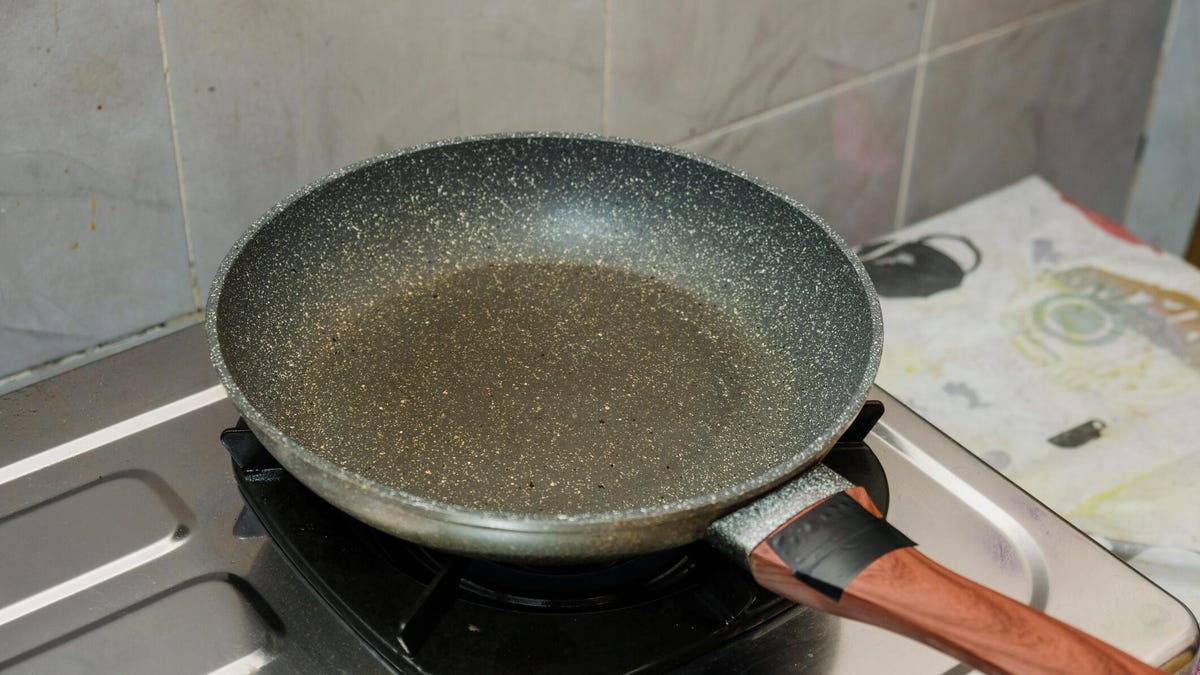
Ask a professional chef what they cook in nonstick pans, and you’ll likely get a short list — a very short list. While nonstick ceramic and PTFE-coated pans have their place in the modern kitchen, most foods do better when cooked with some sort of metal frying pan.
Cast iron, stainless steel, copper and carbon steel do a far better job of imparting heat to food, which is the best way to get coveted char and a reliable sear on meat, fish and vegetables.
Nonstick pans top out at medium heat — which is exactly why your rack should be stocked with mostly pans made from other materials. Searing a steak or chicken thigh in a nonstick pan means fighting for a crust you’ll never quite get. That browning isn’t cosmetic. It’s the Maillard reaction, and it’s where the real flavor lives.
So, what foods should never be cooked in nonstick cookware? I asked Richard LaMarita, a chef-instructor of Health-Centered Culinary Arts at the Institute of Culinary Education in New York. LaMarita describes nonstick cookware, including ceramic, as “niche” and admits it is rarely a go-to pan for most chefs in professional kitchens.
Here’s what LaMarita told me about foods that don’t belong in a nonstick frying pan.
1. Meat and fish
Getting a proper sear on steak, pork chops, chicken or fish is next to impossible in a nonstick pan.
First are foods that require or desire searing on the outside. When you’re looking for a deep, caramelized crust with good color, such as on a steak, chicken breast or a piece of salmon, you won’t get the color you want from a nonstick pan. Nonstick is not made to tolerate the high heat required to achieve the desired crust, and its surface is not geared toward developing that crust because of the coating on the pan.
2. Most vegetables
Cast iron is ideal for cooking vegetables.
Much like meat, vegetables need a little char for maximum flavor, and you just won’t get it with a nonstick pan. For zucchini, carrots, onions, asparagus and bok choy, reach for a stainless-steel or cast-iron skillet for best results.
3. Any food you want caramelized
A cast-iron skillet or stainless-steel pan is best for properly caramelizing an onion or creating a fond (leftover bits of caramelized food).
Do you know about fond? It’s the caramelized, crusty bits of food left on the pan after searing, and it’s the key to big flavor (and happiness). Fond is used to make pan sauces. Items are seared first, then picked up, and those beautiful, tasty bits of food are incorporated into the sauce. For making fond, a nonstick pan won’t work. There is simply not enough surface heat.
4. Acidic foods and wine-based sauces
High-acid foods such as tomatoes and wine- or vinegar-based sauces can corrode the surface of a nonstick pan.
Cooking highly acidic foods in nonstick pans is not recommended. Acidic foods include tomato sauce, dishes with a high ratio of vinegar in the pan (such as braised cabbage), and those with lemon juice in the cooking process. “Ratatouille is one dish I wouldn’t cook in a nonstick,” LaMarita says. “The acids in this recipe and others will corrode the delicate nonstick surface over time.”
5. Recipes that require whisking, scraping and stirring
Recipes that require constant stirring or whisking such as Chinese stir-fry or a delicate sauce are not good candidates for a nonstick skillet.
Along the same lines of wearing down the surface, refrain from cooking foods or dishes that require a fair amount of stirring. A stir-fry, sauce or a dish that demands a lot of tossing and mixing could wear down the surface quickly. “I find that nonstick surfaces wear down eventually, even with proper use, so why speed up that process?”
For more, here’s how to tell if your Teflon pans are safe, and a complete guide to reheating every type of leftover.
Read the full article here