

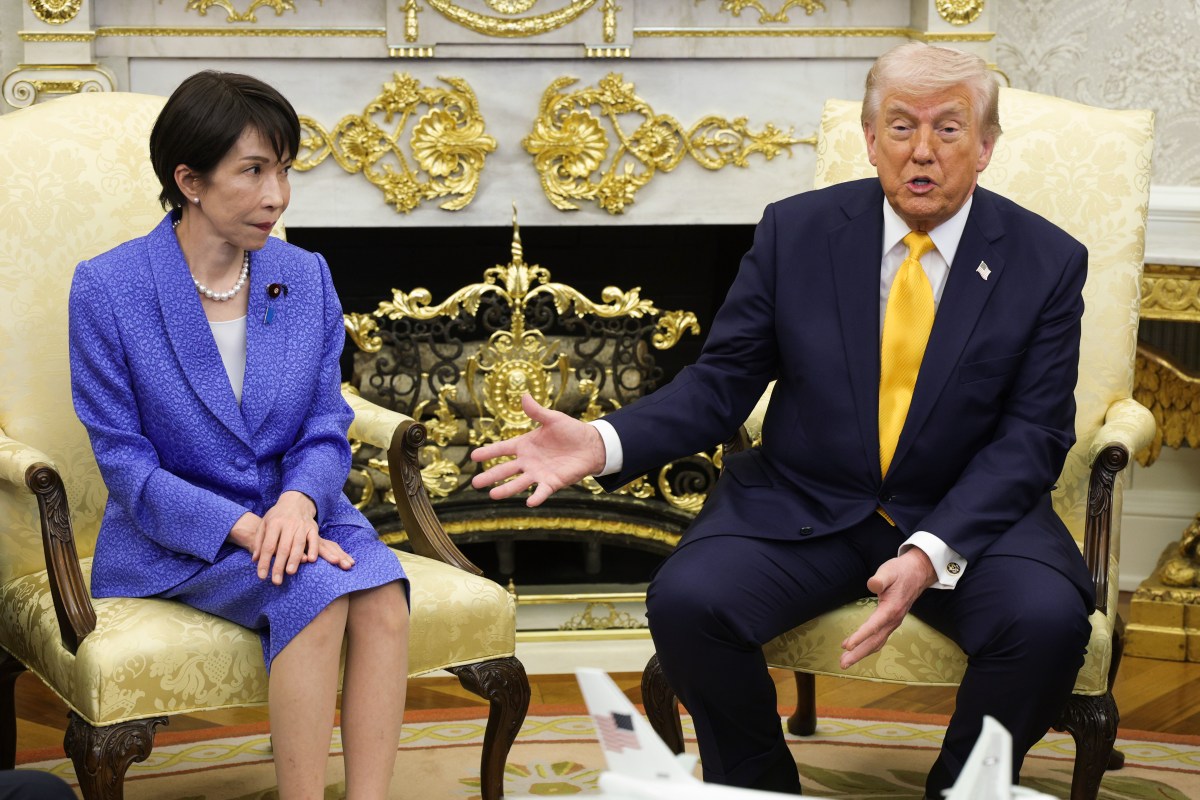
Japan overhauled its pacifist consensus of the past 80 years in just one day last month, when Prime Minister Sanae Takaichi announced an era-defining change to arms exports rules. No longer just a diplomatic power, Takaichi is readying Japan for the inevitable geopolitical confrontations of the 21st century.
The prime minister’s proactivity has won her a rare thing indeed: President Donald Trump’s respect. Here is a leader, the Trump administration thinks, that is paying up for its own security in a region where the threat of an ever-aggressive China looms large.
Takaichi’s reforms green-light the sale of lethal weapons, including missiles, warships and jets. Defense exports were previously limited to nonlethal equipment, a self-imposed policy that came after World War II. There are still rules of the road: Sales will be approved on a case-by-case basis by the National Security Council and weapons are available only to friendly states.
Defense minister Shinjiro Koizumi, a core proponent of arms sale diplomacy, will relish this new tool in Japan’s geopolitical arsenal. He has already presided over a surging military budget, now touching to 2 percent of GDP, which is a 60 percent increase over four years.
The late Shinzo Abe, Takaichi’s predecessor and mentor, faced fierce internal resistance when he sought to create a nascent security state in the face of an increasingly aggressive China. Abe wanted Japan’s military capabilities to match its diplomatic prestige. Buoyed by a supermajority in the House of Representatives, Takaichi has taken up the torch with relish.
Stronger Alliances in a Critical Region
In his first term, President Trump embraced Japan’s vision for a free and open Indo-Pacific, which upholds freedom of navigation and trade, national sovereignty and quality infrastructure. These precepts are both distinctly Japanese and a rebuke of China’s contempt for all three. Trump knows he needs Japan to keep China in check in the Indo-Pacific, through which 60 percent of global trade flows, in and around $1 trillion of U.S. investments.
The United States’ national security strategy and national defense strategy, released in December and January, respectively, rightly position the Indo-Pacific as a critical geopolitical theater.
Japan is also doing the essential work of maintaining the U.S.-led lattice work of alliances in Asia, binding in partners like the Philippines and Australia.
Last month, Australia’s Department of Defence signed contracts for a $7 billion deal with Japan for cutting-edge warships. The Australian navy will receive 11 upgraded Mogami-class frigates in total, built by Mitsubishi Heavy Industries. Koizumi and his Australian counterpart Richard Marles stressed the operational importance of the vessels. The deal also signals to Washington that its regional allies have teeth.
China’s excessive alarm over Japan’s rearmament only underscores the archipelago’s importance for regional security. Any fair-minded observer would not conclude that Japan is seeking to dominate the region militarily. Japan is simply developing the capabilities needed to deter—and, if necessary, respond to—unlawful coercion and aggression against sovereign states.
For example, Japan has allocated approximately $6.5 billion for standoff missiles in its defense planning, intended for use only in counterattacks against enemy territory in the event of an attack.
The much more powerful U.S. military would lead a defensive campaign in support of other allies in the region, for example, Taiwan or the Philippines. But Japan would be indispensable to that effort. As well as hosting significant U.S. forces, Japan’s archipelagic geography positions it as a lid over the Asian continent, perfectly positioned to contain China’s expansion into the Pacific Ocean.
Standing Up to China
As America’s allies work to bind it to the Indo-Pacific, Japan’s reforms and the frigate deal come at a good time. President Trump is expected to fly to Beijing in May for talks with China’s President Xi Jinping.
Critical commentators in Washington see the trip as a humble pie moment for Trump. Instead, bilateral discussions between the two superpowers, on the Iran conflict, trade and particularly critical minerals, are crucial. But there is no part of Trump’s political makeup or base that would countenance a craven accommodation with China.
Nor should there be. China has proven itself a revisionist power that wants to upturn the peaceful status quo in the Indo-Pacific in concert with despotic North Korea and imperialist Russia.
China’s navy has been entering the waters of U.S. allies such as the Philippines, as well as nonaligned countries like Vietnam and Indonesia. Moreover, the Chinese government has not ruled out the possibility of forcibly annexing democratic Taiwan and continues to exert pressure through various means, including large-scale military exercises.
The recent U.S.-Japan joint exercise, IF26, highlighted the interoperability of both forces in the defense of the southwest islands, while also deepening understanding with distant allies such as South Korea, France and the United Kingdom. In addition, the U.S.-Japan-Philippines multinational exercise Balikatan 2026 is now underway.
With such goodwill present, Tokyo will be confident that President Trump’s trip to Beijing is an effort to find agreement where possible, while restating inalienable American policy principles on Taiwan, China’s broader antagonizing and the threat of nuclearized North Korea.
The Indo-Pacific is too crucial, for U.S. economic interests and national security, to fall by the wayside. Trump may not stop by Tokyo, but Japan’s government will be closely informed of discussions. The U.S.-Japan alliance is the strongest in the West and has never been more crucial.
Derek Grossman is professor of the practice of political science and international relations at the University of Southern California.
All views expressed in this article are the writer’s own.
Read the full article here
