



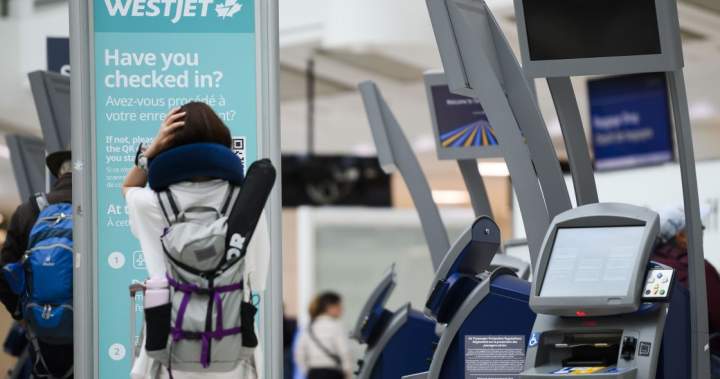
Air travellers may be left scrambling in the coming days if a WestJet flight attendant’s strike happens over the long weekend.
With both a strike notice and a lockout notice issued by the two sides, passengers should know their rights and options in case they face sudden changes to their plans, experts say.
Air Passenger Protection Regulations (APPR), set by the Government of Canada and administered by the Canadian Transportation Agency, ensure travellers are given alternative travel arrangements or compensation where applicable, but the specifics depend on who is making the changes and when.
Here’s what to know.
WestJet said in a statement on Friday that it was beginning to park some of its aircraft ahead of the potential labour disruption.
“At this time, negotiations have not resulted in an agreement and as a labour disruption approaches, WestJet must begin the difficult process of parking 737 aircraft,” said WestJet.
If a strike happens, the airline says it will first be “managing changes and cancellations, to ensure the ability to communicate with guests in advance of changes.”
WestJet is currently maintaining its flexible cancellation policy launched last week, which includes the ability to make a one-time change or cancellation to their bookings with no fee for travel bookings between July 30, 2026, and Aug. 4, 2026.


Get daily National news
Get daily Canada news delivered to your inbox so you’ll never miss the day’s top stories.
WestJet said if strike action leads to flight delays or cancellations, “impacted guests will be refunded or reaccommodated, as applicable.”
As required by the air passenger rights legislation, passengers “may be eligible for compensation if a cancellation results in a delay which causes you to arrive 3 or more hours late at your final destination.”
Under the terms of the rules, if WestJet makes a cancellation or schedule change as the result of a labour disruption, that is considered to be outside of the carrier’s control and triggers a specific set of rights that must be met for passengers depending on the circumstances.
If a flight is cancelled or delayed by three hours or more because of a strike, WestJet must provide clear information in a timely manner and passengers must be offered alternate travel arrangements. Those arrangements may also require the air carrier to provide meal vouchers and accommodations.
As a large airline, WestJet must rebook passengers on the next available flight from either its own fleet or a partner airline. If these arrangements cannot be met within nine hours of the original departure, then passengers must be booked on a competing airline if seats are available.
If alternate travel still can’t be arranged within 48 hours, passengers may be rebooked from a nearby airport.
Passengers may also be entitled to compensation, but that may depend on the timing of the cancellations.
“There’s this distinction between ‘within the carrier’s control’ and ‘outside a carrier’s control’ with drastically different rights for passengers,” says air passenger rights advocate Gábor Lukács.
“And if something is within the carrier’s control, then cash compensation is owed, meals and accommodations are owed on top of any rebooking, which is always owed, but there are some nuances there of what type of rebooking is owed.”
Whether cancellations are made before or after a strike occurs, if a passenger decides they want to cancel or modify their booking before WestJet cancels their flight, then they are no longer protected by the terms of the legislation if the flight is cancelled afterwards.
“Once those rights are triggered, then you can expect the airline to rebook you.”
Those who booked through a third-party, including travel agents, airline partners or travel sites, are still protected under the rules, and WestJet would still be required to meet the requirements under its terms. WestJet is urging those customers to ensure they have provided the correct contact information so they may be contacted in the event of potential changes to their itinerary.
When it comes to travel insurance, a lot depends on when the policy was purchased and the specific coverage.
The Travel Health Insurance Association (THIA) is advising travellers to first contact WestJet for information on updates on the strike action and the status of refunds or flight rescheduling and, if they have travel insurance purchased, to check their policies carefully.
“When an airline strike is possible, the most important thing travellers can do is understand their options before they’re disrupted. Start with the airline to confirm whether your flight is affected and what refunds or rebooking options may be available, then review your travel insurance policy to see whether trip cancellation, interruption, delay or missed connection benefits apply,” said association spokesperson Will McAleer in a statement.
“Coverage can vary by policy and timing matters — especially if the strike has already been identified as a known event. If you’re unsure, contact your travel insurance provider before making alternate arrangements or incurring additional expenses.”
Travel insurance purchased after a “known event” date may mean there is no coverage in the event of a strike.
According to insurance provider Travel Guard, the WestJet labour dispute became a “known event” on July 14, which means its policies purchased after that date generally would not cover losses related to the strike.
Read the full article here


