



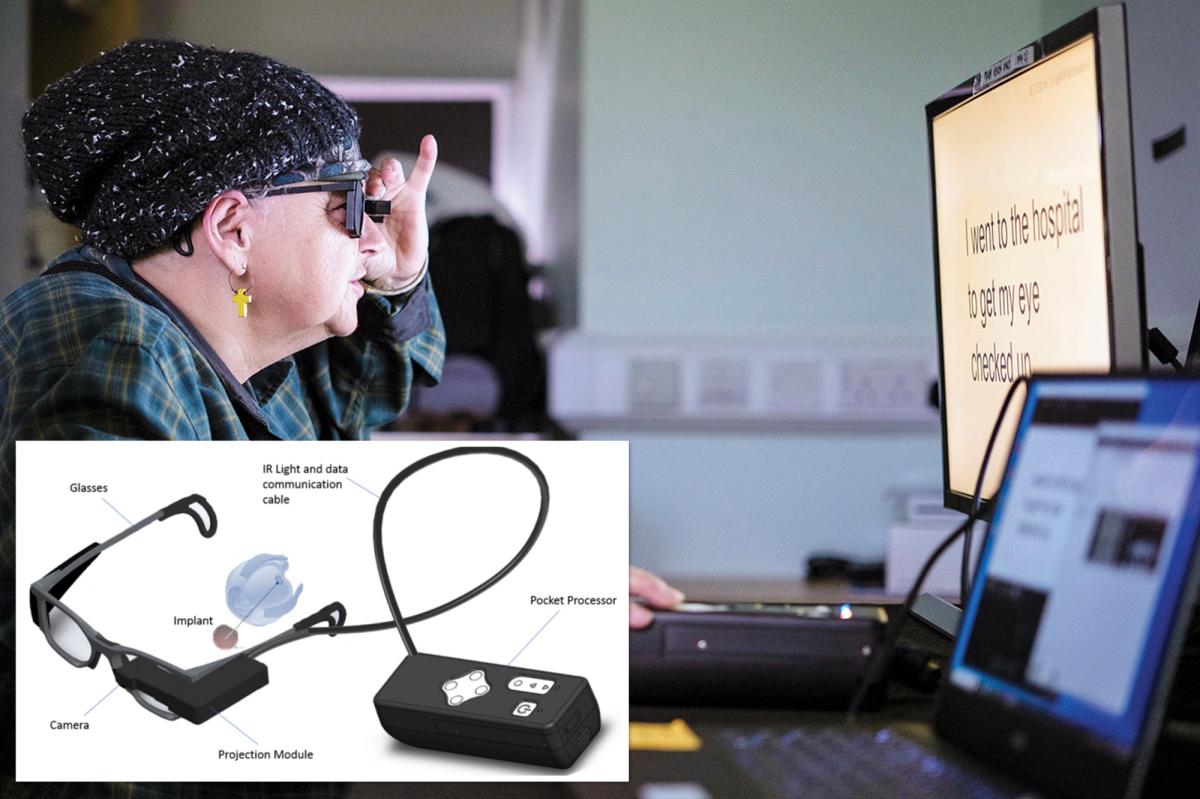
A revolutionary eye implant invented by a Stanford University scientist is giving some blind adults the ability to read, recognize faces and even create artwork again.
The tiny prosthetic implant, called the PRIMA retinal implant system, is smaller than a contact lens and has already helped dozens of patients in European clinical trials regain meaningful eyesight.
The device targets age-related macular degeneration, a prevalent cause of blindness in older adults that affects roughly 1 million people in the United States.
Invented by Stanford ophthalmologist and electrical engineer Daniel Palanker, the implant uses a 2-by-2-millimeter disc containing 370 photosensitive pixels and is surgically placed just behind the retina.
Once the device is implanted, patients must wear special augmented-reality glasses equipped with a camera that captures images and projects them as near-infrared light onto the implant.
The solar-powered pixels then convert that light into electrical signals that stimulate surviving retinal cells, which send information to the brain.

After months of training, 26 out of 32 patients in a clinical trial showed significant vision gains after one year, according to results published in the New England Journal of Medicine. On average, their vision improved by an average of five lines on a standard eye chart.
Many who could previously only see the top line on the chart are now able to read large print and perform daily tasks, with one participant’s vision improving by 12 lines.
Science Corp., the Alameda-based company commercializing the technology, hopes to receive European regulatory approval this summer. Approval from US Food and Drug Administration is further down the road, but the company is pursuing a humanitarian device exemption to speed the process.
Palanker, who previously developed lasers for cataract surgery, said the key innovation was using light for both power and activation rather than wires.
“Until now, people tried restoring sight and all they got were light and shapes,” he said. “We succeeded, I think, because we properly encode information and the brain understands this information as vision.”
The device is currently being adapted for other forms of blindness, including Stargardt disease, with researchers aiming for up to five times better resolution in the next generation of the PRIMA system.
For patients, the technology offers more than restored sight — it brings back independence and joy.
“It’s huge,” said Foundation Fighting Blindness CEO Jason Menzo of the breakthrough system, which adds to an expanding field of vision restoration that includes gene therapy, stem cells and other prostheses. “The field has never ever been anywhere near as advanced as it is today.
“Just knowing there’s something out there,” Menzo added, “just the promise of the technology, whether an individual even gets the device, is lifting people’s spirits.”
Download The California Post App, follow us on social, and subscribe to our newsletters
California Post News: Facebook, Instagram, TikTok, X, YouTube, WhatsApp, LinkedIn
California Post Sports Facebook, Instagram, TikTok, YouTube, X
California Post Opinion
California Post Newsletters: Sign up here!
California Post App: Download here!
Home delivery: Sign up here!
Page Six Hollywood: Sign up here!
Read the full article here


