



“Stand together.” It’s not often you can quote both major party leaders at once, but just now we can. Both Anthony Albanese and Sussan Ley used this exact phrase in their respective Christmas messages this week, moved by the gut-wrenching context of the Bondi terrorist attack. A fine sentiment. A necessary one. But also exactly the reverse of what politics has modelled since.
Almost every day has brought some fresh, visceral controversy. Over charges the Albanese government was so inattentive to antisemitism it is complicit in this tragedy. Over whether it named Islamist terrorism enough. Over whether gun control reforms or royal commissions are necessary. Over who has always supported stronger hate speech laws and who has a history of opposing them. Over laws designed to curtail protests – and the inevitable legal challenges that will follow. Over whether political opponents cried enough, or at all. Over an immigration program that allows “filth” into this country, to quote one formerly senior politician.
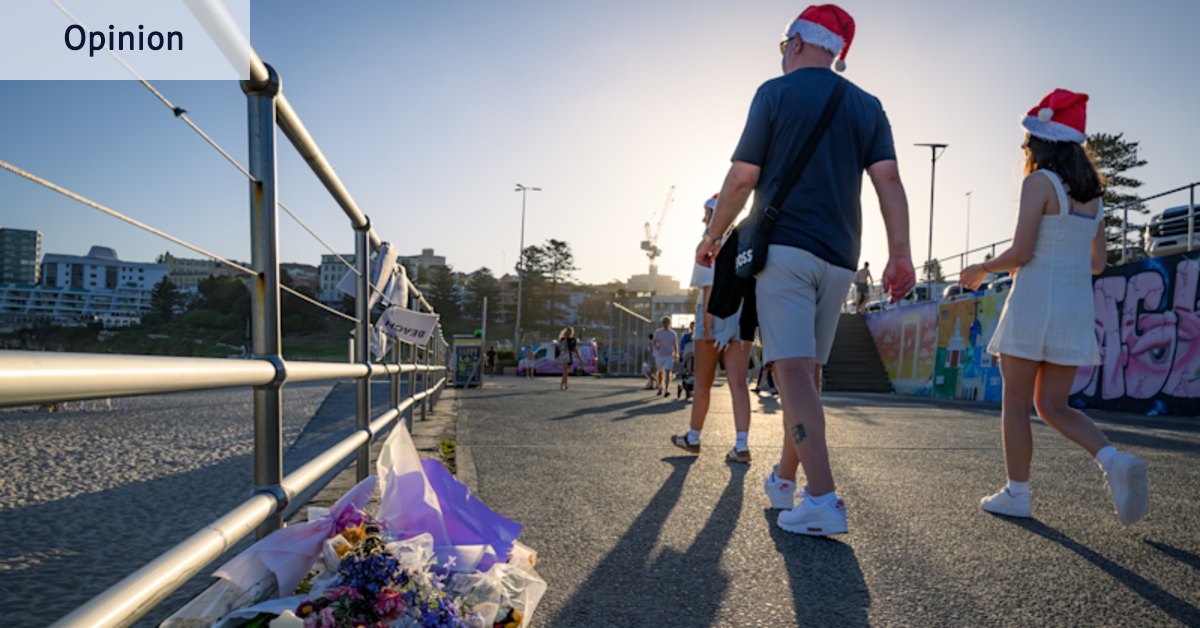
Beachgoers walk past flowers and candles left in remembrance of the victims of the Bondi mass shooting.Credit: Getty Images
That’s the thing about standing together: it’s exceptionally hard to do when you can’t agree about what you’re standing on. And that, in turn, is the thing about terrorism: it is designed to scorch common ground. We don’t need to guess at this, especially in the case of Islamic State, whose propaganda tracts talk explicitly about eliminating the “grey zone” where people of different faiths and worldviews can co-exist. Obviously that strategy is most effective when the fault lines are already active. That’s been true of our political landscape since at least the pandemic, probably before, and seismically so since October 7.
It’s not clear that politics is ever very good at resisting these divisions. Its default setting is, after all, adversarial; based on the idea that conflict can be healthy and productive. But that requires us to see our adversaries as legitimate. Once politics strikes some existential nerve, once the stakes become absolute, politics becomes the very worst forum for us to try to stand together. It becomes instead a conflict over legitimacy itself. That kind of conflict cannot be productive. It is, by definition, zero-sum: a politics with no grey zone, where there is only total victory or total defeat. To “stand together” in that context is to require everyone to stand exactly and exclusively where you are already standing, and to denounce as complicit anyone who isn’t.
Bondi strikes every existential nerve. But it is doubly devastating because it strikes us at a time when two years of carnage in the Middle East have left those nerves so ruthlessly exposed. This is the ultimate zero-sum conflict, in which plenty of people on either side are utterly convinced the other seeks not merely to defeat them, but to exterminate them. Those convictions are real, visceral. As such, they are suffocating. They leave no room to lend any credence to the other’s fear or suffering. In a zero-sum world, to acknowledge such pain becomes to betray one’s own.
Loading
To overcome this requires something far more radical than politics can offer. It requires grace. Grace doesn’t ask whether someone is worthy of empathy. It doesn’t treat a cry from the heart first and foremost as though it is simply a political strategy. It confers dignity and honour, even on those with whom one has the most painful divisions. It’s the thing that allows a mother to stand up in court and forgive the man who slaughtered her son in Christchurch. It doesn’t require us to capitulate or surrender every conviction, but it does ask us to find room within them for what is genuine in our opponents’ claims.
How might that have looked in this moment? Perhaps it might have taken the form of those who attended pro-Palestinian rallies acknowledging that Jews were registering something genuinely terrifying when they saw people chant “Where’s the Jews?” outside the Opera House. Or that it must be deeply shocking to have NSW police advise you to stay away from a landmark in your own city for your own safety. Or that given recent Palestinian-Israeli history – where words like intifada refer to specific campaigns that included violence against Jewish civilians – Jews might reasonably hear chants using the term as a threat. That these are not merely complaints designed to distract. And that, on the contrary, responding to these as good-faith concerns might only have strengthened the protests’ message.
It might also have taken the form of seeing the ordinariness of the vast bulk of protesters who had nothing to do with incendiary banners or chants, and who simply wanted the annihilation of Gaza to end. To see that they, too, were registering something genuinely agonising that the world seemed unprepared to stop. To look into the crowd on the Harbour Bridge and consider that they might not simply be 100,000 Hamas sympathisers or antisemites on a continuum with the Bondi terrorists. And that to do all this would not lessen the seriousness, the reality, the danger of the antisemitism Jews are facing in the slightest.
Read the full article here


