



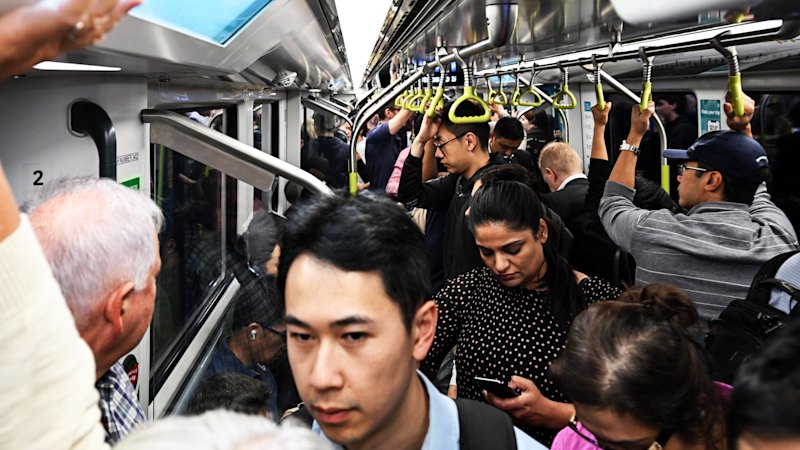
The frequency of services on Sydney’s M1 metro rail line will be temporarily boosted from Monday to cater for demand, as more commuters leave their cars at home to catch trains due to the fuel crisis.
Amid fears oil prices will spike after negotiations between the US and Iran broke down, an extra 166 services a week will be added to the M1 line between Tallawong in the city’s northwest and Sydenham in the south via the CBD.
It will increase the frequency of trains to one every three-and-half minutes during periods of the morning and evening peaks, from every four minutes.
Weekend services will also temporarily increase to a train every seven minutes – from one every 10 minutes – between 10am and 9pm on Saturdays, and 10am and 7pm on Sundays.
The temporary increase in services until June 7 has been made possible by the state government diverting three trains purchased for the yet-to-be opened final stage of the M1 line between Sydenham and Bankstown to the operating section.
Transport Minister John Graham said the government had decided to boost services on the metro line, which was experiencing increased demand, “rather than have trains sitting empty” while the final section of the M1 was completed.
“World-class public transport is permanent cost-of-living relief – that’s why we’re providing more of it,” he said.
The three trains which have been redeployed from the Southwest Metro project will not be required for testing until June 7. They are part of a 45-strong fleet of driverless trains for the entire M1 line.
The government said keeping the three trains in operation on the existing M1 line beyond June 7 would delay the opening of the final section of between Sydenham and Bankstown, which is due to be completed by year’s end.
On-track testing on the southwest section of the line has been paused until May 1 to complete work such as the installation of 1140 fixed gap fillers on station platforms and overhead wiring and signalling.
Once train testing on the southwest section resumes in May, the entire M1 line will be closed over the weekends of May 9-10 and May 16-17. Almost 1.5 million passengers use the M1 line each week.
The fuel crisis has encouraged more people to consider leaving their cars at home and opt for public transport. Last week, toll road operator Transurban released figures showing traffic growth on some of its motorways has eased since the war sent petrol prices skyrocketing.
Sydney Trains chief executive Matt Longland said the rail operator had experienced an increase in patronage of several percentage points on its network since the US and Israel launched attacks on Iran in late February.
“Some of those intercity services coming in from Newcastle and the Central Coast are busy trains in the morning period and the afternoon period. We’ll look at those, and we’ll obviously flex the service offer where we can,” he said.
However, Longland said demand on the network had yet to return to the levels experienced before the COVID-19 pandemic, and the operator was confident it had “plenty of capacity available”.
Despite Victoria and Tasmania offering free public transport, NSW Premier Chris Minns has resisted the push to follow suit, arguing cost-of-living measures need to be an “effective intervention”.


From our partners
Read the full article here


